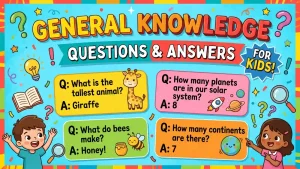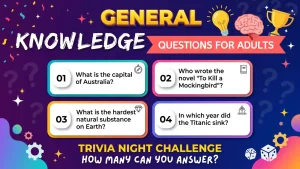
100 general knowledge questions give you a full set of facts to learn from science, history, geography, sports and daily life. They help you test yourself and revise key facts. Work through all 100 to build your knowledge.
I was chatting with a friend when a question came up, and honestly, I had no clue about the answer at first.
I kept wondering, “Am I missing something here?” It made me curious, and I wanted to test what I really knew.
Ready to challenge your brain? Try these 100 general knowledge questions and see how many answers you can get right!
So, I decided to explore 100 General Knowledge Questions and learn more about different topics.
I found questions about history, science, geography, sports, and famous people.
As I tried to answer them, I discovered new facts and learned things I had never known before.
I realized that general knowledge is useful in everyday life.
It helps us learn, think, and feel more confident in conversations.
Now, I feel ready to test my knowledge, share fun facts with friends, and enjoy a good quiz with family.
What Are General Knowledge Questions?
General knowledge questions test what you know about the world. They cover many topics, such as science, geography, history, nature, sports, and famous people.
These questions do not always require special training or expert skills. Many are based on facts that people learn at school, read in books, or discover through daily life.
For example, a question might ask you to name the largest planet in our solar system. Another might ask which country is home to the Great Wall.
General knowledge questions help people learn and remember useful facts. They also encourage curiosity and make learning more fun.
Why Are General Knowledge Questions Important?
There are several reasons to practice general knowledge questions.
- They improve memory: You learn to remember facts and details.
- They build confidence: Knowing the answers can help you feel more prepared.
- They support learning: Questions introduce you to new topics.
- They improve thinking skills: Some questions ask you to compare facts and solve problems.
- They bring people together: Friends and family can enjoy answering questions as a group.
For example:
Ali: Which planet is known as the Red Planet?
Sara: Mars!
Ali: Correct! It gets its name from its reddish color.
This simple exchange shows how a quiz can turn learning into a fun activity.
Background and History of General Knowledge Quizzes
People have tested their knowledge for hundreds of years. Teachers have asked questions to check what students understand. Families have shared facts and riddles to entertain one another. Scholars have also used questions to discuss ideas and test learning.
As schools developed, quizzes became a common way to measure knowledge. Students answered questions about subjects such as math, science, history, and geography.
Later, newspapers and magazines began publishing puzzles, trivia, and quiz challenges. Radio and television made quizzes even more popular. Many people enjoyed watching contestants answer questions to win prizes.
Today, general knowledge quizzes are popular around the world. People take part in school competitions, pub quizzes, television game shows, and online challenges.
The internet has made quizzes easier to access. You can now find hundreds of questions on websites, mobile apps, and social media platforms.
How General Knowledge Quizzes Have Changed
In the past, people often needed books, newspapers, or a quiz host to test their knowledge. Now, they can take a quiz on a phone or computer.
Online quizzes also cover more topics than ever. You can find questions about animals, space, world history, famous landmarks, and everyday facts.
Some quizzes give instant scores. Others explain each answer so users can learn from their mistakes.
The main goal remains the same: to test what people know, share useful facts, and make learning enjoyable.
100 General Knowledge Questions With Answers
Here are 100 general knowledge questions from different subjects. Try to answer each one before reading the answer.
Easy General Knowledge Questions (1–20)
These questions are a good starting point for beginners, children, and anyone who wants a quick quiz.
- What is the capital of France?
Answer: Paris. - How many days are there in a week?
Answer: Seven. - Which planet is known as the Red Planet?
Answer: Mars. - What is the largest ocean on Earth?
Answer: The Pacific Ocean. - How many colors are there in a traditional rainbow?
Answer: Seven. - Which animal is known as the king of the jungle?
Answer: The lion. - What is the name of the star at the center of our solar system?
Answer: The Sun. - How many legs does a spider have?
Answer: Eight. - Which country is famous for the pyramids of Giza?
Answer: Egypt. - What do bees make?
Answer: Honey. - How many months are there in a year?
Answer: Twelve. - Which bird is often linked with peace?
Answer: The dove. - What is the opposite of hot?
Answer: Cold. - Which shape has three sides?
Answer: A triangle. - What is the fastest land animal?
Answer: The cheetah. - Which part of a plant often grows underground and takes in water?
Answer: The root. - What is frozen water called?
Answer: Ice. - Which animal is known for its black and white stripes?
Answer: The zebra. - How many hours are there in one day?
Answer: Twenty-four. - Which language is mainly spoken in Brazil?
Answer: Portuguese.
Science General Knowledge Questions (21–35)
Learn about the human body, space, matter, and the natural world with these science questions.
- What is the chemical formula for water?
Answer: H₂O. - Which planet is the largest in our solar system?
Answer: Jupiter. - What gas do humans need to breathe to stay alive?
Answer: Oxygen. - What is the process by which plants make food using sunlight?
Answer: Photosynthesis. - How many bones are usually found in an adult human body?
Answer: 206. - What force pulls objects toward Earth?
Answer: Gravity. - Which organ pumps blood around the human body?
Answer: The heart. - What is the boiling point of water at sea level?
Answer: About 100°C or 212°F. - Which planet is closest to the Sun?
Answer: Mercury. - What is the center of an atom called?
Answer: The nucleus. - Which gas do plants take in during photosynthesis?
Answer: Carbon dioxide. - What is the hardest natural substance on Earth?
Answer: Diamond. - Which part of the human body helps us think and control our actions?
Answer: The brain. - What is the name of the galaxy that contains our solar system?
Answer: The Milky Way. - What do we call animals that eat only plants?
Answer: Herbivores.
Geography General Knowledge Questions (36–50)
Test your knowledge of countries, capitals, oceans, mountains, and famous places.
- What is the capital of Japan?
Answer: Tokyo. - Which is the largest country in the world by land area?
Answer: Russia. - On which continent is the Sahara Desert located?
Answer: Africa. - What is the capital of Australia?
Answer: Canberra. - Which ocean lies between Africa and Australia?
Answer: The Indian Ocean. - What is the capital of Pakistan?
Answer: Islamabad. - Which country is famous for the Eiffel Tower?
Answer: France. - What is the highest mountain above sea level?
Answer: Mount Everest. - Which continent is the smallest by land area?
Answer: Australia. - What is the capital of Canada?
Answer: Ottawa. - Which country has the cities of Madrid and Barcelona?
Answer: Spain. - Which river flows through Egypt and is famous for its role in ancient Egyptian life?
Answer: The Nile River. - What is the capital of Italy?
Answer: Rome. - Which country is home to the Great Wall?
Answer: China. - What is the largest hot desert in the world?
Answer: The Sahara Desert.
History General Knowledge Questions (51–60)
These questions cover famous people, ancient civilizations, and important events.
- Who was the first president of the United States?
Answer: George Washington. - Which ancient civilization built the pyramids of Giza?
Answer: The ancient Egyptians. - In which year did World War II end?
Answer: 1945. - Who was known as the Maid of Orléans?
Answer: Joan of Arc. - Which ship sank in April 1912 after hitting an iceberg?
Answer: The RMS Titanic. - Who was the first person to walk on the Moon?
Answer: Neil Armstrong. - Which ancient city was buried by the eruption of Mount Vesuvius in AD 79?
Answer: Pompeii. - Who was the first woman to win a Nobel Prize?
Answer: Marie Curie. - Which famous wall divided Berlin during the Cold War?
Answer: The Berlin Wall. - Who is traditionally credited with developing the movable-type printing press in Europe?
Answer: Johannes Gutenberg.
Sports General Knowledge Questions (61–70)
Do you know the rules, players, and history of popular sports? Try these questions.
- How many players does one soccer team have on the field at the start of a standard match?
Answer: Eleven. - Which sport is played at Wimbledon?
Answer: Tennis. - How many rings appear on the Olympic symbol?
Answer: Five. - Which sport uses a bat, ball, and wickets?
Answer: Cricket. - In which sport can players score a touchdown?
Answer: American football. - How many points is a free throw worth in basketball?
Answer: One point. - Which country hosted the first modern Olympic Games in 1896?
Answer: Greece. - What is the name of the international governing body for association football known by its acronym?
Answer: FIFA. - Which sport is associated with the Tour de France?
Answer: Cycling. - In which sport would you perform a slam dunk?
Answer: Basketball.
Animal and Nature General Knowledge Questions (71–80)
Discover facts about wildlife, plants, and the natural world.
- What is the largest animal on Earth?
Answer: The blue whale. - Which mammal can fly?
Answer: The bat. - What is a baby frog called during its early aquatic stage?
Answer: A tadpole. - Which animal is known for changing its color to help it blend into its surroundings?
Answer: The chameleon. - What is the largest living land animal?
Answer: The African bush elephant. - Which bird is famous for its ability to mimic human speech?
Answer: The parrot. - What do pandas mainly eat in the wild?
Answer: Bamboo. - Which animal is known for carrying its home on its back?
Answer: The tortoise. - What is the name of the natural process in which water vapor turns into liquid water?
Answer: Condensation. - What do we call a group of wolves?
Answer: A pack.
Food, Literature, and Arts Questions (81–90)
These questions cover food, books, music, and creative works.
- Which fruit is known for having its seeds on the outside?
Answer: The strawberry. - Which country is widely associated with the origin of pizza as we know it today?
Answer: Italy. - Who wrote Romeo and Juliet?
Answer: William Shakespeare. - Which instrument has black and white keys?
Answer: The piano. - What is the main ingredient in traditional hummus?
Answer: Chickpeas. - Who painted the Mona Lisa?
Answer: Leonardo da Vinci. - Which type of art uses a camera to capture images?
Answer: Photography. - What is the name of the fictional wizard who attends Hogwarts in a popular book series?
Answer: Harry Potter. - Which musical instrument usually has six strings and is often used in rock music?
Answer: The guitar. - What do we call a person who writes poems?
Answer: A poet.
Mixed and Challenging General Knowledge Questions (91–100)
Ready for a bigger challenge? These questions cover technology, inventions, language, and other useful facts.
- What does CPU stand for in computing?
Answer: Central Processing Unit. - Which planet is famous for its large ring system?
Answer: Saturn. - What is the smallest prime number?
Answer: Two. - Which scientist developed the theory of general relativity?
Answer: Albert Einstein. - What is the currency of Japan?
Answer: The yen. - Which metal is liquid at room temperature under normal conditions?
Answer: Mercury. - What is the main language spoken in Mexico?
Answer: Spanish. - What does WWW stand for in a web address?
Answer: World Wide Web. - Which blood cells help the body fight infections?
Answer: White blood cells. - What is the name of the study of earthquakes?
Answer: Seismology.
How to Use These 100 General Knowledge Questions
You can use these questions in many fun and useful ways. You do not need special equipment or a lot of time. Choose a topic, read a question, and try to answer it.
1. Play With Friends and Family
Take turns asking questions. Give one point for each correct answer. The person with the most points at the end wins.
Example:
Ahmed: What is the capital of Italy?
Sara: Rome!
Ahmed: Correct. You get one point.
2. Use Them in the Classroom
Teachers can use these questions to review lessons or start a class discussion. Students can work alone, in pairs, or in teams.
3. Practice Every Day
Answer five or ten questions each day. Review the answers you missed. This helps you build knowledge over time.
4. Share Quiz Challenges Online
You can post a question on social media and ask people to comment with their answers. You can also use the questions for short videos or quiz posts.
5. Make the Quiz Harder
Hide the answers and set a time limit. You can also give extra points for explaining why an answer is correct.
Common Mistakes When Answering General Knowledge Questions
Even simple questions can lead to mistakes. Some facts sound similar, while others may change over time.
Here are a few things to remember:
- Read each question carefully. A question about the largest animal is not the same as one about the largest land animal.
- Check the wording. A question about the capital of a country asks for a city, not the country’s largest city.
- Watch for changing facts. World records, population figures, and current leaders can change.
- Do not rush. Take a moment to think before choosing an answer.
- Learn from wrong answers. A mistake can help you remember a fact the next time.
For example, many people think Sydney is the capital of Australia. The correct answer is Canberra. Sydney is a major Australian city, but it is not the national capital.
Learning the difference between similar facts is part of improving your general knowledge.
Frequently Asked Questions
General knowledge questions test what you know about topics such as science, history, geography, sports, nature, and culture.
Read books, follow reliable news sources, watch educational videos, and take short quizzes. Try to learn a few new facts each day.
Yes. Many questions are easy enough for children, while the history, science, and mixed sections may also challenge older students. Adults can enjoy them too.
Yes. You can use them for classroom games, revision, group activities, and quiz competitions.
Start with five to ten questions each day. As you become more confident, try answering more questions or choosing harder topics.
It helps you learn about the world, remember useful facts, join conversations, and build a stronger base for future learning.
Repeat the questions, review the answers you missed, and explain each fact in your own words. Short daily practice can help you remember more.
Conclusion
These 100 general knowledge questions are a simple way to test your knowledge and learn new facts. They cover many topics, including science, geography, history, sports, animals, and art.
You can use them for school, family games, friendly competitions, or daily practice. Some questions may be easy, while others may teach you something new. Every correct answer helps you build confidence, and every wrong answer gives you a chance to learn.
Try answering all 100 questions without looking at the answers first. Then check your score and review the facts you missed. You can repeat the quiz later to see how much you remember.
Learning does not have to be boring. A few questions each day can help you become more curious and better informed.
So, how many questions did you answer correctly? Share the quiz with your friends and family, challenge them to beat your score, and keep learning something new every day!