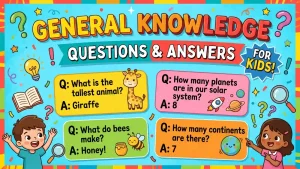
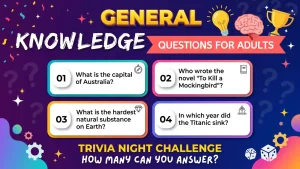
5th grade trivia questions are short, fun fact questions made for fifth graders. They cover science, math, history, geography, and more. This post shares 100 of them with answers for home, school, and game nights.
Have you ever wondered how much a 5th grader really knows about the world? 5th Grade Trivia Questions are a fun way to test your knowledge and learn something new!
Hey, I want to share something that happened to me recently.
I was chatting with a friend when we started talking about 5th Grade Trivia Questions.
Honestly, I wondered how many questions I could answer correctly.
I kept asking myself, “Am I missing something here?” Some questions seemed easy, but others made me think hard.
So, I decided to explore 5th Grade Trivia Questions and learn more about the topics they cover.
After trying a few, I realized how fun it is to test my knowledge and discover new facts.
These questions are great for students, parents, teachers, and anyone who loves a good quiz.
Now, I feel ready to take on more trivia challenges and share fun facts with friends at school or online.
Definition and Meaning of 5th Grade Trivia Questions
5th grade trivia questions are short questions about different subjects that are suitable for students in fifth grade. In the United States, fifth-grade students are often around 10 or 11 years old. The questions test what they know and help them learn more.
Trivia questions can cover many topics. Some ask about facts you may learn in school. Others explore fun facts about the world.
For example:
- Science: What gas do plants take in from the air?
- Math: What is 12 multiplied by 8?
- Geography: What is the largest ocean on Earth?
- History: Who was the first president of the United States?
- Animals: What is the largest animal in the world?
- Sports: How many players are on a soccer team on the field at one time?
These questions have clear answers. Some are easy, while others need more thought.
Why Are Trivia Questions Useful?
Trivia questions help students learn in a fun way. They turn facts into a game. This can make learning feel less like homework.
Here are some key benefits:
1. They build knowledge. Students learn facts about science, nature, history, and other subjects.
2. They improve memory. Answering questions helps students recall what they have learned.
3. They build confidence. Getting an answer right can make students feel proud.
4. They support teamwork. Students can work together to solve questions.
5. They encourage curiosity. A question can lead to more learning.
For example:
Teacher: Which planet is closest to the Sun?
Student: Mercury!
Teacher: Correct! Mercury is the closest planet to the Sun.
This simple exchange helps students remember an important science fact.
Who Can Use Fifth Grade Trivia?
These questions are useful for students, parents, teachers, and quiz lovers. Teachers can use them in class. Parents can use them to help children practice at home. Friends can use them to challenge each other.
You do not need special tools to play. All you need is a list of questions and a way to keep score.
Background and History of Trivia Questions
Trivia has been part of human learning for a long time. People have always asked questions to share knowledge, test memory, and learn about the world.
In the past, students often learned facts through books, classroom lessons, and oral quizzes. Teachers asked questions to check what students understood. Families also shared stories, riddles, and facts with children.
The word trivia comes from a Latin word linked to places where roads meet. Over time, the English word came to refer to small facts and pieces of information. Today, trivia usually means interesting facts or questions about many subjects.
Trivia in Schools
Schools have long used questions to help students learn. Teachers may ask students to name countries, solve math problems, or explain how plants grow.
As classroom games became popular, teachers began using quiz contests to make learning more exciting. Students could compete alone or in teams.
Fifth-grade trivia follows this same idea. It uses questions that match the skills and knowledge of children around ages 10 and 11.
Trivia on Television
Trivia games became popular on radio and television. Many shows asked people to answer questions for prizes or points. Viewers at home could also try to answer.
These shows helped make general knowledge games a popular form of entertainment.
Trivia in the Digital Age
The internet has made trivia easier to access. Today, students can find quizzes on websites, learning apps, and educational videos.
Online trivia can cover almost any topic. Some quizzes give instant answers. Others let players compete against friends.
Fifth-grade trivia is now used in classrooms, at birthday parties, during family game nights, and in online learning activities.
Although the tools have changed, the main goal remains the same: learn useful facts while having fun.
Usage of 5th Grade Trivia Questions in Different Contexts
Fifth-grade trivia questions can be used in many settings. They are not just for school. They can also make free time more fun.
1. In the Classroom
Teachers can use trivia to review lessons before a test. They can divide students into teams and award points for correct answers.
Teacher: What is the process by which plants make their food?
Student: Photosynthesis!
Teacher: Correct! Your team earns one point.
This kind of game helps students review facts in a fun way.
2. At Home
Parents can ask trivia questions during dinner or on a long car ride. Children can also ask questions to test their parents.
Child: What is the largest ocean on Earth?
Parent: The Pacific Ocean!
Child: Correct!
Family trivia can help everyone learn together.
3. On Social Media
Students and families may share quiz questions on social media. A post might ask people to name the capital of a country or solve a simple math problem.
For example:
“Quick quiz! How many sides does a hexagon have?”
People can write their answers in the comments.
When sharing content online, children should follow family safety rules and avoid posting private information.
4. In Online Games
Trivia games are common on websites and mobile apps. Players answer questions to earn points, unlock levels, or beat other players.
A game might ask:
“Which animal is known as the tallest land animal?”
Players who answer “giraffe” earn points.
These games combine learning with friendly competition.
5. At Parties and Events
Trivia is a simple activity for birthdays, school events, and family gatherings. One person can read questions while the others answer.
You can make the game more exciting by using a timer or giving bonus points for difficult questions.
Common Misconceptions and Clarifications
Some people think trivia questions are only for students who get high grades. This is not true. Trivia is for anyone who wants to learn and have fun.
Here are some common misunderstandings.
Misconception 1: Trivia Is Only About School Subjects
Trivia can cover school topics, but it can also include animals, music, sports, food, nature, and everyday life.
For example:
- Which bird is famous for its ability to mimic human speech?
- How many days are there in a leap year?
- Which sport uses a racket and a shuttlecock?
These questions go beyond regular classroom lessons.
Misconception 2: All Trivia Questions Are Easy
Some fifth-grade trivia questions are simple. Others can be challenging.
For example, naming a common planet may be easy for many students. Explaining why Earth has seasons may require more thought.
The difficulty depends on the topic and the student’s knowledge.
Misconception 3: Getting an Answer Wrong Means You Failed
A wrong answer is a chance to learn. When students discover the correct answer, they may remember it better next time.
For example:
Friend A: I think the largest planet is Earth.
Friend B: It is actually Jupiter!
Friend A: Thanks! I will remember that.
This is how trivia can help people learn.
Misconception 4: Trivia Must Be Timed
A timer can make a game exciting, but it is not required. Students can take their time and discuss their answers.
Untimed games may be better when the main goal is learning rather than competition.
Misconception 5: Every Quiz Has the Same Difficulty
Different quizzes focus on different skills. Some test memory, while others test logic or problem-solving.
A good fifth-grade quiz should offer a mix of easy, medium, and challenging questions.
Similar Terms and Alternatives
Several terms are related to fifth-grade trivia questions. They may sound similar, but they can have different purposes.
1. General Knowledge Questions
These questions test knowledge about many subjects, such as history, geography, science, and culture.
Example: What is the capital of Japan?
2. Educational Quiz Questions
These questions are often used to review a lesson or test a student’s understanding of a subject.
Example: What is 25 divided by 5?
3. Brain Teasers
Brain teasers are puzzles that make people think in creative ways. They may have unusual or surprising answers.
Example: What has hands but cannot clap?
Answer: A clock.
4. Riddles
Riddles describe something in a clever way and ask the player to guess what it is.
Example: What has a neck but no head?
Answer: A bottle.
5. Practice Test Questions
These questions help students prepare for school tests or exams. They often focus on specific learning goals.
Comparison Table
| Type | Main Purpose | Example |
| Trivia questions | Test general facts | What is the largest ocean? |
| General knowledge | Explore many subjects | What is the capital of Italy? |
| Brain teasers | Test creative thinking | What has hands but cannot clap? |
| Riddles | Solve a word puzzle | What has a neck but no head? |
| Practice tests | Review school lessons | What is 9 × 7? |
All these activities can help children learn. The best choice depends on whether you want to test facts, solve puzzles, or review schoolwork.
How to Respond to 5th Grade Trivia Questions
Answering trivia questions can be fun, even when you are unsure. You do not need to know every answer. The goal is to think, try, and learn.
1. Give a Direct Answer
If you know the answer, say it clearly.
Question: Which planet is known as the Red Planet?
Answer: Mars.
A short answer is often enough.
2. Explain Your Answer
Some questions give you a chance to share what you know.
Question: Why do we need plants?
Answer: Plants provide oxygen, food, and shelter for many living things.
An explanation can help you learn more about the topic.
3. Make an Educated Guess
If you are not sure, think about what you already know.
Question: Which animal is a mammal: a shark, a dolphin, or a trout?
You may know that sharks and trout are fish. That helps you choose dolphin.
Guessing can be useful when you have a reason for your choice.
4. Ask for a Hint
There is nothing wrong with asking for help.
Player: I am not sure. Can I have a hint?
Quiz Host: This planet has rings around it.
Player: Saturn!
A hint can make a difficult question easier.
5. Respond in a Funny Way
You can keep the game friendly with a little humor.
Friend: What is the largest planet in our solar system?
You: I hope it is not the one I live on!
Friend: It is Jupiter!
Humor can make a quiz more enjoyable, but remember to respect other players.
6. Learn From the Correct Answer
If you get a question wrong, listen to the explanation. You can even write down the answer and review it later.
The best response to a trivia question is one that helps you learn, whether you answer correctly or not.
Regional and Cultural Differences
Fifth-grade trivia questions are used in many countries. However, school systems, languages, and local knowledge can change the kinds of questions students see.
Some questions are easy for children in one country but unfamiliar to children in another.
Questions About Countries and Capitals
Students may learn about the country where they live before studying other parts of the world.
For example, a student in Pakistan may know facts about Islamabad, Lahore, and the Indus River. A student in the United States may know more about Washington, D.C., or the Mississippi River.
Both students can learn from questions about other places.
History Questions
History lessons often focus on local events and important people.
A quiz in Pakistan may include questions about Muhammad Ali Jinnah or the creation of Pakistan. A quiz in the United States may include questions about the American Revolution.
International trivia can help students understand other countries and their histories.
Language Differences
Trivia questions may be translated into different languages. However, some words, jokes, or riddles do not translate easily.
A riddle that works in English may need different wording in Urdu or another language.
Different School Systems
Fifth grade does not cover exactly the same material in every country. Some students may learn a science topic earlier or later than others.
For this reason, it is helpful to choose questions that match the players’ ages and learning levels.
How to Make Trivia More Inclusive
Try including questions about different countries, cultures, animals, foods, and traditions.
Avoid assuming that every student knows the same local facts. Explain unfamiliar terms when needed.
A good trivia game helps everyone learn about both familiar and new topics.
Comparison With Similar Trivia Activities
Fifth-grade trivia is one of many ways to test knowledge. Other quiz styles can make learning more varied.
| Activity | What It Tests | Best Use |
| Easy trivia | Basic facts | Warm-up games |
| Fifth-grade trivia | Age-appropriate general knowledge | Home and school |
| Hard trivia | More advanced facts | Older students and quiz fans |
| Science trivia | Science knowledge | Science lessons |
| Math challenges | Number skills | Math practice |
| Geography quizzes | Countries, places, and maps | Geography lessons |
| Logic puzzles | Reasoning skills | Problem-solving practice |
Which Activity Should You Choose?
Choose easy trivia when players are new to quizzes. Use fifth-grade trivia when you want a balanced mix of school subjects and general facts.
Choose hard trivia when players want a challenge. Science and geography quizzes are useful when you want to focus on one subject.
You can also combine different activities in one game.
For example, start with five easy questions, add five science questions, and finish with three brain teasers. This keeps the game fresh and gives everyone a chance to shine.
Usage in Online Communities and Gaming

Online quizzes and trivia games let people test their knowledge from almost anywhere. Students can play alone, challenge friends, or join team activities.
Online Quiz Websites
Educational websites often offer quizzes on science, history, geography, and other subjects. Some show the correct answer as soon as you respond.
This makes it easy to review facts and learn at your own pace.
Social Media Challenges
A trivia challenge may ask users to answer one question each day. People can post their answers and invite friends to join.
For children, it is best to use age-appropriate platforms with adult guidance. Never share private details just to join a quiz.
Multiplayer Trivia Games
Some games let players compete in real time. Each player answers questions to earn points.
For example:
Player 1: I got the geography question right!
Player 2: Nice! I got the science question.
This friendly competition can make learning more exciting.
Tips for Playing Online
- Read each question carefully.
- Check the rules before starting.
- Use trusted educational websites.
- Be kind when other players make mistakes.
- Do not share passwords, home addresses, or other private information.
- Take breaks if you have been looking at a screen for a long time.
Online trivia is most useful when it combines fun, learning, and safe habits.
Hidden or Offensive Meanings
The phrase “5th grade trivia questions” has no common hidden or offensive meaning. It simply refers to quiz questions suited to fifth-grade students.
However, the content of a trivia question still matters.
Keep Questions Respectful
Questions should not insult people or make fun of a person’s background, ability, or appearance.
For example, questions about countries and cultures should teach facts without using harmful stereotypes.
Check Facts Carefully
A question may contain incorrect information or use an unclear term. Always check the answer before using the question in a classroom or public quiz.
Some facts can also change over time. For example, the number of people living in a city may change, so questions about population should include a date or a reliable source.
Be Careful With Tricky Questions
Some questions are designed to confuse players. That can be fun, but the wording should still be fair.
For example:
Question: How many months have 28 days?
Answer: All 12 months have at least 28 days.
This is a word trick, not an offensive question.
Respect Different Age Groups
A quiz for fifth-grade students should use suitable language and topics. Avoid adult themes or questions that could make children feel uncomfortable.
Good trivia should challenge the mind without hurting anyone’s feelings.
Suitability for Professional Communication
Fifth-grade trivia questions are mainly used for learning and entertainment. Still, they can be useful in many professional settings.
In Schools
Teachers can use trivia to review lessons, start a class, or check what students remember.
For example, a teacher may begin a science lesson with three quick questions about plants.
In Educational Presentations
Teachers, tutors, and education writers can add trivia to slides, worksheets, and learning materials. Short questions help keep students involved.
In Team-Building Activities
Some workplaces use general knowledge quizzes during team events. These games can help coworkers relax and work together.
Questions for adults may need to be more advanced than fifth-grade trivia.
In Emails and Formal Documents
The phrase is clear and suitable when describing educational content. For example:
“We have prepared a set of fifth-grade trivia questions for the school event.”
In a formal setting, avoid overly casual wording if the document requires a serious tone. You can use alternatives such as:
- Fifth-grade knowledge quiz
- Grade 5 general knowledge assessment
- Fifth-grade educational quiz
- Grade 5 review questions
The best term depends on the purpose. Use “5th grade trivia questions” for fun quizzes and “Grade 5 assessment questions” for formal academic testing.
Frequently Asked Questions
They are questions about subjects such as science, math, history, geography, animals, and general knowledge.
A good quiz can include science, math, geography, history, language, animals, sports, and everyday facts.
Some are easy, while others are more challenging. The difficulty depends on the topic and the player.
Teachers can divide students into teams, read questions aloud, and award points for correct answers.
A short game can have 10 questions. A longer game may have 20, 30, or more. Choose a number that fits your time.
Conclusion
5th grade trivia questions make learning fun, simple, and exciting. They cover many subjects, including science, math, history, geography, animals, and sports. Students can use them to review school lessons, build memory, and discover new facts.
These questions are also great for family game nights, classroom contests, birthday parties, and online quizzes. You can play alone or compete with friends. You can even create your own questions about topics you enjoy.
Remember, trivia is not only about getting every answer right. It is also about asking questions, thinking carefully, and learning from mistakes. When you get an answer wrong, use it as a chance to learn something new.
Start with easy questions and move to harder ones as your knowledge grows. Try different subjects to find out what you know best.
So, gather your friends, pick a quiz, and see how many questions you can answer. Keep learning, stay curious, and enjoy the challenge!
Keep Exploring

Thomas Mitchell is a writer at New Learn Knowledge, sharing clear and useful educational content.
He enjoys creating simple guides and informative articles that help readers learn and discover new knowledge.