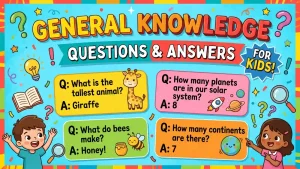
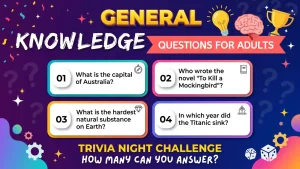
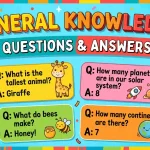
Easy general knowledge questions are simple questions about everyday subjects, with clear answers. They suit beginners, kids and anyone who wants a quick quiz. This post shares easy questions you can answer fast and use to build your knowledge.
Hey, I want to share something that happened to me recently with Easy General Knowledge Questions.
I was chatting with a friend when I came across a simple question, and honestly, I did not know the answer at first.
I kept wondering, “Am I missing something here?” It was a bit confusing, and I did not want to give the wrong answer.
So, I decided to look into Easy General Knowledge Questions and learn more about them.
I soon realized that these questions can cover many simple topics, such as history, geography, science, sports, and everyday facts.
Learning them can help you improve your knowledge and feel more confident in conversations, quizzes, and daily life.
Now, whenever I see Easy General Knowledge Questions, I feel ready to answer them and learn something new.
Definition and Meaning of Easy General Knowledge Questions

Easy general knowledge questions are simple questions about common facts and information from different areas of knowledge. They are designed to be easy to understand and answer.
The word “general” means broad or covering many areas. “Knowledge” means information that a person learns or knows. A “question” asks for an answer.
Together, the phrase means questions that test basic knowledge about many common subjects.
For example:
- What is the capital of France?
- How many days are in a week?
- Which animal is known as the king of the jungle?
- How many continents are there?
- What is the largest ocean?
- Who wrote Romeo and Juliet?
- Which planet is closest to the Sun?
These questions do not usually require advanced study. Many answers can be learned through school, books, travel, news, television, or everyday life.
Example
Teacher: “How many months are in a year?”
Student: “There are 12 months.”
The question is easy, but it checks basic knowledge.
Easy general knowledge questions can cover many subjects, including:
- Geography
- History
- Science
- Sports
- Literature
- Animals
- Space
- Countries and capitals
- Famous people
- Everyday facts
They are often used to make learning more active. Instead of only reading facts, you try to remember the answer yourself.
This makes simple questions a useful tool for learning, revision, and entertainment.
Easy General Knowledge Questions Background and History

People have tested their knowledge through questions for many years. Teachers have long used questions to check what students understand. Families and communities have also used quizzes and trivia games for entertainment.
The modern idea of the general knowledge quiz became popular through newspapers, magazines, radio, television, and later the internet. Quiz shows made questions about history, science, sports, and culture popular with large audiences.
As technology changed, general knowledge questions became even easier to access.
Today, people can find quizzes on:
- Websites
- Mobile apps
- Social media
- Educational platforms
- Online games
- YouTube
- School learning systems
The growth of the internet also changed how people learn facts. Instead of waiting for a book or television program, people can search for information in seconds.
Easy questions became especially popular because they are suitable for many age groups.
For example, a child may enjoy:
“What color is the sky on a clear day?”
A student may answer:
“Blue.”
An adult may enjoy:
“Which country is famous for the Eiffel Tower?”
The answer is:
“France.”
The basic idea remains the same: ask a question, think about the answer, and learn something new.
Today, easy general knowledge questions are used for both education and entertainment.
Easy General Knowledge Questions Usage in Various Contexts

Easy general knowledge questions can be used in many situations. They are not limited to classrooms.
In School
Teachers can use simple questions to review lessons.
Teacher: “What is the largest planet in our solar system?”
Student: “Jupiter.”
This can make revision more active.
In Family Games
Families can ask each other questions during game nights.
Parent: “How many legs does a spider have?”
Child: “Eight!”
Simple questions can turn learning into a fun activity.
On Social Media
People often post trivia questions to encourage comments.
For example:
“Can you answer this? What is the capital of Japan?”
People may reply:
“Tokyo!”
In Online Games
Quiz games use questions to challenge players. Players may compete against friends or strangers.
In Casual Conversations
General knowledge can also make conversations more interesting.
Friend: “Do you know which ocean is the largest?”
You: “Yes, the Pacific Ocean.”
In Competitions
Schools, clubs, and organizations may use general knowledge questions in quiz competitions.
The level can range from very easy to very difficult. Easy questions are often used at the beginning to help participants feel comfortable.
Easy General Knowledge Questions Common Misconceptions and Clarifications

People sometimes think general knowledge means knowing everything. That is not true.
No one knows every fact.
General knowledge simply refers to useful information from many different subjects. A person may know a lot about science but know very little about history. Another person may know many sports facts but have limited knowledge of geography.
Another common misunderstanding is that easy questions are not useful.
In fact, basic questions can help build a strong foundation. Before learning complex ideas, you often need to understand simple facts first.
For example, knowing the names and locations of countries can help you understand world geography. Knowing basic science facts can help you understand more advanced scientific topics later.
There is also a difference between general knowledge and specialized knowledge.
General knowledge covers many subjects. Specialized knowledge focuses on one specific field.
For example:
“What is the capital of Italy?”
This is a general knowledge question.
But:
“What is the chemical formula for a specific organic compound?”
This may require specialized knowledge.
Another misconception is that remembering an answer always means understanding the subject. Memory is useful, but understanding is also important.
The goal of general knowledge questions should be learning, not simply memorizing answers.
Easy General Knowledge Questions Similar Terms and Alternatives
Several phrases have a meaning similar to easy general knowledge questions.
| Term | Meaning |
| Easy trivia questions | Simple questions about common facts |
| Basic knowledge questions | Questions about fundamental information |
| General trivia | Facts and questions from many subjects |
| Quiz questions | Questions used in a quiz or test |
| Fun knowledge questions | Questions designed mainly for entertainment |
| Simple quiz questions | Easy questions used for quizzes |
| Educational questions | Questions designed to support learning |
These phrases can overlap, but they are not always identical.
For example, trivia questions may focus more on fun or unusual facts. Educational questions may be designed specifically to teach a lesson.
The phrase easy general knowledge questions is broader. It can include facts from many subjects while keeping the questions simple.
How to Respond to Easy General Knowledge Questions

How you respond depends on the situation.
Casual Response
If a friend asks you a simple question, you can answer directly.
Friend: “What is the largest ocean?”
You: “The Pacific Ocean.”
Funny Response
You can make the answer playful if you are with friends.
Friend: “How many days are in a week?”
You: “Seven. My brain is working today!”
Professional Response
In a school or work setting, keep your answer clear.
Question: “What is the capital of Canada?”
Answer: “Ottawa.”
When You Do Not Know
You do not need to guess.
You can simply say:
“I’m not sure. Let me check.”
This is a good habit because it helps you avoid sharing incorrect information.
When You Want to Learn More
You can also ask a follow-up question.
Friend: “The Pacific Ocean is the largest ocean.”
You: “Really? What is the second-largest?”
This turns a simple question into a learning opportunity.
Easy General Knowledge Questions Regional or Cultural Differences

General knowledge can vary between countries and cultures.
Some facts are widely known around the world. For example, many people know that Earth is a planet and that the Sun is a star.
Other questions may depend on local history, geography, sports, or culture.
For example, a question about a famous national athlete may be very easy for people in that country but less familiar to people elsewhere.
Language can also change how questions are written. A question may be simple in one language but harder for someone learning that language.
Educational systems also differ. Students in different countries may study different historical events, national leaders, authors, or geographical facts.
This does not mean one group has more knowledge than another. It often means people have learned different information based on their environment and education.
Good general knowledge quizzes should consider the audience.
For an international audience, questions about widely known facts can make the quiz easier and more accessible.
For a local audience, questions about national culture and history can make the quiz more relevant.
Comparison with Similar Terms
The following comparison can help explain the difference between related types of questions:
| Type | Main Focus | Difficulty |
| Easy General Knowledge Questions | Basic facts from many subjects | Easy |
| Easy Trivia Questions | Fun and interesting facts | Easy |
| General Knowledge Questions | Broad knowledge | Easy to difficult |
| Quiz Questions | Any topic used in a quiz | Varies |
| Academic Questions | School or study-related subjects | Usually moderate to difficult |
| Specialized Questions | One specific field | Often difficult |
For example:
Easy general knowledge:
“What is the largest continent?”
Academic question:
“What are the main causes of a particular historical event?”
Specialized question:
“What process allows a specific type of cell to produce energy?”
The first question can be answered with basic knowledge. The others may require more detailed study.
Easy General Knowledge Questions Usage in Online Communities and Gaming

Easy general knowledge questions are very common online.
Websites and social platforms often use quizzes to increase interaction. A simple question can encourage people to comment with their answers.
For example:
“Quick quiz: Which planet is known as the Red Planet?”
Users may respond:
“Mars!”
Online quiz games use a similar format. Players may receive a question, select an answer, and earn points for a correct response.
Gaming communities may also create trivia challenges based on:
- Video games
- Movies
- Sports
- History
- Science
- Geography
- Famous characters
Easy questions can be useful because they allow more people to join the activity.
If you are answering questions online, remember that not every answer you see is correct. Some users may guess, joke, or share outdated information.
When a fact is important, check it with a reliable source.
Easy General Knowledge Questions Hidden or Offensive Meanings

The phrase “easy general knowledge questions” does not normally have a hidden or offensive meaning.
It is a straightforward educational phrase.
However, individual questions can sometimes involve sensitive topics. Questions about politics, religion, war, culture, or historical events may need careful wording.
For example, a question about a historical conflict may be factual, but people can have different views about the event.
Tone also matters.
A quiz question should not make fun of a person’s culture, language, nationality, age, or level of education.
Instead of asking a question in a way that embarrasses someone, use a friendly tone:
“Here’s a quick one. Do you know the answer?”
This keeps the activity positive.
The goal of an easy knowledge quiz should be to encourage learning, not embarrass people.
Easy General Knowledge Questions Suitability for Professional Communication

The phrase “easy general knowledge questions” is appropriate for professional and educational settings.
You can use it in:
- School materials
- Educational websites
- Training activities
- Quiz competitions
- Presentations
- Learning apps
- Classroom activities
- Team-building games
For example:
“We prepared a set of easy general knowledge questions for the students.”
This sounds clear and professional.
For formal documents, you can also use phrases such as:
- Basic general knowledge questions
- Introductory knowledge questions
- General knowledge quiz
- Basic trivia questions
- Foundational knowledge questions
The best phrase depends on your audience.
For children, easy quiz questions may sound friendly. For an educational report, basic general knowledge questions may sound more formal.
FAQs About Easy General Knowledge Questions
They are simple questions about common facts from subjects such as science, history, geography, sports and daily life.
Almost anyone can try them. They can be useful for children, students, adults, and families.
Yes. Simple questions can help children learn new facts in a fun and interactive way.
You can use them in classrooms, quizzes, family games, online activities, social media posts, and educational websites.
Conclusion
Easy general knowledge questions are a simple way to learn, practice, and have fun. They cover many subjects, so you can learn something new every time you take a quiz.
These questions can help children with learning, students with revision, and adults with everyday knowledge. They can also make family games, classroom activities, social media posts, and online quizzes more interesting.
You do not need to know every answer. Getting a question wrong can also be part of learning. When you find an answer you do not know, take a moment to learn it.
Start with simple questions about science, geography, history, sports, animals, and everyday facts. As your knowledge grows, you can move on to harder questions.
Learning does not have to feel difficult. Sometimes, one easy question is enough to teach you something new.
Continue Reading
- General Knowledge Trivia: Questions to Test Your Knowledge (for 2026)
- 100+ General Knowledge Quiz Questions With Answers (for 2026)
- 100+ General Knowledge Questions for Students With Answers (for 2026)

Thomas Mitchell is a writer at New Learn Knowledge, sharing clear and useful educational content.
He enjoys creating simple guides and informative articles that help readers learn and discover new knowledge.