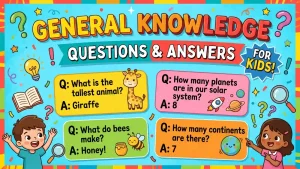
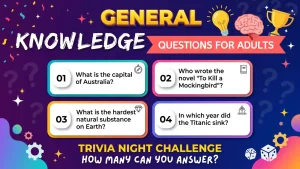
Trivia questions for everyone are short fact questions that anyone can try, whatever their age or level. They cover science, history, geography, sport, animals and everyday life. This guide explains what trivia questions are, how to answer them, and shares questions with answers.
Definition & Meaning of Trivia Questions
Trivia questions are questions about facts, events, people, places, and other topics. They test your general knowledge and your ability to remember useful or interesting facts.
The word trivia refers to small pieces of information. These facts may seem simple, but they can be fun to learn. Some are common facts that many people know. Others are surprising facts that only a few people remember.
For example, a trivia question may ask you to name the largest planet in our solar system. Another may ask who wrote a famous book or which country has a certain landmark.
Here are some examples:
- Science: Which planet is known as the Red Planet?
- Geography: What is the capital of Japan?
- History: Who was the first person to walk on the Moon?
- Animals: What is the largest animal in the world?
- Sports: How many players are on a soccer team on the field?
- Movies: Which movie features the character Simba?
These questions have clear answers. Players use what they already know or try to work out the answer.
What Makes a Good Trivia Question?
A good trivia question should be clear, interesting, and easy to understand. It should test knowledge without making the player guess what the question means.
For example:
Question: What is the largest planet in our solar system?
Answer: Jupiter.
This question is short and has one clear answer.
A question can also be more challenging:
Question: Which element has the chemical symbol Au?
Answer: Gold.
Both questions help players learn while having fun.
Are Trivia Questions the Same as General Knowledge Questions?
Trivia questions and general knowledge questions are closely related. Both test what people know about different subjects.
However, trivia often focuses on short, interesting facts. General knowledge can cover a wider range of information, including facts that are useful in everyday life.
For example, knowing the capital of France is general knowledge. Knowing the name of a less famous historical figure may be a more specialized trivia fact.
In simple terms, trivia questions make learning facts fun through questions and answers.
Background & History of Trivia Questions
Trivia questions have a long history. People have always enjoyed asking questions, sharing facts, and testing what others know.
Long before modern quizzes, people learned through stories, riddles, puzzles, and group discussions. Teachers also used questions to help students remember facts and understand new ideas.
The word trivia comes from Latin roots linked to the idea of three roads meeting. Over time, the word became connected with ordinary or common information. Later, it came to mean small facts that people might find interesting.
The Growth of Trivia Games
Trivia became more popular as newspapers, magazines, radio, and television gave people new ways to enjoy quizzes.
In the 20th century, quiz shows became a common form of entertainment. People watched contestants answer questions about history, music, science, sports, and popular culture.
Board games also helped make trivia a popular activity. Friends and families could gather around a table, answer questions, and compete for points.
As these games grew, trivia became more than a way to test knowledge. It became a social activity that brought people together.
Trivia in the Digital Age
The internet changed how people play trivia. Today, anyone can find questions online, create a quiz, or challenge friends through a phone or computer.
Social media users often share quick quizzes. Video creators use trivia to keep viewers interested. Teachers use online quiz tools to make lessons more active.
Gaming communities also enjoy trivia competitions. Players may answer questions about video games, characters, game history, or popular gaming events.
For example:
Ali: I found a quiz about world capitals. Want to try it?
Sara: Sure! Ask me five questions.
Ali: What is the capital of Italy?
Sara: Rome!
This simple exchange shows how trivia can turn learning into a fun activity.
Today, trivia questions are used in classrooms, family gatherings, workplaces, online communities, and entertainment events. They continue to grow because they are easy to share and simple to play.
Usage of Trivia Questions in Various Contexts
Trivia questions fit many situations. You can use them to learn, relax, compete, or start a conversation. The type of question often depends on the people playing and the setting.
1. Trivia Questions in Daily Conversations
Trivia can make a normal conversation more interesting. You can ask a question while talking with friends, eating dinner, or spending time with family.
Example:
Ayesha: Do you know which animal is the tallest in the world?
Hamza: Is it an elephant?
Ayesha: No, it is the giraffe!
This kind of question can lead to more questions and new facts.
2. Trivia Questions in Text Messages
You can send trivia questions through text messages to challenge a friend. Short questions work best because they are easy to read and answer.
Example:
You: Quick trivia! How many days are there in a leap year?
Friend: 366 days!
You: Correct! Here comes the next question.
Trivia messages can help friends stay connected and give them something fun to discuss.
3. Trivia Questions on Social Media
Trivia posts are common on platforms such as Instagram, Facebook, and X. Users share polls, quizzes, short videos, and question challenges.
For example, a creator might post:
Question: Which ocean is the largest in the world?
A. Atlantic Ocean
B. Indian Ocean
C. Pacific Ocean
D. Arctic Ocean
Answer: C. Pacific Ocean.
People can answer in the comments or take part in a poll.
4. Trivia Questions in Gaming
Many online games include quizzes and knowledge challenges. Players may answer questions to earn points, unlock rewards, or compete with others.
Trivia can also focus on a particular game.
Player 1: Which character is known as the hero of the Mushroom Kingdom?
Player 2: Mario!
Player 1: Correct!
These questions are especially fun for people who enjoy the same games.
5. Trivia Questions at School and Work
Teachers can use trivia questions to review lessons. They can also help students prepare for tests in a fun way.
At work, teams may use short quizzes during meetings, training sessions, or social events.
For example:
Team Leader: What does CPU stand for?
Team Member: Central Processing Unit.
Team Leader: Correct!
In all these settings, trivia questions make learning more active and help people share what they know.
Common Misconceptions & Clarifications
People sometimes misunderstand trivia questions. They may think trivia is only for experts, that every question must be difficult, or that trivia has no real value.
These ideas are not correct. Trivia can be simple, challenging, educational, or entertaining. The best questions depend on the players and the purpose of the quiz.
Misconception 1: Trivia Questions Must Be Difficult
Trivia questions do not have to be hard. They can be made for young children, students, adults, or experts.
For example:
Easy: How many legs does a spider have?
Answer: Eight.
Harder: What is the chemical symbol for potassium?
Answer: K.
Both are trivia questions, even though they require different levels of knowledge.
Misconception 2: Trivia Is Only About General Knowledge
Trivia can cover almost any subject. You can find quizzes about books, films, music, sports, science, nature, food, and video games.
A movie fan may enjoy questions about famous actors. A sports fan may prefer questions about teams and records. A student may choose science or history.
Trivia works best when the topic matches the players’ interests.
Misconception 3: Trivia Has No Educational Value
Trivia is fun, but it can also help people learn. Answering questions encourages players to recall facts and notice what they do not know.
When players check the correct answers, they can learn new information. Repeating questions over time may also help them remember facts.
However, trivia alone does not replace studying a subject in depth. A quiz may teach one fact without explaining the full topic.
Misconception 4: Every Trivia Question Has One Simple Answer
Many trivia questions have one clear answer, but some need more context.
For example, a question about the world’s largest country should explain whether it means land area, population, or another measure.
Questions about changing records may also need a date because the answer can change over time.
Clear wording and reliable sources help make trivia fair.
Misconception 5: Getting an Answer Wrong Means You Know Nothing
Missing a question is part of the game. Nobody knows every fact about every subject.
If you get an answer wrong, use it as a chance to learn. A friendly trivia game should encourage curiosity rather than make people feel embarrassed.
For example:
Mina: I thought the capital of Australia was Sydney.
Omar: That is a common mistake. The capital is Canberra.
Mina: Now I know!
Trivia should be a positive way to share knowledge, learn new facts, and enjoy time with others.
Similar Terms & Alternatives to Trivia Questions
Several terms are closely related to trivia questions. They may sound similar, but each can have a slightly different meaning.
1. General Knowledge Questions
General knowledge questions test what people know about a wide range of subjects.
Example: What is the capital of Egypt?
These questions are useful for school activities, quizzes, and everyday learning.
2. Quiz Questions
Quiz questions are questions used in a test or game. They may cover trivia, school lessons, work training, or a specific subject.
Example: Which gas do plants absorb from the air?
Quiz questions can test simple facts or deeper understanding.
3. Brain Teasers
Brain teasers are puzzles that require careful thought. They often test logic rather than the ability to remember facts.
Example: What has hands but cannot clap?
Answer: A clock.
4. Riddles
Riddles describe something in a clever or confusing way. Players must work out what the description means.
Example: What has a neck but no head?
Answer: A bottle.
5. Pop Quizzes
A pop quiz is a short test, often given without much warning. It is usually used in an educational setting.
Example: A teacher asks students five questions about yesterday’s lesson.
6. Fun Facts
Fun facts are interesting pieces of information. They are not questions by themselves, but they can become trivia questions.
Fun fact: Octopuses have three hearts.
Trivia question: How many hearts does an octopus have?
Comparison Table
| Term | Main purpose | Example |
| Trivia questions | Test knowledge of facts | Which planet is closest to the Sun? |
| General knowledge questions | Test broad knowledge | What is the capital of Canada? |
| Quiz questions | Test knowledge or skills | Which answer is correct? |
| Brain teasers | Test logic and thinking | What has hands but cannot clap? |
| Riddles | Solve a clever description | What has a neck but no head? |
| Pop quizzes | Test learning without much notice | A short classroom test |
| Fun facts | Share interesting information | Bees help pollinate many plants. |
These terms can overlap. For example, a quiz may include trivia questions, riddles, and brain teasers in the same activity.
How to Respond to Trivia Questions
Your response to a trivia question depends on whether you know the answer, want to guess, or need more information. You can respond in a casual, funny, thoughtful, or professional way.
1. Give a Direct Answer
If you know the answer, keep it simple.
Friend: What is the largest planet in our solar system?
You: Jupiter.
A direct answer is often best in a timed quiz.
2. Make a Friendly Guess
If you are unsure, you can still take part.
Friend: Which country is famous for the ancient pyramids of Giza?
You: I think it is Egypt.
A guess shows that you are willing to try. If the answer is wrong, you can learn from it.
3. Use Humor
Funny replies can make a casual game more enjoyable, as long as they do not insult another player.
Friend: What is the fastest land animal?
You: My cat when it hears the food bag open!
Friend: Nice try. The answer is the cheetah.
Humor works well among friends, but a timed competition may require a clear answer.
4. Ask for a Hint
If a question is too hard, ask for a clue.
Friend: Which planet has the most prominent rings?
You: Can I get a hint?
Friend: It is a gas giant.
You: Saturn?
This can keep the game moving and make the challenge more fun.
5. Ask for Clarification
Sometimes a question is unclear. You can ask the person to explain what they mean.
Friend: What is the biggest animal?
You: Do you mean the biggest animal alive today or the biggest animal ever known?
This is a useful response because the answer may depend on the meaning of the question.
6. Respond in a Professional Setting
In a classroom, meeting, or training session, answer clearly and politely.
Trainer: What does HTML stand for?
You: HTML stands for HyperText Markup Language.
If you do not know the answer, you can say:
“I’m not sure, but I would like to learn the correct answer.”
This sounds respectful and shows a willingness to learn.
7. Set a Boundary When Needed
Trivia games should be enjoyable. If a question asks for private details about your life, you do not have to answer.
Friend: What is your personal password? That is today’s trivia question!
You: Nice try! Let’s keep the questions about general knowledge.
You can be friendly while protecting your privacy.
Regional or Cultural Differences in Trivia Questions
Trivia questions are popular in many parts of the world. However, the subjects, wording, and difficulty often change based on local culture, language, and interests.
A quiz made for one country may include questions that are easy for local players but difficult for people from other places.
1. Local History and Culture
Trivia quizzes often include important events, national heroes, traditional foods, famous buildings, and cultural celebrations.
For example, a quiz for players in Pakistan may ask about the country’s independence, major cities, national symbols, or famous historical sites.
A quiz for players in Japan may focus on Japanese history, cultural traditions, or well-known landmarks.
These questions help people learn about their own country and other cultures.
2. Sports Trivia
Sports interests vary from region to region. Cricket is widely followed in Pakistan, India, and other countries. Soccer has a large global audience, while basketball is especially popular in the United States.
As a result, a local trivia night may focus on cricket players and tournaments, while another may feature soccer teams or basketball records.
The best sports trivia depends on what the players enjoy.
3. Language Differences
Trivia questions must be clear in the language used by the players. A word may have one meaning in one language and a different meaning in another.
Translating a question word for word may also make it confusing. The writer should use natural language and explain terms that may be unfamiliar.
For example, a quiz about British and American English could ask which word is used for the same item in each country.
4. Food and Traditions
Food trivia can be a fun way to explore cultural differences.
Example:
Player 1: Which country is closely associated with sushi?
Player 2: Japan.
Player 1: Correct!
Other questions may cover pizza, tacos, biryani, or traditional dishes from different parts of the world.
It is important to avoid treating every person from a country as having the same tastes or customs. Cultural trivia should share information without relying on stereotypes.
5. Regional Trivia and Fairness
A fair quiz should match the knowledge level of its audience. If players come from different backgrounds, include questions from several regions.
You can mix world history, science, geography, entertainment, food, and sports. This gives everyone a chance to answer.
The goal is to celebrate knowledge and culture, not to make people feel left out.
Comparison with Similar Terms
Trivia questions are often confused with other forms of games and learning activities. Comparing them helps you choose the right format for your needs.
| Feature | Trivia questions | Brain teasers | Riddles | Educational tests |
| Main focus | Facts and knowledge | Logic and problem-solving | Clever clues | Learning and understanding |
| Typical answer | A factual answer | A logical solution | A hidden object or idea | An answer based on a lesson |
| Difficulty | Easy to hard | Easy to very hard | Easy to hard | Depends on the subject |
| Common setting | Parties, games, classrooms | Puzzles and games | Family fun and word games | Schools and training |
| Main benefit | Builds knowledge | Develops reasoning | Encourages creative thinking | Measures learning |
When Should You Use Each Type?
Use trivia questions when you want to test facts or learn about new subjects.
Use brain teasers when you want players to solve a problem.
Use riddles when you want a short, clever challenge.
Use educational tests when you need to check how well someone understands a lesson.
For example, a teacher might use trivia questions to review a history lesson, brain teasers to develop problem-solving skills, and a formal test to measure what students have learned.
These activities can work well together. A game night could begin with general knowledge trivia, move to riddles, and end with a few difficult brain teasers.
The main difference is the purpose. Trivia asks what you know, while brain teasers and riddles often ask how you think.
Usage in Online Communities & Dating Apps

Trivia questions are popular in online communities because they are easy to share and encourage people to interact. They can help strangers find common interests and give friends a simple activity to enjoy together.
1. Trivia on Social Platforms
On platforms such as Instagram, Facebook, and X, users post questions to invite comments and reactions.
A post might say:
“Quick quiz! Which is the smallest planet in our solar system?”
People can answer in the comments. The creator can reveal the correct answer later and explain the fact.
Short questions work well online because users can read them quickly. Images, polls, and multiple-choice answers can make the experience more engaging.
2. Trivia in Gaming Communities
Online gaming groups often use trivia to connect players. The questions may focus on popular games, characters, maps, gaming history, or famous releases.
For example:
Player A: Which company created Minecraft?
Player B: Mojang.
Player A: Correct!
Game-specific trivia can be a good way to meet people who share the same interests.
3. Trivia on Dating Apps
Trivia questions can also help people start conversations on dating apps. A light question may reveal someone’s interests and make the first chat feel less awkward.
For example:
Person A: Let’s play a quick trivia game. Which country would you most like to visit?
Person B: Italy. I love the food and history. What about you?
This example combines a quiz-like conversation with a question about personal interests. The second question is not factual trivia, but it helps the two people get to know each other.
You could also ask:
- What is your favorite movie for a quiz night?
- Which historical period would you like to learn about?
- What subject could you answer trivia questions about all day?
4. Tips for Online Trivia
Keep these points in mind when sharing trivia online:
- Keep questions short. Simple wording helps people understand them.
- Choose suitable topics. Avoid questions that may embarrass other players.
- Check your facts. Use reliable sources before sharing answers.
- Respect privacy. Do not ask for passwords, private records, or sensitive personal details.
- Be a good sport. Correct mistakes politely instead of mocking someone.
Trivia can make online conversations more interesting, but it should remain friendly and respectful.
Hidden or Offensive Meanings of Trivia Questions
The phrase “trivia questions” does not usually have a hidden or offensive meaning. It refers to questions that test knowledge of facts and interesting information.
However, the way people use trivia can sometimes cause problems. A question may be harmless in one setting but rude or uncomfortable in another.
1. Personal Questions Disguised as Trivia
Some people may call a personal question a trivia challenge to make it sound like a game.
For example:
Friend: Trivia time! What is your bank password?
You: That is private. Ask me a question about history instead.
A password is not trivia. It is private information, and you should never share it in a quiz.
2. Questions That Embarrass People
A trivia game can become unpleasant if players use questions to mock someone’s education, background, or lack of knowledge.
For example:
Player A: You do not know the capital of France? That is embarrassing!
Player B: Everyone has different knowledge. Let’s move on.
A better approach is to explain the correct answer and continue the game.
3. Sensitive Cultural Topics
Questions about religion, politics, culture, or historical conflicts may require extra care. Some topics are sensitive because people have different beliefs and experiences.
If you include these subjects, write questions that focus on accurate information rather than insults or stereotypes.
4. Misleading Questions
A question can also be unfair if it leaves out important details or uses unclear wording.
For example, asking for the “biggest city” without explaining whether you mean population within city limits or a wider urban area may lead to different answers.
Adding context helps avoid arguments.
5. Tone Matters
The same trivia question can sound friendly or rude depending on the tone.
A cheerful challenge invites people to play. A sarcastic question may make them feel foolish.
Trivia should encourage curiosity, not shame people for what they do not know.
If a question makes someone uncomfortable, change the topic or choose a different question.
Suitability for Professional Communication
Trivia questions can be suitable for professional settings when they support a clear purpose. They can help teams learn, encourage conversation, and make training sessions more engaging.
However, the questions should match the workplace and the people taking part.
1. Trivia for Team-Building Activities
Companies sometimes use quizzes during team events or staff gatherings. These activities give coworkers a chance to relax and learn about one another.
For example, a team leader may prepare questions about science, geography, popular culture, or company history.
A short quiz can also help new team members feel included.
2. Trivia for Training
Trivia questions can help employees review information from a training session.
For example:
Trainer: Which action should you take before opening an unexpected email attachment?
Employee: Check whether the email and attachment are safe.
The exact answer will depend on the organization’s security rules, but the format can help reinforce important lessons.
3. Keep Questions Respectful
Professional trivia should avoid questions about a coworker’s private life, income, health, religion, or other sensitive matters.
Choose neutral topics that most people can enjoy. If the quiz is competitive, make sure the rules are clear and the answers are correct.
4. Use Clear Professional Language
In formal writing, “knowledge quiz,” “quiz questions,” or “knowledge check” may be more suitable than a casual phrase such as “trivia challenge.”
Here are some examples:
Casual: “Let’s do some trivia questions!”
Professional: “Let’s begin with a short general knowledge quiz.”
Training: “Please complete the following knowledge check.”
Team event: “Join us for a short quiz to test your knowledge and have fun.”
The best phrase depends on the purpose. Trivia questions are usually fine in the workplace, especially during informal activities, training, and team events.
Frequently Asked Questions
Trivia questions test knowledge of facts about subjects such as science, history, geography, sports, animals, and entertainment. They are often used in quizzes and games.
Their main purpose is to test knowledge while making learning fun. They can also encourage memory, curiosity, teamwork, and friendly competition.
Here are three simple examples: What is the capital of France? Paris. Which planet is known as the Red Planet? Mars. How many sides does a triangle have? Three.
Yes. Trivia questions can help children learn facts, improve recall, and explore new subjects. Choose age-appropriate questions and explain answers in simple language.
Trivia often focuses on short, interesting facts. General knowledge covers a broad range of information about the world. The two categories overlap and are often used together.
Conclusion
Trivia questions are a simple and fun way to test what you know. They cover many subjects, from science and history to sports, movies, animals, and geography. You can play them alone, with friends, in class, or online.
These questions can do more than entertain you. They can help you remember facts, learn about new topics, and start interesting conversations. They also give people a chance to share knowledge and enjoy friendly competition.
Trivia is not the same as a brain teaser or a riddle, although these activities can be part of the same quiz. The main goal of trivia is to test knowledge through questions about facts and information.
When making or playing a trivia quiz, keep the questions clear, check your answers, and respect other players. Do not worry if you get an answer wrong. Every mistake can teach you something new.
The best trivia questions make you think, help you learn, and leave you wanting to try one more question.
Keep playing with more quizzes on this site: general knowledge quiz, trivia questions for kids, family trivia questions, and trivia today.

Thomas Mitchell is a writer at New Learn Knowledge, sharing clear and useful educational content.
He enjoys creating simple guides and informative articles that help readers learn and discover new knowledge.