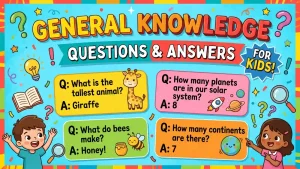
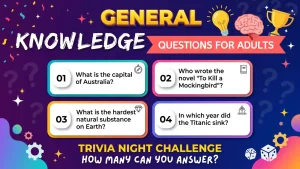
Useful general knowledge is basic information that helps you in everyday life, from science and history to geography and culture. It helps you understand news, answer quiz questions, and join conversations with confidence. You can build it with a little reading, short quizzes, and daily review.
What Is Useful General Knowledge?

Useful general knowledge means basic facts and information that are helpful in everyday life.
It covers many subjects. These include:
- Science: facts about the human body, animals, plants, and space.
- Geography: countries, cities, oceans, rivers, and mountains.
- History: important people, events, and dates.
- Technology: common devices, apps, and digital tools.
- Culture: languages, traditions, food, art, and customs.
- Nature: weather, seasons, plants, and animals.
- Daily life: money, time, health, safety, and common rules.
The word useful means something that helps you. The term general knowledge means information about many different subjects.
For example, knowing that Earth moves around the Sun is useful general knowledge. Knowing that water freezes at 0°C under standard conditions is another common example.
You may hear these facts in many places.
Friend: “What is the largest planet?”
You: “Jupiter.”
Teacher: “Which ocean is the largest?”
Student: “The Pacific Ocean.”
General knowledge can also help when you read or watch something online. If you know basic facts, it is easier to understand new information.
It is important to remember that general knowledge is not always the same for everyone. A fact may be common in one country or group but less known in another.
Where Did Useful General Knowledge Come From?

People have shared useful knowledge for thousands of years. Long before the internet, people learned facts from parents, teachers, books, travelers, and community members.
Early societies passed knowledge through stories, lessons, records, and oral traditions. People needed information about farming, weather, animals, seasons, travel, and local places.
Later, books made it easier to save and share information. Schools also helped people learn basic knowledge across many subjects.
The growth of newspapers, radio, television, and encyclopedias gave people access to even more information.
The internet changed this process again. Today, people can find information within seconds. Search engines, online libraries, educational websites, videos, and social media all help people learn.
General knowledge has also become common in quiz shows, school tests, interviews, games, and online quizzes.
However, having access to more information does not mean that every fact online is correct. People should still check important information and use trusted sources.
Today, useful general knowledge is often learned through a mix of school, reading, conversation, media, and personal experience.
Where Is Useful General Knowledge Used?

Useful general knowledge appears in many parts of daily life.
How Is Useful General Knowledge Used in Daily Conversations?
People often use simple facts when talking with friends or family.
Ali: “How many continents are there?”
Sara: “There are seven.”
How Is Useful General Knowledge Used in Texting?
Facts can also appear in chat messages.
Sam: “Did you know honey can last for a very long time?”
John: “Really? I did not know that.”
How Is Useful General Knowledge Used on Social Media?
People often post short facts as quizzes or educational content.
Post: “Can you name the largest ocean?”
Comment: “The Pacific Ocean.”
How Is Useful General Knowledge Used in Gaming?
Many trivia games use general knowledge questions.
Player 1: “What is the capital of Japan?”
Player 2: “Tokyo!”
How Is Useful General Knowledge Used in Professional Settings?
Basic knowledge can also help during meetings, interviews, and presentations.
For example, knowing important facts about a country, industry, or current topic can help you join a discussion.
The key point is simple: useful general knowledge helps people understand and discuss many topics.
What Are Common Misconceptions About Useful General Knowledge?

There are several common misunderstandings about general knowledge.
First, general knowledge does not mean knowing everything. Nobody knows every fact. People often have strong knowledge in some areas and less knowledge in others.
Second, a fact being popular does not always make it true. Information can spread online even when it is wrong.
For example, someone may share a “fact” on social media. Other people may repeat it without checking the source. This does not prove that the information is correct.
Third, general knowledge can change. New discoveries can improve or change what people know about science, history, and technology.
Another important point is that general knowledge can vary between cultures. A fact that is widely known in one country may not be widely known somewhere else.
Some people also confuse general knowledge with expert knowledge. They are not the same.
General knowledge covers many subjects at a basic level.
Expert knowledge is deep knowledge of one subject.
For example, knowing that the human heart pumps blood is general knowledge. Understanding complex heart surgery requires expert knowledge.
What Terms Are Similar to Useful General Knowledge?
Several terms are close to useful general knowledge.
| Term | Simple Meaning |
| General knowledge | Basic information about many subjects |
| Common knowledge | Information known by many people in a group |
| Basic knowledge | Simple facts about one subject |
| Public knowledge | Information available to the public |
| Shared knowledge | Information known by members of a group |
| General information | Basic information about a topic |
| Well-known fact | A fact known by many people |
These terms can overlap, but they are not always identical.
For example, common knowledge usually refers to information that many people in a particular group know. General knowledge covers a wider range of subjects.
How Should You Respond to Useful General Knowledge?

When someone shares a fact, your response can depend on the situation.
What Is a Casual Response?
“Oh, I did not know that!”
What Is a Curious Response?
“Really? How does that work?”
What Is a Funny Response?
“My brain just learned something new!”
What Is a Professional Response?
“That is useful information. Thank you for sharing it.”
What Is a Privacy-Conscious Response?
Sometimes you may not want to discuss a personal topic. You can politely change the subject.
“That is interesting, but I would rather talk about something else.”
You do not need to know the answer to every question. It is fine to say:
“I am not sure. Let me check.”
This is often better than giving an answer that may be wrong.
How Does Useful General Knowledge Differ by Region and Culture?

General knowledge can differ across countries and cultures.
For example, people may learn different historical events, national symbols, holidays, famous people, and local traditions.
Language can also affect how information is shared. A fact may be common in one language but less familiar in another.
School systems also play a role. Students in different countries may study different subjects and historical events.
There are also regional differences in everyday knowledge. A person who lives near the sea may know more about local marine life. Someone who lives in a farming area may know more about crops and seasons.
This does not mean one person has more general knowledge than another. It shows that knowledge is often shaped by culture, education, location, and experience.
How Is Useful General Knowledge Different from Similar Terms?
| Expression | Main Idea | Example |
| Useful general knowledge | Helpful facts from many subjects | Knowing basic world geography |
| General knowledge | Broad information | Knowing basic history and science |
| Common knowledge | Information known by a group | Knowing that water is needed for life |
| Basic knowledge | Simple information about a subject | Knowing basic computer skills |
| Expert knowledge | Deep knowledge of one field | Knowing advanced medical science |
| Public knowledge | Information available to people | A country’s public laws |
These terms are related, but the meaning depends on context.
How Is Useful General Knowledge Used in Online Communities?

Online communities often use general knowledge for quizzes, discussions, posts, comments, and games.
On platforms such as Twitter/X, people may share short facts and ask followers questions.
Gaming communities may use trivia as part of games or friendly competitions.
Dating apps can also include simple questions as conversation starters.
For example:
Person A: “Quick question: What is the largest planet?”
Person B: “Jupiter. Why?”
Person A: “Just testing your trivia skills!”
A general knowledge question can make conversation easier because it gives both people something simple to discuss.
However, people should avoid using questions to embarrass others. Not knowing a fact is normal.
A good response is often friendly and relaxed.
Does Useful General Knowledge Have Hidden or Offensive Meanings?

The phrase useful general knowledge does not normally have an offensive meaning. It is a neutral phrase.
Still, context matters.
A person may use a simple question to make fun of someone who does not know the answer. In that case, the problem is not the phrase itself. The problem is the tone and purpose.
For example:
Friendly: “Do you know the capital of France?”
Unfriendly: “You do not even know the capital of France?”
The words are similar, but the tone is different.
Online conversations can also make tone harder to understand. A short message may sound rude even when the writer did not mean it that way.
When sharing facts, it is better to be helpful, respectful, and clear.
Is Useful General Knowledge Suitable for Professional Communication?

The phrase useful general knowledge is suitable for most professional and educational settings.
You can use it in:
- Blog posts
- School work
- Training materials
- Presentations
- Educational websites
- Quizzes
- Informal workplace discussions
For a more formal style, you can use terms such as:
- General information
- Basic knowledge
- Essential information
- Relevant information
- Background knowledge
For example:
Casual: “Here are some useful general knowledge facts.”
Professional: “Here is some essential background information.”
Both sentences are clear. The second one has a more formal tone.
Frequently Asked Questions
Useful general knowledge is basic information that helps people understand the world and handle everyday life.
It can include science, history, geography, culture, nature, technology, and daily life.
It helps people understand new topics, answer questions, join conversations, and learn more easily.
No. The terms are close, but common knowledge usually means information known by many people in a group.
Read books, follow trusted educational sources, learn about different subjects, and ask questions when you are unsure.
Conclusion
Useful general knowledge helps us learn about the world. It includes simple facts about science, history, geography, culture, technology, and daily life.
You can use this knowledge at school, work, online, or during everyday conversations. It can help you understand new ideas and take part in discussions.
General knowledge does not mean knowing every answer. It is about building a broad base of useful information.
It is also important to check facts. Information on social media and other websites is not always correct.
The best way to build knowledge is to stay curious. Read, ask questions, learn from trusted sources, and explore new subjects. Even one new fact each day can help you understand the world a little better.
Continue Reading:
- Country Facts: General Knowledge and World Insights (for 2026)
- World Geography Knowledge: Facts, Places, and Global Insights (for 2026)
- General Knowledge Trivia: Questions to Test Your Knowledge (for 2026)
- General Knowledge for Students: Easy Facts to Know (for 2026)
- Easy General Knowledge: Questions and Answers (for 2026)

Thomas Mitchell is a writer at New Learn Knowledge, sharing clear and useful educational content.
He enjoys creating simple guides and informative articles that help readers learn and discover new knowledge.