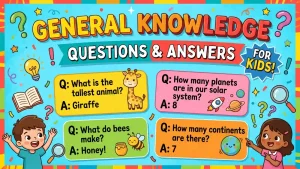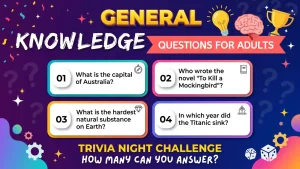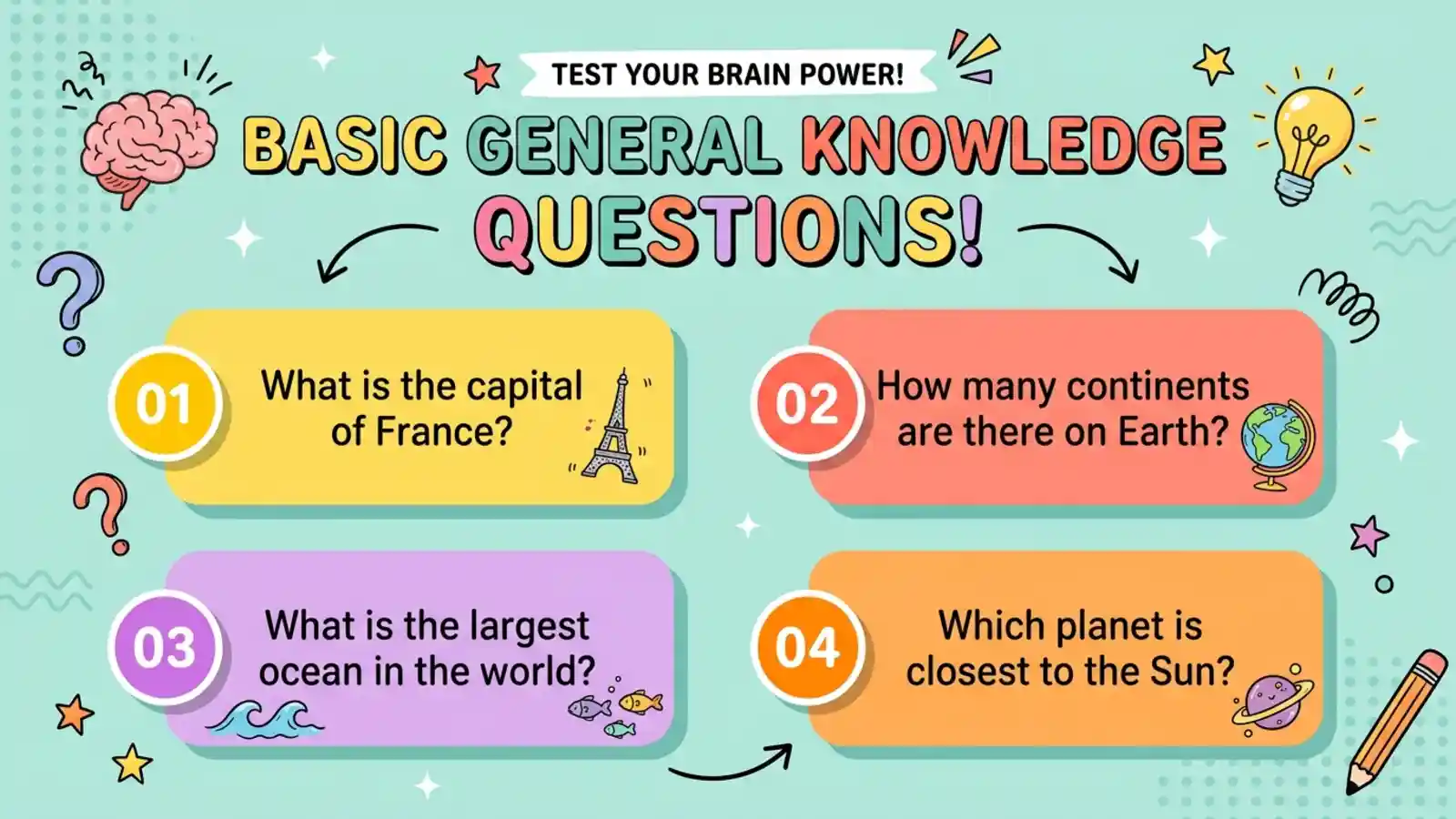
Basic general knowledge questions are simple questions about common facts from science, history, geography and everyday life. They help beginners learn facts, build confidence and prepare for school, work and quizzes. This guide explains what they are, shows examples, and shares questions with answers for beginners.
Definition and Meaning of Basic General Knowledge Questions
Basic general knowledge questions are simple questions about common facts and important information. They cover different subjects and help people understand the world better.
The word basic means simple or easy to understand. General knowledge means facts about many subjects, rather than just one topic. Questions are things we ask to get information or test what we know.
Together, basic general knowledge questions are easy questions that test what a person knows about everyday facts, places, people, nature, and the world.
Examples of Basic General Knowledge Questions
Here are some simple questions with answers.
- What is the capital of France?
Answer: Paris. - How many days are there in a week?
Answer: Seven. - Which planet is known as the Red Planet?
Answer: Mars. - What is the largest ocean in the world?
Answer: The Pacific Ocean. - How many legs does a spider have?
Answer: Eight. - Which animal is known as the king of the jungle?
Answer: The lion. - What is the main source of energy for Earth?
Answer: The Sun. - How many months are there in a year?
Answer: Twelve.
These questions cover science, geography, nature, and everyday facts.
Why Are These Questions Important?
Basic general knowledge questions help people learn new facts and remember useful information. They also improve thinking skills and encourage curiosity.
For example:
Ali: Which planet do we live on?
Sara: Earth!
Ali: Correct. Do you know which planet is closest to the Sun?
Sara: Mercury!
This short conversation shows how a simple quiz can help people learn while having fun.
These questions are also useful for school tests, quiz competitions, job interview preparation, and family games.
Background and History of General Knowledge Questions
People have asked questions to share knowledge for thousands of years. Long before the internet, people learned through stories, books, teachers, family members, and discussions.
In ancient times, teachers asked students questions to check what they had learned. People also shared facts about nature, farming, travel, health, and local history. Asking questions was an important way to pass knowledge from one generation to the next.
As schools and libraries developed, books became a common source of general knowledge. Encyclopedias helped readers learn about many subjects in one place. Newspapers and magazines also shared information about science, world events, famous people, and new discoveries.
The Rise of Quizzes
Quizzes became popular ways to test knowledge in classrooms, clubs, and social events. Teachers used questions to check students’ learning. Families and friends also played question-and-answer games for fun.
Radio and television later brought quiz shows to large audiences. People could answer questions at home while watching contestants compete for prizes.
These shows covered subjects such as history, geography, science, music, and sports. They helped make general knowledge an enjoyable part of everyday life.
General Knowledge in the Digital Age
Today, people can find general knowledge questions on websites, mobile apps, social media, and video platforms.
Online quizzes allow users to test their knowledge in just a few minutes. Students can practise before exams, while adults can enjoy quizzes during breaks.
For example:
Ayesha: I found a quiz about world capitals online.
Hassan: Great! Did you know the capital of Japan?
Ayesha: Yes, it is Tokyo.
Hassan: Let’s see how many more we can answer!
Digital tools have made learning faster and more accessible. However, it is still important to check facts because not every website shares correct information.
General knowledge questions have changed in how people ask and answer them, but their main purpose remains the same: to help people learn, think, and share knowledge.
Usage in Various Contexts
Basic general knowledge questions are useful in many parts of daily life. They can be used for learning, entertainment, friendly competition, and personal growth.
1. At School
Teachers use general knowledge questions to help students remember facts and understand new topics.
Teacher: Which gas do humans need to breathe?
Student: Oxygen.
Teacher: Correct!
These questions can make lessons more active and enjoyable.
2. At Home
Families can use simple questions during meals, holidays, or game nights.
Mother: How many days are there in a leap year?
Child: Three hundred and sixty-six days!
This is a simple way to learn together.
3. On Social Media
Many websites and social media accounts share quiz questions to attract attention and encourage people to participate.
For example:
Post: Which is the largest planet in our solar system?
Comment: Jupiter!
People can answer in the comments and compare their knowledge with others.
4. In Online Games
Quiz games often include questions about animals, countries, science, sports, and famous people.
Player 1: Quick! Which country is famous for the Eiffel Tower?
Player 2: France!
These questions make games more educational.
5. In Job Interviews
Some employers use general knowledge questions to test awareness, reasoning, or basic understanding. The exact questions depend on the job.
For example:
Interviewer: Why is teamwork important?
Candidate: It helps people share ideas, solve problems, and reach common goals.
Not every job interview includes general knowledge questions, but being informed can help candidates feel more prepared.
6. During Everyday Conversations
General knowledge can help people join conversations and understand the world around them.
Friend 1: Did you know that bees help pollinate many plants?
Friend 2: Yes! They play an important role in nature.
In all these situations, basic general knowledge questions make learning easier and more engaging.
Common Misconceptions and Clarifications
People sometimes misunderstand what basic general knowledge questions are and how they should be used.
Misconception 1: General Knowledge Is Only for Students
This is not true. General knowledge is useful for people of all ages.
Children can learn about animals and colours. Teenagers can explore science and geography. Adults can learn about history, current events, and world cultures.
Everyone can benefit from learning new facts.
Misconception 2: Every Question Has an Easy Answer
Some questions look simple but require careful thought. For example, asking about the largest country depends on whether you mean land area, population, or another measure.
A clear question should explain what it is asking.
Misconception 3: Memorising Facts Is Enough
Remembering facts is helpful, but understanding them is also important.
For example, knowing that plants need sunlight is useful. Understanding how sunlight helps plants make food gives you deeper knowledge.
Misconception 4: General Knowledge Never Changes
Some facts remain stable, but others can change.
Population figures, world records, political leaders, and scientific findings may change over time. It is important to check reliable sources for facts that need updating.
Misconception 5: A Wrong Answer Means You Are Not Smart
Everyone makes mistakes. A quiz is a chance to learn, not a measure of a person’s entire intelligence.
For example:
Hamza: I thought Sydney was the capital of Australia.
Noor: It is a major city, but Canberra is the capital.
Hamza: Thanks! I learned something new.
This is a positive way to respond to a mistake.
Misconception 6: All Online Quiz Answers Are Correct
Online quizzes can contain mistakes, outdated facts, or confusing wording. Check trusted sources when an answer seems doubtful.
How to Use These Questions Correctly
- Read each question carefully.
- Check whether the question asks for one answer or several.
- Learn why the answer is correct.
- Review facts that may change.
- Treat mistakes as learning opportunities.
These habits can make general knowledge practice more useful and enjoyable.
Similar Terms and Alternatives
Several terms are related to basic general knowledge questions. They have similar meanings, but each may serve a slightly different purpose.
1. General Knowledge Quiz
A general knowledge quiz is a set of questions about different subjects. It may include multiple-choice questions, true-or-false questions, or short answers.
Example: A quiz with 20 questions about science, geography, and history.
2. Trivia Questions
Trivia questions focus on interesting facts. They often include unusual details about animals, celebrities, films, sports, and history.
Example: Which animal has three hearts? Answer: An octopus.
3. Educational Questions
Educational questions are designed to help people learn about a subject. They may be easy or difficult.
Example: Why do plants need sunlight?
4. Basic Knowledge Test
A basic knowledge test checks whether someone understands important facts or simple concepts.
Example: A short science test for school students.
5. General Awareness Questions
General awareness questions often focus on public affairs, current events, society, and important developments. The exact meaning depends on the setting.
Example: Who is the current head of a country’s government?
6. Brain Teasers
Brain teasers test reasoning and creative thinking. They are not always based on facts.
Example: What has hands but cannot clap? Answer: A clock.
Comparison Table
| Term | Main purpose | Example topic |
| Basic general knowledge questions | Test common facts | Planets |
| General knowledge quiz | Test knowledge across subjects | History and science |
| Trivia questions | Share interesting facts | Animals |
| Educational questions | Teach a concept | Plant growth |
| General awareness questions | Test awareness | Current affairs |
| Brain teasers | Test reasoning | Riddles |
Choosing the right term depends on your goal. If you want to test facts from several subjects, basic general knowledge questions are a good choice.
How to Respond to Basic General Knowledge Questions
Answering general knowledge questions can feel easy when you know the facts. If you do not know an answer, you can still respond in a positive way.
1. Give a Direct Answer
When you know the answer, keep it clear and simple.
Friend: What is the capital of Italy?
You: Rome.
A direct answer is best for quick quizzes and everyday conversations.
2. Explain Your Answer
Some questions need more than one word.
Friend: Why is the Sun important to Earth?
You: It gives us light and heat. It also helps plants make food.
This type of answer shows that you understand the topic.
3. Ask for a Hint
If you are unsure, asking for a hint can help you think.
Friend: Which planet is famous for its rings?
You: Can I have a hint?
Friend: It is the sixth planet from the Sun.
You: Saturn!
4. Admit When You Do Not Know
It is fine to say that you do not know an answer.
You can say:
- “I’m not sure. Let me check.”
- “I don’t know, but I’d like to learn.”
- “Can you tell me the answer?”
- “I need a little more time to think.”
These responses show curiosity and honesty.
5. Make It Funny
A friendly joke can make a quiz more enjoyable, as long as it does not embarrass anyone.
Friend: Which animal is the tallest in the world?
You: A giraffe. It would have a great view at a concert!
6. Respond Professionally
In a classroom, interview, or work setting, answer clearly and stay calm.
If you do not know the answer, you can say, “I’m not certain, but I would be happy to verify it.”
7. Protect Your Privacy
Most general knowledge questions do not ask for personal information. If someone mixes a quiz with private questions, you do not need to share sensitive details.
For example, you can say, “I’d prefer to keep that information private.”
The best response depends on the situation. Be clear, respectful, and willing to learn.
Regional or Cultural Differences
Basic general knowledge questions are used around the world, but the topics may vary by country, language, and culture.
Some questions focus on facts that are widely known internationally. Others focus on local history, national symbols, popular sports, and cultural traditions.
Questions About National History
In Pakistan, a general knowledge quiz may include questions about the country’s independence, national symbols, provinces, rivers, and important historical figures.
In the United States, a quiz might include questions about the Declaration of Independence, state capitals, and national holidays.
These questions reflect the history and culture of each country.
Questions About Geography
Some geography questions are common worldwide.
Examples include:
- What is the largest ocean in the world?
- Which continent is the Sahara Desert in?
- What is the capital of Japan?
Other questions focus on local places, such as rivers, mountains, cities, and neighbouring countries.
Language Differences
General knowledge questions can be translated into many languages. However, translations must be clear and accurate.
A question that makes sense in English may need different wording in Urdu or another language. Simple language helps people understand the question without confusion.
Cultural Knowledge
Some quizzes include festivals, food, music, clothing, and traditions.
For example, a quiz about Pakistan may include questions about Eid celebrations or regional foods. A quiz about Japan may include questions about traditional festivals or cultural customs.
It is important to avoid assuming that every person from a country knows the same facts or follows the same traditions.
Sports and Entertainment
Popular quiz topics also vary by region. Cricket is widely followed in Pakistan, India, and several other countries. Football is popular across many parts of the world.
Local films, famous artists, and national sports stars may also appear in general knowledge quizzes.
How to Make Questions Fair
To make a quiz useful for people from different backgrounds:
- Use clear, simple language.
- Explain unfamiliar terms.
- Include topics from different regions.
- Avoid cultural stereotypes.
- Check that the answers are accurate.
A balanced quiz helps people learn about both their own communities and the wider world.
Comparison With Similar Terms
Basic general knowledge questions, trivia, and academic test questions may look similar, but they have different goals.
| Feature | Basic general knowledge | Trivia | Academic test |
| Main goal | Check common facts | Share interesting facts | Measure subject learning |
| Difficulty | Usually easy | Easy to challenging | Depends on the course |
| Topics | Many subjects | Often unusual facts | Specific school subjects |
| Learning style | Short questions and answers | Fun facts and challenges | Lessons and assessments |
| Common use | Home, school, quizzes | Parties and games | Schools and exams |
Basic General Knowledge Questions
These questions focus on common facts from different subjects.
Example: How many hours are there in a day?
Answer: 24.
Trivia Questions
Trivia questions may focus on surprising or less familiar facts.
Example: Which mammal is capable of true flight?
Answer: A bat.
Academic Questions
Academic questions often test knowledge taught in a course.
Example: What is the process by which plants make food using sunlight?
Answer: Photosynthesis.
Brain Teasers
Brain teasers ask people to solve a puzzle or think in an unusual way.
Example: What gets wetter as it dries?
Answer: A towel.
Which Type Should You Choose?
Choose basic general knowledge questions when you want to practise everyday facts. Use trivia questions when you want a fun challenge. Choose academic questions when you need to study a subject. Use brain teasers when you want to improve problem-solving skills.
You can also combine these types to create a quiz that is both educational and entertaining.
Usage in Online Communities and Dating Apps

Basic general knowledge questions are common in online quizzes, discussion groups, gaming communities, and social media posts.
They help people share facts, challenge friends, and start conversations. However, general knowledge questions are not a special feature of dating apps, and their use depends on the people involved.
1. Social Media
On platforms such as X, Instagram, and Facebook, users may post a question and invite others to comment.
Example:
Post: Which planet is closest to the Sun?
Comment: Mercury!
These posts can encourage friendly discussion and help people discover new facts.
2. Gaming Communities
Online games may include quizzes about science, history, sports, and entertainment.
Player 1: What is the largest mammal in the world?
Player 2: The blue whale!
These questions add a learning element to online games.
3. Online Learning Groups
Students may share quiz questions in study groups to prepare for tests or help each other learn.
A useful approach is to share the question first and reveal the answer afterward. This gives everyone a chance to think.
4. Dating Apps
On apps such as Tinder, people sometimes use light questions to start conversations. General knowledge questions can be one way to break the ice.
For example:
Person A: Quick quiz: What is the largest planet in our solar system?
Person B: Jupiter! Your turn to ask me one.
This can make a conversation fun, but it should not feel like an exam. If the other person does not enjoy quizzes, try a different topic.
Tips for Online Quizzes
- Keep questions short and clear.
- Avoid insulting people who get answers wrong.
- Check facts before sharing them.
- Respect different levels of knowledge.
- Do not use a quiz to pressure someone into sharing private information.
Online quizzes work best when they create friendly conversations and help people learn together.
Hidden or Offensive Meanings
The phrase basic general knowledge questions has no widely recognised hidden or offensive meaning. It normally refers to simple questions about common facts.
However, the way a person asks a question can affect how it feels.
When Questions Can Sound Insulting
A simple question can sound rude if it is used to make someone feel foolish.
For example:
Person A: You don’t know the capital of France? Everyone knows that!
Person B: I may not know that fact, but I’m happy to learn.
The problem is not the question itself. The problem is the way Person A uses it to judge someone.
Questions Can Depend on Context
A question that seems easy to one person may be difficult for another. People have different interests, education, experiences, and opportunities to learn.
Someone who knows a lot about science may not know much about sports. A person who enjoys history may struggle with questions about technology.
This is normal.
Avoid Unfair Assumptions
Do not assume that someone is unintelligent because they miss a question. One answer cannot measure a person’s full knowledge or abilities.
Likewise, avoid questions that rely on stereotypes about a person’s country, language, age, or background.
Be Careful With Sensitive Topics
Some quizzes include politics, religion, or cultural traditions. These subjects can be personal or complex. Questions should be worded respectfully and answers should be checked carefully.
How to Keep a Quiz Friendly
- Ask questions without mocking anyone.
- Accept that people may make mistakes.
- Explain the answer when needed.
- Avoid using a quiz to embarrass others.
- Respect different backgrounds and opinions.
General knowledge should bring people together, not make them feel small.
Suitability for Professional Communication
Basic general knowledge questions can be suitable for professional settings when they are relevant, respectful, and clearly worded.
Teachers may use them in classrooms. Employers may use some general knowledge questions during interviews. Trainers may use them to start a workshop or review basic facts.
However, not every workplace situation needs a quiz.
In Job Interviews
Some roles require awareness of current events, geography, science, or industry-related facts. An employer may ask questions to understand how a candidate thinks or handles unfamiliar information.
For example:
Interviewer: What would you do if you were unsure whether a fact in a report was correct?
Candidate: I would check a reliable source and confirm the information before using it.
This answer shows care and good judgment.
In Meetings and Training
A short quiz can help employees review information or stay engaged during training.
For example, a company may ask questions about workplace safety, customer service, or company policies.
The questions should match the purpose of the session.
In Emails and Workplace Messages
The phrase itself is professional enough to use in writing, but the wording should match the situation.
Examples include:
- “Please complete the basic general knowledge quiz before Friday.”
- “We will begin the session with five general knowledge questions.”
- “This activity will help students review key facts.”
These statements are clear and polite.
Professional Alternatives
Depending on the purpose, you could use:
- General knowledge assessment for a more formal evaluation.
- Knowledge check for a short review.
- Basic knowledge quiz for a simple test.
- General awareness questions for broad awareness topics.
- Learning review questions for training or education.
Best Practices
Keep questions relevant to the task. Use accurate information and avoid embarrassing people who give wrong answers. If a question concerns current events or changing facts, check that the answer is up to date.
In professional communication, the goal should be to support learning, encourage clear thinking, and share useful information.
Frequently Asked Questions
They are simple questions about common facts from subjects such as science, geography, history, animals, sports, and everyday life.
Anyone can practise them. They are useful for children, students, adults, teachers, and people who enjoy quizzes.
Here are five examples: What is the capital of France? Paris. Which planet is known as the Red Planet? Mars. How many days are there in a week? Seven. Which is the largest ocean? The Pacific Ocean. What is the main source of energy for Earth? The Sun.
Read books, explore reliable websites, follow educational news, watch learning videos, and take short quizzes. Review the answers you get wrong so you can remember them.
Yes. They can help students learn facts, improve recall, build curiosity, and prepare for quizzes. They are most useful when combined with deeper learning.
Conclusion
Basic general knowledge questions are a simple way to learn about the world. They cover many topics, including science, history, geography, animals, sports, and everyday facts. People of all ages can use them to build knowledge and enjoy learning.
You can practise these questions at school, at home, with friends, or through online quizzes. They can also help you prepare for classroom activities and some types of tests.
The best way to improve is to practise a little each day. Read each question carefully, check your answers, and take time to understand facts you did not know before.
Remember, you do not need to know every answer. Making mistakes is part of learning. Stay curious, ask questions, and keep exploring new topics.
Start with a few basic general knowledge questions today. You may discover something surprising, learn a useful fact, or find a new subject that interests you.
Keep learning with more quizzes on this site: general knowledge quiz, trivia questions for kids, general knowledge for students, and trivia today.

Thomas Mitchell is a writer at New Learn Knowledge, sharing clear and useful educational content.
He enjoys creating simple guides and informative articles that help readers learn and discover new knowledge.