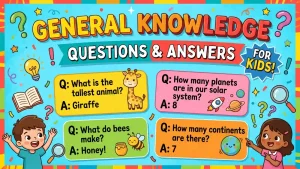
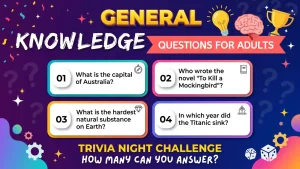
Important general knowledge questions are questions about useful facts from science, history, geography and daily life. They help you test your knowledge, prepare for exams and quizzes, and stay informed. This guide gives you important general knowledge questions with answers to revise key facts.
Definition & Meaning of Important General Knowledge Questions
Important general knowledge questions are questions about useful facts from different areas of life. They help people learn about the world, understand basic ideas, and test what they already know.
These questions do not always require special training. Many are based on facts that people can learn through reading, school lessons, news, and daily experiences.
For example, a general knowledge question may ask about the capital of a country, the human body, a famous historical event, or a planet in our solar system.
The main goal of general knowledge questions is to build awareness and encourage learning.
Examples of Important General Knowledge Questions
Here are some common questions with their answers.
- What is the capital of France?
Answer: Paris. - Which planet is known as the Red Planet?
Answer: Mars. - What is the largest ocean in the world?
Answer: The Pacific Ocean. - How many days are there in a leap year?
Answer: 366 days. - Which gas do plants absorb from the air during photosynthesis?
Answer: Carbon dioxide. - Who wrote the play Romeo and Juliet?
Answer: William Shakespeare. - What is the largest mammal in the world?
Answer: The blue whale. - Which organ pumps blood around the human body?
Answer: The heart. - What is the currency of Japan?
Answer: The Japanese yen. - How many continents are commonly taught in the seven-continent model?
Answer: Seven.
Why Are These Questions Important?
General knowledge questions help people learn facts from many subjects. They also support reading, thinking, and problem-solving skills.
Students can use them to prepare for exams. Adults can use them to stay informed and take part in conversations. Families can use them to enjoy quiz games together.
For example:
Ali: Which planet is closest to the Sun?
Sara: Mercury!
Ali: Correct. You remembered that well.
This simple exchange makes learning enjoyable. It also shows how questions can help people share knowledge with others.
Background & History of General Knowledge Questions
People have shared knowledge for thousands of years. In the past, much learning took place through stories, spoken lessons, books, and discussions. Elders passed facts and skills to younger people. Teachers helped students understand the world around them.
As schools and libraries developed, people gained more ways to learn. Books about science, geography, history, and culture made information easier to study.
General knowledge became an important part of education. Schools began using questions to check what students had learned. Teachers asked about famous people, important events, countries, and scientific facts.
The Rise of Quizzes
Quiz questions became popular in classrooms, newspapers, magazines, and social clubs. They gave people a simple way to test their knowledge.
Radio and television later helped quizzes reach larger audiences. Many people began watching quiz shows to answer questions and learn new facts.
These shows often covered topics such as history, sports, music, science, and world geography.
General Knowledge in the Digital Age
The internet changed how people learn and test their knowledge. Today, websites, mobile apps, online videos, and social media provide many types of quizzes.
People can answer questions on their phones or computers. Some quizzes offer scores, timers, and leaderboards. Others explain the correct answers so users can learn from mistakes.
Online learning has also made general knowledge more accessible to people around the world.
For example:
Teacher: What is the largest planet in our solar system?
Student: Jupiter.
Teacher: Correct. Jupiter is the largest planet in our solar system.
This type of question can now appear in a classroom, an online quiz, or a learning app.
Today, important general knowledge questions remain a simple way to learn, revise facts, and explore new subjects.
Usage in Various Contexts
Important general knowledge questions are useful in many parts of daily life. They can help people study, prepare for tests, enjoy games, and learn about current and past events.
1. In Education
Teachers use general knowledge questions to check what students know. These questions can also help students revise lessons.
Example:
Teacher: Which is the largest continent by land area?
Student: Asia.
Teacher: Correct!
Students can practice these questions before school tests and quiz competitions.
2. In Daily Conversations
General knowledge can make conversations more interesting. Friends and family members often share facts or ask each other simple questions.
Example:
Ahmed: Do you know which animal is the tallest in the world?
Hina: Is it the giraffe?
Ahmed: Yes, it is!
Questions like these can start friendly discussions and help people learn together.
3. On Social Media
Many social media pages share daily quiz questions. Users can answer in comments, join polls, or challenge friends.
For example:
Question: Which country is famous for the ancient pyramids of Giza?
Answer: Egypt.
Quiz posts can help people discover new facts while using social media.
4. In Gaming
General knowledge is also used in trivia games and quiz competitions. Players answer questions to earn points and move to the next level.
Example:
Player 1: What is the fastest land animal?
Player 2: The cheetah!
These games make learning feel like entertainment.
5. In Job Interviews and Competitive Exams
Some interviews and exams include general awareness questions. These may cover history, geography, science, or important national and international events.
Candidates should check the exam syllabus because the required topics can vary.
Using general knowledge in different settings helps people practice recall, build confidence, and learn about new subjects.
Common Misconceptions & Clarifications
People sometimes misunderstand the purpose of general knowledge questions. They may think these questions are only for students or that everyone should know every answer. Neither idea is correct.
Misconception 1: General Knowledge Is Only for Students
General knowledge is useful for people of all ages. Children can learn basic facts, while adults can explore history, science, technology, and current affairs.
There is always something new to learn.
Misconception 2: Everyone Must Know Every Answer
No one knows everything. People have different interests and experiences. Someone may know a lot about sports but know less about astronomy.
Not knowing an answer is a chance to learn, not a reason to feel embarrassed.
Misconception 3: General Knowledge Never Changes
Some facts stay the same, such as the basic structure of the solar system. Other information changes over time.
For example, population figures, political leaders, world records, and scientific findings may change. It is important to check reliable and recent sources when a question involves current information.
Misconception 4: Hard Questions Are Always Better
Difficult questions can be fun, but easy questions are valuable too. Basic questions help learners build a strong foundation.
A good quiz includes a mix of easy, medium, and hard questions.
Misconception 5: Memorizing Facts Is the Only Goal
Memorization is useful, but understanding matters too. Knowing why something happens can help people remember it and use the information correctly.
For example, learning that plants absorb carbon dioxide is helpful. Understanding how plants use it during photosynthesis provides deeper knowledge.
Misconception 6: Every Online Answer Is Correct
Online quizzes may contain errors or outdated information. Always check facts against trusted educational sources, especially when an answer seems unusual.
The best way to improve general knowledge is to stay curious, ask questions, and check facts carefully.
Similar Terms & Alternatives
Several terms are closely related to important general knowledge questions. However, each term can have a slightly different meaning.
1. General Knowledge Quiz Questions
These are questions used in a quiz to test knowledge across different subjects.
Example: Which planet is famous for its rings?
Answer: Saturn.
2. General Knowledge Questions and Answers
This phrase refers to questions presented with their correct answers. It is useful for learners who want to study without taking a formal test.
Example:
Question: What is the capital of Italy?
Answer: Rome.
3. Trivia Questions
Trivia questions usually focus on interesting or lesser-known facts. They often appear in games and entertainment.
Example: What is the name of the toy cowboy in Toy Story?
Answer: Woody.
4. Current Affairs Questions
These questions cover recent events, news, politics, sports, and other changing topics.
Example: Which country hosted a particular international event?
The answer depends on the event and year.
5. Educational Questions
Educational questions help learners understand a specific subject. They may test memory, understanding, or problem-solving.
Example: Why does ice float on water?
Answer: Ice is less dense than liquid water.
6. Brain Teasers
Brain teasers challenge people to solve puzzles or think in unusual ways. They may depend more on logic than on stored facts.
Example: What has hands but cannot clap?
Answer: A clock.
Comparison Table
| Term | Main purpose | Example topic |
| General knowledge questions | Test broad knowledge | Countries and capitals |
| Trivia questions | Share interesting facts | Movies and unusual facts |
| Current affairs questions | Test recent awareness | Recent world events |
| Educational questions | Support learning | Science and maths |
| Brain teasers | Challenge logical thinking | Puzzles and patterns |
These terms can overlap. A general knowledge quiz may include trivia, educational questions, and brain teasers in the same activity.
How to Respond to General Knowledge Questions
Answering general knowledge questions can feel easy when you know the topic. It can feel harder when you are unsure. The best response depends on the situation.
1. Give a Direct Answer
If you know the answer, respond clearly.
Friend: What is the capital of Japan?
You: Tokyo.
A short answer is often enough.
2. Explain Your Answer
In a classroom or group discussion, you may want to add a little detail.
Friend: Which planet is known as the Red Planet?
You: Mars. Its surface looks reddish because of iron-rich dust and rocks.
This response shares both the answer and a useful fact.
3. Admit When You Do Not Know
You do not need to guess every time.
Friend: Which is the smallest country in the world by area?
You: I am not sure. Let me check.
This is an honest and sensible response.
4. Make It Fun
When playing with friends, a funny response can keep the mood light.
Friend: What is the largest ocean?
You: I should know this! Is it the Pacific Ocean?
Friend: Correct!
Humor can make a quiz more enjoyable, as long as it stays friendly.
5. Ask for a Hint
If a question is difficult, ask for a clue.
Friend: Which scientist developed the theory of general relativity?
You: Can I have a hint?
Friend: He was a famous physicist with the surname Einstein.
You: Albert Einstein!
6. Respond Professionally
During an interview or formal quiz, stay calm and give a clear answer. If you are unsure, explain that you would like to verify the information rather than invent an answer.
Tips for Better Answers
- Read the full question before answering.
- Pay attention to words such as largest, first, current, and oldest.
- Take a moment to think.
- Avoid rushing when a question has several parts.
- Learn from incorrect answers.
- Check changing facts before using them.
Confidence grows with practice. You do not need to know every answer to become better at general knowledge.
Regional or Cultural Differences
General knowledge questions are popular around the world, but the topics may differ by country and culture. What people consider important can depend on their education, history, language, and daily lives.
1. National History and Culture
Many countries include questions about their own history, leaders, national symbols, and famous people.
For example, a quiz in Pakistan may ask about the country’s independence, national poet, major rivers, or capital city. A quiz in France may focus on French history, landmarks, and cultural figures.
These questions help people understand their national identity and heritage.
2. Geography
Some quizzes focus on nearby countries, local cities, rivers, mountains, and borders. Others focus on world geography.
For example:
Teacher: What is the capital of Pakistan?
Student: Islamabad.
Teacher: Correct!
A world geography quiz may also ask about the capitals of Brazil, Egypt, or Japan.
3. Language Differences
General knowledge questions can be translated into many languages. The facts may remain the same, but the wording can change.
For example, the English question “What is the largest ocean?” can be asked in Urdu or another language. The answer remains the Pacific Ocean.
Translation should be clear so learners understand exactly what the question asks.
4. Cultural Awareness
Some questions involve food, festivals, traditions, sports, or famous works of art. People from different backgrounds may know different facts about these subjects.
A good quiz should avoid assuming that everyone shares the same experiences.
5. Local and Global Knowledge
Local questions are useful because they help people learn about their communities. Global questions help them understand the wider world.
A balanced quiz can include both.
General knowledge becomes more useful when it respects cultural differences and encourages people to learn about places beyond their own communities.
Comparison with Similar Terms
Important general knowledge questions are related to several other types of questions. Understanding the differences can help you choose the right quiz for your needs.
| Feature | General Knowledge | Trivia | Current Affairs | Subject Quiz |
| Main focus | Broad facts | Interesting facts | Recent events | One subject |
| Topics | History, science, geography, and more | Entertainment and unusual facts | News and public events | Maths, biology, or history |
| Information changes? | Some facts change | Depends on the fact | Often changes | Depends on the subject |
| Common use | Learning and quizzes | Games and fun | Exams and awareness | School and study |
| Example | What is the largest ocean? | Which character lives in a pineapple under the sea? | Who won a recent election? | What is photosynthesis? |
Which Type Should You Choose?
Choose general knowledge questions when you want to explore different subjects.
Choose trivia questions when you want a fun challenge with friends or family.
Choose current affairs questions when you want to learn about recent events. Use updated and trusted sources for these questions.
Choose a subject quiz when you need to prepare for a school test or improve a specific skill.
You can also combine these formats to create a more interesting quiz. For example, a classroom competition could include geography, science, sports, history, and a few brain teasers.
Usage in Online Communities & Dating Apps

General knowledge questions are common in online communities, quiz groups, learning apps, and gaming platforms. They can help people connect, share interests, and enjoy friendly competition.
1. Social Media Communities
People often post daily questions on platforms such as X, Facebook, Instagram, and other social networks.
Example:
Post: Which planet is the largest in our solar system?
Comment: Jupiter!
Other users may add explanations or suggest new questions. These posts can encourage learning and discussion.
2. Online Quiz Groups
Some online communities focus on daily challenges, educational facts, and quiz competitions. Members may answer questions, compare scores, and share resources.
Always check the source of unusual claims before repeating them.
3. Gaming Communities
Trivia games allow players to compete by answering questions within a time limit. Some games cover many topics, while others focus on areas such as movies, sports, or science.
Example:
Player 1: What is the chemical symbol for gold?
Player 2: Au!
Player 1: Correct!
These short challenges can make online gaming more educational.
4. Dating Apps and Getting to Know People
On dating apps such as Tinder, people sometimes use light questions to start conversations. General knowledge questions can be a fun choice when both people enjoy quizzes.
For example:
Person A: Quick quiz: What is the largest planet?
Person B: Jupiter. Your turn to ask me one!
This can lead to a friendly exchange. However, not everyone enjoys being tested, so keep the questions light and optional.
Online Safety Tips
- Do not share private information to join a quiz.
- Avoid suspicious links that promise prizes.
- Be respectful when someone gives a wrong answer.
- Do not use questions to embarrass or insult others.
- Check the facts before sharing quiz posts.
Online quizzes are most enjoyable when they bring people together and make learning feel easy.
Hidden or Offensive Meanings
The phrase “important general knowledge questions” has no widely recognized offensive meaning. It normally refers to useful questions about facts, education, and the world.
However, the way a question is asked can affect how another person feels.
1. Questions That Make People Feel Embarrassed
Some people may use basic questions to make others feel uninformed.
For example:
Person A: You do not know the capital of France? Everyone knows that!
This response sounds rude because it judges the person instead of helping them learn.
A kinder response would be:
Person A: It is Paris. Now you know!
2. Sensitive Cultural Topics
Questions about religion, ethnicity, politics, or cultural practices can be sensitive. They should be worded with care and based on reliable information.
Avoid questions that rely on stereotypes or treat one culture as better than another.
3. Incorrect or Misleading Questions
A quiz may contain an outdated answer or a question with more than one possible interpretation. For example, questions about the world’s largest city may depend on whether the source measures city boundaries, urban areas, or metropolitan populations.
When a question seems unclear, explain what definition you are using.
4. Jokes and Sarcasm
Friends may joke about wrong answers, but jokes can hurt when they sound insulting. Consider your audience and keep the tone friendly.
5. Respectful Learning
The purpose of general knowledge questions should be to teach, test, and entertain. They should not be used to shame people or spread false information.
Context matters. A question can be useful and respectful when it invites learning rather than judgment.
Suitability for Professional Communication
Important general knowledge questions can be useful in professional settings, especially during interviews, training sessions, meetings, and team-building activities.
However, the questions should match the purpose of the discussion.
1. Job Interviews
Some employers ask general awareness questions to assess a candidate’s knowledge or ability to discuss relevant topics. The exact questions depend on the role and employer.
Candidates should review the job description and prepare for relevant subjects.
2. Workplace Training
Trainers can use short quizzes to check whether employees understand new information.
For example:
Trainer: Which password is safer: a short common word or a long, unique password?
Employee: A long, unique password.
Trainer: Correct. It is harder to guess.
This type of question can support practical learning.
3. Team-Building Activities
A general knowledge quiz can help colleagues interact in a relaxed setting. Questions about geography, science, literature, and sports can encourage teamwork.
Make sure the topics are suitable for everyone taking part.
4. Professional Writing
When discussing general knowledge in reports, emails, or presentations, use clear language. Avoid slang and jokes if the subject is formal.
For example:
Informal: “Let’s see who knows the most random facts!”
Professional: “Let’s begin with a short general knowledge quiz to encourage participation and review key facts.”
5. Accuracy and Credibility
In professional communication, it is important to verify information. Avoid presenting guesses as facts, especially when the information affects a decision.
General knowledge questions are suitable for professional settings when they are relevant, accurate, respectful, and easy to understand.
FAQs About Important General Knowledge Questions
They are questions about useful facts from many subjects, such as science, history, geography, sports, and everyday life.
Students, job seekers, and curious readers. They help in exams, interviews, quizzes, and daily conversations.
A small daily goal works best. Learn five to ten questions with answers each day and revise them weekly.
They overlap. Trivia is often about fun or unusual facts, while important general knowledge questions focus on facts that are useful for study, exams, and everyday awareness.
Practise with quizzes, revise in short daily sessions, and connect each fact to something you already know. Regular revision keeps facts fresh.
Keep exploring: try our quiz games with answers for extra practice, revise exam preparation questions before a test, and browse general knowledge questions with answers to strengthen your basics.
Conclusion
Important general knowledge questions are a simple way to learn about the world. They cover many topics, including science, history, geography, sports, and culture. They can help students prepare for exams, adults learn new facts, and families enjoy quiz games.
You do not need to know every answer to benefit from general knowledge. The key is to stay curious, ask questions, and learn from mistakes. Even a few questions each day can help you build knowledge over time.
You can practice with friends, join online quiz groups, or create your own questions. Start with easy facts and move on to harder topics as your knowledge grows.
Remember to check your answers with reliable sources, especially when information changes over time.
The more you learn, the more you discover. Make general knowledge a daily habit, enjoy the process, and keep exploring the world one question at a time.

Thomas Mitchell is a writer at New Learn Knowledge, sharing clear and useful educational content.
He enjoys creating simple guides and informative articles that help readers learn and discover new knowledge.