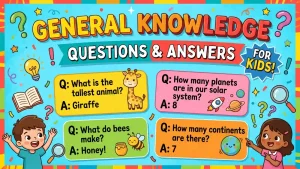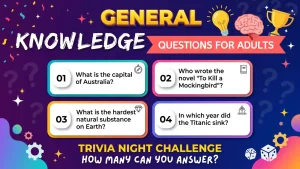
General knowledge test questions check what you know across science, history, geography, sports and daily life. They help you measure your progress and find weak areas. Take this test to check your score.
Hey, I want to share something that happened to me recently while trying general knowledge test questions.
I was chatting with a friend when they asked me a question, and honestly, I had no clue what the answer was at first.
I kept wondering, “Am I missing something here?” It was a bit confusing, and I wanted to find the right answer.
So, I decided to practice general knowledge test questions and learn more about different topics.
As I practiced, I realized how useful these tests can be.
They help us check what we know, improve our memory, and learn new facts about the world.
Now, I feel more confident whenever I face a general knowledge test at school, prepare for an exam, or take part in a quiz with friends.
Definition & Meaning of General Knowledge Test Questions
General knowledge test questions are questions that check what a person knows about different subjects. They cover facts about the world, people, places, events, and everyday life.
Unlike tests that focus on one school subject, general knowledge tests include many topics. A single quiz may ask about planets, famous leaders, world capitals, animals, inventions, or sports.
For example:
- Geography: What is the capital of Japan?
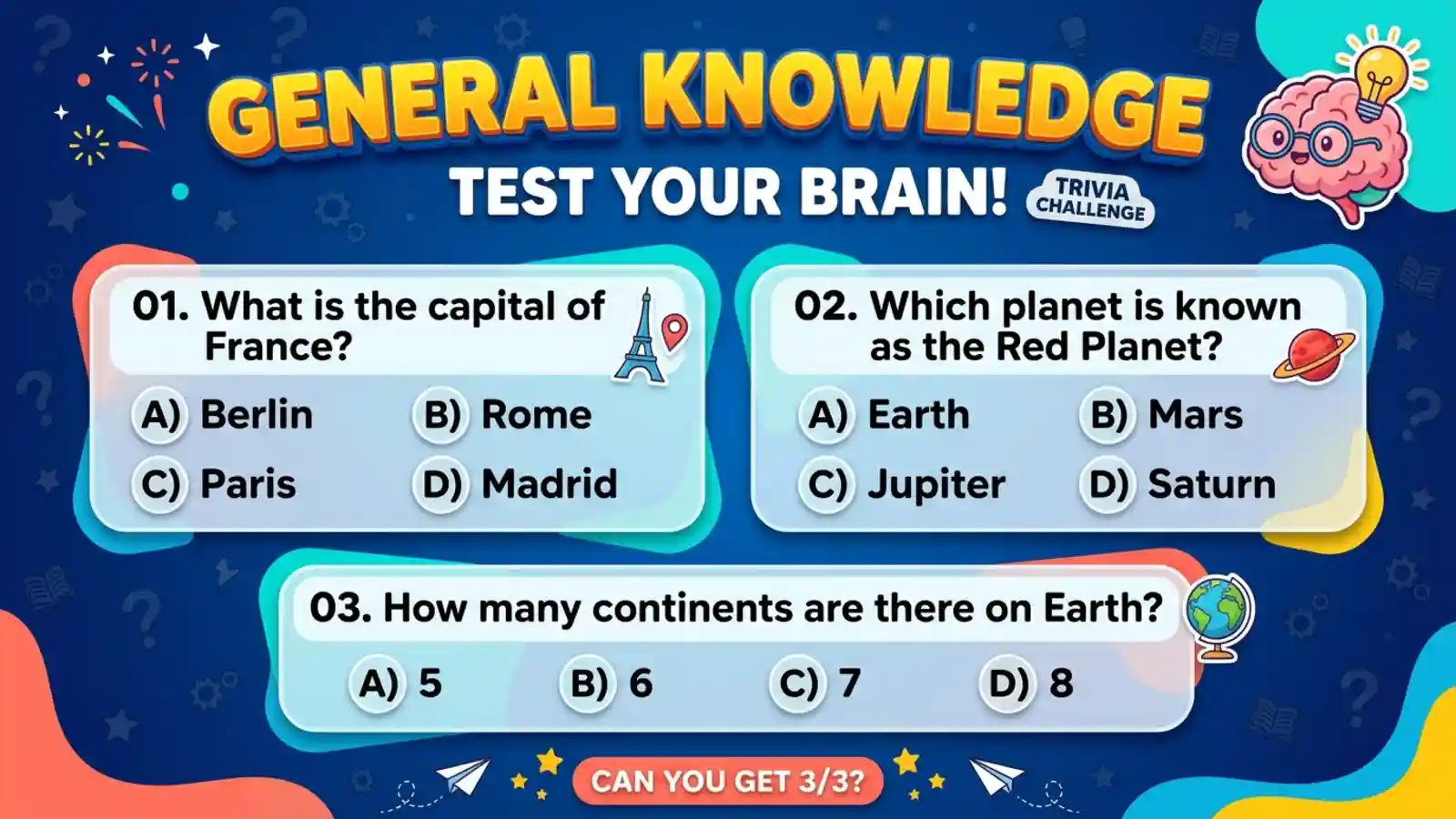
- Science: Which planet is known as the Red Planet?
- History: Who was the first person to walk on the Moon?
- Sports: How many players are on a soccer team on the field?
- Nature: What is the largest animal in the world?
- Literature: Who wrote Romeo and Juliet?
These questions help people check their knowledge and discover what they still need to learn.
What Makes a Good General Knowledge Question?
A good question should be clear, simple, and based on a reliable fact. It should also have an answer that can be checked.
For example:
Question: What is the largest ocean on Earth?
Answer: The Pacific Ocean.
This question tests basic knowledge about geography. It has one clear answer.
Some questions may need more thought. For example, a question about the causes of a historical event may have several parts to its answer. These questions test both knowledge and understanding.
Different Types of General Knowledge Questions
General knowledge tests can include several types of questions.
1. Multiple-choice questions
These questions offer a list of answers.
Example:
Which planet is closest to the Sun?
A. Earth
B. Mercury
C. Mars
D. Jupiter
Answer: B. Mercury
2. True or false questions
These ask you to decide whether a statement is correct.
Example: The Earth moves around the Sun.
Answer: True.
3. Short-answer questions
These require a brief answer.
Example: What is the capital of France?
Answer: Paris.
4. Picture-based questions
These ask you to identify an object, person, animal, or place from an image.
5. Hard general knowledge questions
These test deeper knowledge of science, history, geography, and other subjects.
General knowledge test questions are useful for people of all ages. They can support learning, improve recall, and make education more enjoyable.
Background & History of General Knowledge Tests
People have tested knowledge for thousands of years. In ancient societies, teachers, scholars, and leaders asked questions to check what others had learned. These early methods helped people share ideas and pass knowledge from one generation to the next.
In ancient China, civil service examinations became an important way to select government officials. These exams tested knowledge of classical texts and other subjects. They were not the same as modern general knowledge quizzes, but they showed how questions could be used to assess learning.
As schools developed, written tests became more common. Teachers used questions to check whether students understood lessons in subjects such as mathematics, history, language, and science.
Over time, quizzes became popular outside schools as well.
The Growth of Quiz Culture
Newspapers and magazines helped make trivia questions popular with the public. Readers enjoyed solving puzzles, answering facts-based questions, and comparing their scores with others.
Radio and television later brought quizzes to a much larger audience. Game shows invited people to answer questions about history, science, entertainment, and everyday facts. Viewers could also play along at home.
These shows helped turn general knowledge into a form of entertainment.
General Knowledge Tests in the Digital Age
The internet has changed how people take quizzes. Today, anyone with a phone or computer can find thousands of general knowledge questions online.
Educational websites offer quizzes for students. Social media pages share short questions that encourage people to comment with answers. Mobile apps allow users to track scores and compete with friends.
For example:
Friend 1: Which is the largest planet in our solar system?
Friend 2: Jupiter!
Friend 1: Correct! Here comes the next question.
Online quizzes have also become popular in classrooms and workplaces. Teachers can use them to review lessons, while employers may use knowledge tests as part of training.
Today, general knowledge tests serve two main purposes: education and entertainment. They help people learn facts, check their progress, and enjoy friendly competition.
Usage of General Knowledge Test Questions in Various Contexts
General knowledge test questions can be used in schools, homes, workplaces, and online communities. Their purpose may change, but the main goal stays the same: to test knowledge and encourage learning.
1. In Schools and Classrooms
Teachers use general knowledge questions to review lessons and make learning more active. These questions can also help students prepare for quizzes and competitions.
Example:
Teacher: Which gas do plants absorb from the air?
Student: Carbon dioxide.
Teacher: Correct! Plants use it during photosynthesis.
Short quizzes can help students remember facts and find topics they need to study again.
2. During Family Gatherings
Families can use general knowledge questions to create fun games. Parents can ask children easy questions, while adults can try harder ones.
Example:
Dad: Which animal is known as the king of the jungle?
Child: The lion!
Dad: That’s right. Can you name another wild animal?
This type of game can make family time more enjoyable.
3. On Social Media
People often share quiz questions on platforms such as Facebook, Instagram, and X. Some posts ask users to choose an answer or leave a comment.
Example:
Post: Which country is famous for the pyramids of Giza?
Comment 1: Egypt!
Comment 2: I knew this one!
These posts can encourage discussion and help people learn new facts.
4. In Online Games
Trivia games let players answer questions to earn points, unlock levels, or beat other players.
Example:
Player 1: I got the history question right!
Player 2: Nice! Let’s see if you can answer the science question.
These games combine learning with competition.
5. In Job Preparation
Some job tests include general knowledge questions, especially when candidates need broad awareness of current affairs, history, geography, or public information.
For example, a candidate preparing for a public service exam may study national facts and world events.
However, the topics depend on the job and the exam. Not every employer uses general knowledge tests.
6. For Personal Learning
You can answer a few questions every day to build your knowledge. You might focus on one subject each week, such as science, geography, or history.
A simple daily routine can help you learn without feeling overwhelmed.
Common Misconceptions & Clarifications
People sometimes misunderstand the purpose of general knowledge test questions. Knowing the facts about these tests can help you use them in a better way.
Misconception 1: General Knowledge Tests Are Only for Students
This is not true. Students use these tests for schoolwork, but adults can enjoy them too.
General knowledge questions are useful for anyone who wants to learn more about the world. They can also help people prepare for competitions, interviews, and exams.
Misconception 2: You Must Know Everything to Score Well
No one knows every fact. General knowledge covers a wide range of subjects, so it is normal to be strong in some areas and weak in others.
For example, you may know many facts about sports but struggle with astronomy. A quiz can show you where to improve.
The goal is not to know everything. The goal is to keep learning.
Misconception 3: General Knowledge Questions Are Always Easy
Some questions test basic facts, while others require detailed knowledge.
For example:
- Easy: How many days are in a week?
- Medium: Which country has the city of Kyoto?
- Hard: What is the name of the process by which plants lose water vapor through their leaves?
The difficulty depends on the topic and the knowledge needed to answer.
Misconception 4: A Wrong Answer Means You Failed
A wrong answer can be a useful learning moment. When you discover the correct answer, you have a chance to remember it for the future.
For example:
Quiz host: What is the smallest planet in our solar system?
Player: Mars?
Quiz host: The correct answer is Mercury.
The player can now remember this fact for the next quiz.
Misconception 5: All Online Quiz Answers Are Correct
Not every website provides accurate information. Some questions may contain outdated facts, unclear wording, or incorrect answers.
Always check important facts against reliable sources, such as educational institutions, museums, or official websites.
Misconception 6: General Knowledge Is the Same as Intelligence
A quiz score measures performance on a particular set of questions. It does not measure every part of a person’s intelligence, creativity, judgment, or ability to solve problems.
Someone may have a low score on a history quiz but excellent practical skills.
Use test results to guide your learning, not to judge your worth.
Similar Terms & Alternatives
Several terms are related to general knowledge test questions. They may sound similar, but each can have a slightly different meaning.
1. General Knowledge Quiz Questions
These are questions used in a quiz to test knowledge across different subjects.
Example: Which is the largest continent?
Answer: Asia.
This phrase is useful when searching for online quizzes or quiz games.
2. Trivia Questions
Trivia questions usually focus on interesting facts about people, places, events, entertainment, and everyday life.
Example: What is the name of Harry Potter’s school?
Answer: Hogwarts.
Trivia often has a fun or entertaining purpose.
3. General Awareness Questions
General awareness questions often focus on public affairs, current events, society, government, and important developments.
They are common in some competitive exams and job preparation materials.
4. Knowledge Assessment Questions
These questions are used to check how much a person understands about a subject or topic.
Teachers, trainers, and organizations may use them to measure learning.
5. Practice Test Questions
Practice test questions help people prepare for a real exam. They often follow the format or difficulty of the actual test.
For example, a student may use practice questions before taking a school science exam.
6. Brain Teasers
Brain teasers focus more on reasoning, patterns, or creative thinking than on recalling general facts.
Example: What has hands but cannot clap?
Answer: A clock.
7. Current Affairs Questions
These questions focus on recent events in politics, business, science, sports, and other areas.
Their answers may change over time, so it is important to check the date and source.
How to Respond to General Knowledge Test Questions
Your response depends on the type of question, your confidence, and the situation. You may answer directly, ask for a hint, or explain that you do not know.
1. Give a Direct Answer
If you know the answer, keep it simple.
Question: What is the capital of Italy?
You: Rome.
This works well in quizzes, classrooms, and casual conversations.
2. Explain Your Answer
Some questions need more than one word. A short explanation can show that you understand the topic.
Question: Why do we see lightning before hearing thunder?
You: Light travels faster than sound, so we see the flash first.
3. Ask for a Hint
If you are unsure, ask for help rather than guessing without thinking.
Friend: Which planet has the most prominent ring system?
You: Can I get a hint?
This keeps the game fun and gives you a chance to learn.
4. Admit You Do Not Know
There is nothing wrong with not knowing an answer.
You can say:
- “I’m not sure.”
- “I don’t know this one yet.”
- “That’s a good question. Let me learn about it.”
- “I need to study this topic more.”
These responses show honesty and a willingness to learn.
5. Respond With Humor
When playing with friends, a light joke can make the quiz more enjoyable.
Friend: What is the largest planet in our solar system?
You: I was going to say Earth, but I think Jupiter has us beat!
Humor works best when everyone understands that you are joking.
6. Respond in a Professional Setting
During a job interview or formal assessment, answer clearly and avoid unnecessary jokes.
Interviewer: Which organization is responsible for maintaining international peace and security?
Candidate: The United Nations Security Council has primary responsibility for maintaining international peace and security under the UN Charter.
A precise answer is often better than a long, uncertain explanation.
7. Correct a Mistake Politely
If another person gives an incorrect answer, explain the correct fact without making them feel embarrassed.
You might say, “I think the answer is Mercury. It is the closest planet to the Sun.”
The aim is to share knowledge, not to win an argument.
Regional or Cultural Differences
General knowledge questions are used around the world, but the topics and expected answers can differ by country and culture.
Some facts are widely taught across the world. Questions about planets, basic mathematics, and major scientific discoveries often appear in international quizzes.
Other questions depend on local history, language, traditions, or education systems.
1. National History and Culture
A quiz in Pakistan may include questions about Pakistan’s independence, national symbols, important leaders, and major historical events.
A quiz in the United States may include questions about American presidents, the Constitution, and national history.
Similarly, quizzes in India may cover Indian history, geography, festivals, and important public figures.
These differences help make quizzes relevant to local audiences.
2. Language Differences
The same question can be written in different languages.
For example:
- English: What is the capital of Japan?
- Urdu: جاپان کا دارالحکومت کیا ہے؟
Both questions ask for the same fact. The answer is Tokyo.
However, translations must be clear. A poorly translated question can confuse people or change its meaning.
3. Different School Curricula
Students in different countries may study different historical events, authors, leaders, and scientific topics.
As a result, a question that seems easy to one group may be unfamiliar to another.
This does not mean one group is more knowledgeable. It may simply mean that they have learned different things.
4. Local and Global Knowledge
A balanced quiz can include both local and international questions.
For example, a quiz for Pakistani students might include questions about Pakistan’s provinces, world capitals, major rivers, and space exploration.
This helps students build local awareness while learning about the wider world.
5. Avoiding Cultural Bias
Quiz writers should use respectful language and avoid questions that treat one culture as better than another.
They should also explain answers when a topic has different cultural interpretations.
A good general knowledge test helps people learn about both their own communities and the rest of the world.
Comparison With Similar Terms
General knowledge tests, trivia quizzes, aptitude tests, and subject tests all use questions, but they serve different purposes.
| Type | Main purpose | Example |
| General knowledge test | Checks knowledge across many subjects | What is the capital of Canada? |
| Trivia quiz | Tests interesting facts, often for fun | Which animal is the tallest in the world? |
| Aptitude test | Measures certain skills or abilities | What number comes next in a pattern? |
| Subject test | Checks knowledge of one subject | What is photosynthesis? |
| Current affairs quiz | Tests knowledge of recent events | Which country hosted a recent international summit? |
| IQ-style reasoning test | Tests selected reasoning skills | Which shape completes the pattern? |
| Practice exam | Helps prepare for a specific test | Answer a sample driving theory question |
General Knowledge Test vs. Trivia Quiz
A general knowledge test may be used for learning, exam preparation, or assessment. A trivia quiz is often designed for entertainment, although it can also be educational.
General Knowledge Test vs. Aptitude Test
A general knowledge test asks what you know. An aptitude test focuses on particular abilities, such as reasoning, numerical skills, or pattern recognition.
General Knowledge Test vs. Subject Test
A general knowledge test covers several areas. A subject test focuses on one field, such as biology, history, or mathematics.
General Knowledge Test vs. Current Affairs Quiz
General knowledge questions can include facts that remain stable for many years. Current affairs questions focus on recent developments and may need frequent updates.
Choosing the right type of test depends on your goal. If you want to learn about many topics, choose a general knowledge quiz. If you need to prepare for a specific exam, choose practice questions that match its syllabus.
Usage in Online Communities & Dating Apps

General knowledge test questions are popular online because they are easy to share and answer. People use them in social media posts, gaming groups, discussion forums, and even casual conversations on dating apps.
1. Social Media Challenges
Quiz pages often post questions and ask followers to comment with their answers.
For example:
Post: Which planet is known as the Red Planet?
Comment: Mars! This one was easy.
These posts can start conversations and encourage friendly competition.
2. Online Trivia Communities
Trivia communities allow users to test their knowledge, share interesting facts, and challenge other players.
Some communities focus on history or science, while others cover movies, music, sports, and geography.
Members may discuss why an answer is correct or share sources to support a claim.
3. Gaming Communities
Many online games include trivia rounds or knowledge challenges. Players may work alone or in teams to earn points.
For example:
Player 1: I know the answer to the geography question!
Player 2: Go ahead. Let’s see if you’re right.
Friendly competition can make learning more exciting.
4. Dating Apps and Icebreakers
On dating apps such as Tinder, simple quiz questions can help people start a conversation. They are not a standard feature of every dating app, but users can ask their own questions in messages.
For example:
Person 1: Quick quiz: Which country has the city of Rome?
Person 2: Italy. Do I get a prize?
Person 1: Yes, one more question!
This approach can make a conversation feel relaxed and playful.
5. Tips for Using Quiz Questions Online
- Keep questions short: Simple questions are easier to answer in a message.
- Choose suitable topics: Avoid questions that may embarrass or upset someone.
- Do not judge people by their scores: A quiz is only a small test of knowledge.
- Check your facts: Make sure your answer is correct before sharing it.
- Keep the tone friendly: A quiz should invite conversation, not create pressure.
General knowledge questions can help people connect online. The best questions are clear, interesting, and fun to answer.
Hidden or Offensive Meanings
The phrase “general knowledge test questions” has no common hidden or offensive meaning. It refers to questions that test knowledge across a range of subjects.
However, the way people ask or use these questions can affect how others feel.
1. Questions Used to Embarrass Others
Some people use quizzes to make others feel uninformed. They may ask very difficult questions in public and laugh when someone gets the answer wrong.
For example:
Person 1: You don’t know that? Everyone knows it!
Person 2: I haven’t studied that topic yet.
This kind of response can make a learning activity feel unpleasant.
A better approach is to treat mistakes as part of learning.
2. Questions With Biased Assumptions
A quiz may include questions based on stereotypes or unfair assumptions about a country, culture, gender, or group of people.
Such questions can spread misinformation or make people feel excluded.
Quiz writers should use reliable sources and respectful wording.
3. Ambiguous Questions
Some questions have more than one possible answer because they are not worded clearly.
For example, asking “What is the biggest country?” could refer to land area, population, or another measure.
A clearer version is: “Which country has the largest land area?”
This wording makes the expected answer easier to identify.
4. Outdated Information
Some facts change over time. Population rankings, office holders, world records, and current affairs may become outdated.
Quiz writers should check dates and update questions when needed.
5. Tone Matters
A question asked with kindness can encourage learning. The same question asked in a mocking tone can cause embarrassment.
General knowledge questions are best used to share facts, encourage curiosity, and help people improve.
Suitability for Professional Communication
General knowledge test questions can be useful in professional settings, especially in education, recruitment, training, and team-building activities.
However, the way they are used should match the purpose of the situation.
1. In Job Interviews
Some employers ask general knowledge questions to assess awareness of relevant topics. This may be useful for certain roles, exams, or industries.
For example, an interviewer may ask about major industry developments or basic facts related to the job.
Candidates should answer honestly and clearly. If they do not know an answer, they should avoid making up facts.
2. In Workplace Training
Companies can use short quizzes to check whether employees understand training materials, safety rules, or company policies.
For example:
Trainer: What should you do if you receive a suspicious email?
Employee: Report it according to the company’s security policy and avoid opening suspicious links.
In this case, the questions support practical learning.
3. In Meetings and Team Activities
General knowledge quizzes can be used as light team-building activities. They may help employees relax and work together.
The questions should be suitable for everyone and should not make participation feel forced.
4. In Formal Documents
The phrase “general knowledge test questions” is suitable for formal educational materials, training guides, and exam-preparation websites.
You can use alternatives depending on the setting:
- General knowledge assessment questions
- General knowledge practice test
- Knowledge evaluation questions
- General awareness assessment
- General knowledge examination
For example, a teacher might write, “Complete the general knowledge assessment to review your understanding.”
5. Professional Communication Tips
When creating a professional quiz:
- Use clear and direct language.
- Check every answer for accuracy.
- Make the difficulty suitable for the audience.
- Avoid biased or misleading questions.
- Explain answers when useful.
- Focus on learning rather than embarrassment.
General knowledge tests can support professional learning when the questions are relevant, fair, and well designed.
FAQs About General Knowledge Test Questions
General knowledge test questions check what you know about subjects such as science, history, geography, sports, nature, and world events.
They help you review facts, find gaps in your knowledge, improve recall, and learn about different topics. They can also support exam preparation and friendly quiz games.
Study a little each day. Read reliable educational sources, review important facts, take practice quizzes, and check the answers you get wrong.
Common topics include history, geography, science, literature, sports, technology, nature, famous people, and current affairs. The topics depend on the test.
Yes. Children can benefit from simple questions about animals, colors, planets, countries, and everyday life. Choose questions that match their age and learning level.
Start with topics you enjoy and practice regularly. Use short quizzes, read trusted sources, and review new facts. Learning a few facts each day can build your knowledge over time.
You can find them on educational websites, quiz platforms, school resources, books, and learning apps. Choose trustworthy sources and check answers when a fact seems unclear or outdated.
Conclusion
General knowledge test questions are a simple and enjoyable way to test what you know about the world. They cover many subjects, including science, history, geography, sports, and everyday life. Students can use them to review lessons, while adults can use them to keep learning and enjoy friendly challenges.
These tests come in many forms. Some use multiple-choice answers, while others ask for short answers, true-or-false choices, or deeper explanations. You can find them in classrooms, books, online quizzes, social media, and games.
The best way to improve is to practice often. Start with easy questions, explore new topics, and review your mistakes. Always use reliable sources to check your answers.
Remember, you do not need to know every fact. Every question is a chance to learn something new. Keep asking questions, stay curious, and enjoy the process of building your general knowledge one fact at a time.

Thomas Mitchell is a writer at New Learn Knowledge, sharing clear and useful educational content.
He enjoys creating simple guides and informative articles that help readers learn and discover new knowledge.