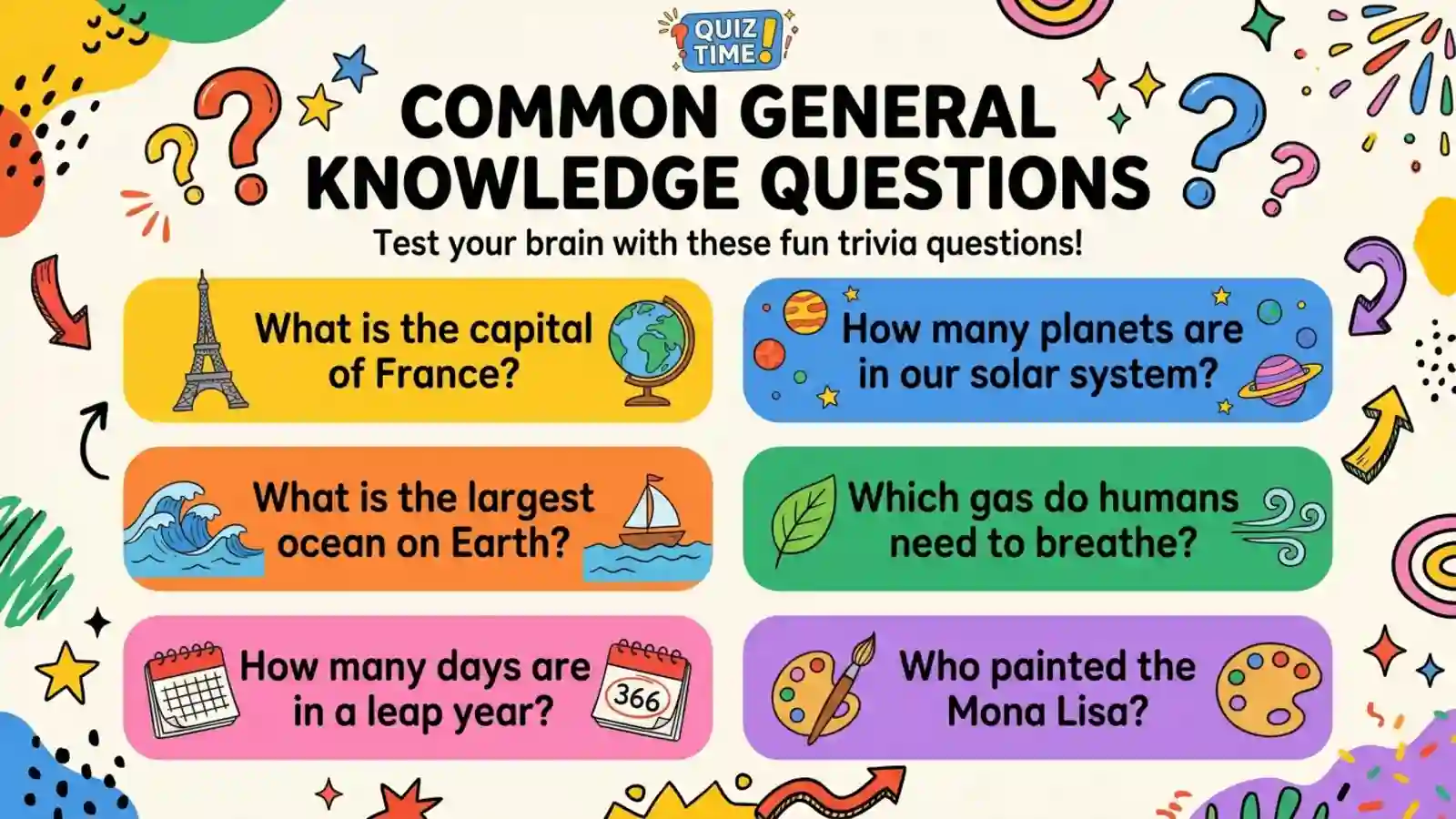
Common general knowledge questions cover facts most people meet in school, work and daily life. They help you revise the basics and stay informed. Use this set to test yourself on everyday facts.
Hey, I want to share something that happened to me recently while exploring common general knowledge questions.
I was chatting with a friend when they asked me a simple question, and honestly, I had no clue what the answer was at first.
I kept wondering, “Am I missing something here?” It was a bit confusing, and I wanted to find the right answer.
So, I decided to explore common general knowledge questions and learn more about their answers.
As I practiced, I realized how useful these questions are in daily life. They help us learn new facts, improve our memory, and build confidence.
Now, I feel more prepared whenever someone asks me a general knowledge question at school, at work, or on social media.
Definition & Meaning of Common General Knowledge Questions
Common general knowledge questions are questions about facts that many people learn through school, reading, daily life, and personal experience. They cover a wide range of subjects and do not usually require expert knowledge.
These questions help test what a person knows about the world. They may ask about countries, famous people, historical events, science, nature, sports, or important inventions.
For example:
- Geography: What is the capital of Japan?
- Science: Which planet is known as the Red Planet?
- History: Who was the first person to walk on the Moon?
- Animals: What is the largest land animal?
- Sports: How many players are on a soccer team on the field?
- Nature: What do plants need to grow?
- Literature: Who wrote Romeo and Juliet?
The answers are Tokyo, Mars, Neil Armstrong, the African elephant, 11 players per team, and sunlight, water, and nutrients, respectively. William Shakespeare wrote Romeo and Juliet.
What Makes a General Knowledge Question Common?
A question is often called common when it covers a familiar fact that many people have a chance to learn. It may appear in school lessons, quiz books, TV shows, or online games.
For example, “How many days are there in a week?” is a common question because most people learn the answer at an early age.
However, a question that seems easy to one person may be difficult for another. People have different interests, educational backgrounds, and life experiences.
Why Are These Questions Useful?
Common general knowledge questions offer several benefits:
- Build knowledge: They help you learn new facts.
- Improve memory: They encourage you to recall information.
- Support education: They can help students review school topics.
- Start conversations: They give friends and family something fun to discuss.
- Build confidence: Knowing more facts can make quizzes easier.
For example:
Ali: Which is the largest ocean in the world?
Sara: The Pacific Ocean!
Ali: Correct. It is the largest ocean on Earth.
This short exchange shows how a simple question can make learning fun. You do not need to study for hours to improve your knowledge. Answering a few questions each day can help you learn over time.
Background & History of General Knowledge Questions
People have shared knowledge for thousands of years. Long before the internet, families, teachers, and communities passed facts from one generation to the next. They used stories, books, lessons, and conversations to teach people about the world.
As schools became more common, teachers began using questions to check what students had learned. Students answered questions about history, mathematics, geography, science, and language. This made questions an important part of education.
The Growth of Quizzes and Trivia
Quizzes have changed over time. In the past, people often tested their knowledge through spoken questions, written exams, and books. Later, newspapers and magazines began publishing puzzles, riddles, and trivia challenges.
Radio and television brought quiz shows into people’s homes. These programs allowed viewers to watch contestants answer questions about many subjects. They also made trivia a popular form of entertainment.
Board games and family quiz games became another way to share knowledge. Friends and relatives could compete, learn new facts, and enjoy time together.
The Internet Changed General Knowledge Learning
The internet made it much easier to find and answer general knowledge questions. People no longer need to visit a library or buy a quiz book to learn basic facts.
Today, learners can use websites, mobile apps, videos, and online tests. Many websites offer short quizzes with instant results. Some even track scores and show progress over time.
Social media has also helped spread trivia questions. People share questions about animals, countries, famous people, and science. Others answer in the comments or challenge their friends.
General Knowledge Questions Today
Today, common general knowledge questions are used in many places:
- Schools: Teachers use them to review lessons.
- Job preparation: Some exams include general awareness questions.
- Quiz competitions: Teams answer questions to earn points.
- Family activities: Parents use quizzes to help children learn.
- Online platforms: Users take quizzes for fun and practice.
The main purpose has stayed the same: to test knowledge and encourage learning. The biggest change is how quickly people can find questions, check answers, and discover new facts.
Usage of Common General Knowledge Questions in Various Contexts
Common general knowledge questions are useful in many daily situations. They can make learning more enjoyable and help people connect with others.
1. In Daily Conversations
People often ask simple questions during conversations. These questions can help start a discussion or share an interesting fact.
Example:
Hamza: Do you know which country has the largest population?
Mina: Is it India?
Hamza: Yes. India became the world’s most populous country in 2023.
A question like this can lead to a longer discussion about countries, cultures, and population growth.
2. In Schools and Classrooms
Teachers use general knowledge questions to check what students remember. They may ask questions at the start of a lesson or use them in group activities.
Teacher: Which gas do humans need to breathe?
Student: Oxygen.
Teacher: Correct. Oxygen is needed for normal human respiration.
These activities help students practice recalling facts and speaking in front of others.
3. In Text Messages
Friends can send general knowledge questions through text messages. This is an easy way to keep in touch and learn something new.
Ali: Quick quiz! How many sides does a hexagon have?
Usman: Six.
Ali: Correct! Your turn to ask me one.
This format is simple and works well for short daily challenges.
4. On Social Media
People share trivia questions on platforms such as Instagram, Facebook, and X. They may post a question, add several answer choices, and ask followers to comment.
For example:
Question: Which is the largest planet in our solar system?
A. Earth
B. Mars
C. Jupiter
D. Venus
Correct answer: Jupiter.
These posts can attract attention and encourage people to take part in a discussion.
5. In Gaming Communities
Many online games include trivia rounds or knowledge-based challenges. Players may need to answer questions before moving to the next level.
Player 1: What is the fastest land animal?
Player 2: The cheetah!
Player 1: Right. One point for you.
Trivia can also be used as a break between matches or as part of a team competition.
6. In Professional Settings
General knowledge questions can be useful during training, educational events, and team-building activities. They can help people learn new facts in a relaxed setting.
However, people should choose suitable questions for the workplace. Questions should be respectful and should not embarrass anyone who does not know an answer.
Common Misconceptions & Clarifications
People sometimes misunderstand what common general knowledge questions are. A few simple points can clear up these mistakes.
Misconception 1: General Knowledge Questions Are Always Easy
Not every general knowledge question is easy. Some ask about familiar facts, while others cover less common events, scientific ideas, or historical details.
For example:
- Easy: How many months are in a year?
- Moderate: Which ancient civilization built the pyramids at Giza?
- Challenging: Which scientist proposed the uncertainty principle?
The answers are 12, ancient Egyptians, and Werner Heisenberg.
Difficulty also depends on a person’s age, education, and interests.
Misconception 2: General Knowledge Is Only About School Subjects
General knowledge is much broader than school lessons. It can include food, music, sports, technology, culture, famous landmarks, and everyday life.
For example, knowing how to read a weather forecast or recognize common road signs can also be useful knowledge.
Misconception 3: Everyone Should Know the Same Facts
People learn different things based on their experiences and interests. A sports fan may know many facts about football, while a nature lover may know more about animals and plants.
Not knowing an answer does not mean someone is unintelligent. It simply means they have an opportunity to learn something new.
Misconception 4: Every Online Quiz Has Correct Answers
Some online quizzes contain outdated facts, unclear wording, or incorrect answers. You should check reliable sources when a fact matters.
For example, questions about population rankings may change over time. A question about the largest country by area, however, has a different answer from a question about the most populous country.
Misconception 5: Memorizing Facts Is the Only Goal
Memorizing facts can help, but understanding them is even more useful. When you know why something is true, you are more likely to remember it and apply it.
For example, learning that Earth revolves around the Sun is useful. Understanding that this movement takes about one year gives you a clearer picture of how our calendar works.
Are These Questions Suitable for Everyone?
Yes. General knowledge questions can be adapted for children, students, adults, and older learners. The key is to choose a suitable difficulty level and a topic that matches the audience.
A good quiz should make people curious rather than make them feel embarrassed.
Similar Terms & Alternatives
Several terms are used in place of common general knowledge questions. They are related, but each may have a slightly different meaning.
1. Trivia Questions
Trivia questions test knowledge of facts. They often focus on fun, interesting, or unusual information.
Example: Which animal has three hearts?
Answer: The octopus.
Trivia questions are popular in parties, online games, and quiz competitions.
2. General Awareness Questions
General awareness questions often cover important events, society, public affairs, and current topics. They are common in school competitions and some recruitment exams.
Example: Which international organization is responsible for many global public health activities?
Answer: The World Health Organization (WHO).
3. Quiz Questions
Quiz questions are questions used in a test or competition. They can cover general knowledge or one specific subject.
Example: What is 8 multiplied by 7?
Answer: 56.
This is a quiz question, but it is mainly a mathematics question rather than a general knowledge question.
4. Educational Questions
Educational questions help people understand or review a subject. They may ask learners to explain an idea instead of recalling a single fact.
Example: Why does ice melt when it gets warm?
Answer: Heat causes ice to change from a solid to a liquid.
5. Brain Teasers
Brain teasers test reasoning and problem-solving skills. They often require people to think carefully instead of simply remembering a fact.
Example: What has hands but cannot clap?
Answer: A clock.
Comparison Table
| Term | Main purpose | Example |
| General knowledge questions | Test broad knowledge | What is the capital of Italy? |
| Trivia questions | Test interesting facts | Which bird can fly backward? |
| General awareness questions | Test knowledge of society and events | What does the WHO do? |
| Quiz questions | Test a chosen topic | What is 9 × 6? |
| Educational questions | Build understanding | Why does rain fall? |
| Brain teasers | Test reasoning | What has a face and two hands? |
These terms often overlap. The best choice depends on the purpose of your activity.
How to Respond to Common General Knowledge Questions
Answering general knowledge questions can be easy when you know the fact. If you are unsure, you can still respond in a friendly and confident way.
1. Give a Direct Answer
If you know the answer, keep it simple.
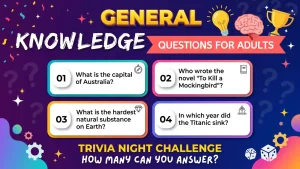
Friend: What is the capital of Australia?
You: Canberra.
A short answer is often enough. You can add more information if the other person wants to know more.
2. Add a Little Explanation
Sometimes, explaining your answer makes the conversation more useful.
Friend: Which planet is closest to the Sun?
You: Mercury. It is the first planet in our solar system.
This approach is helpful in classrooms and study groups.
3. Give a Funny Response
A little humor can make a quiz more enjoyable, as long as it does not insult anyone.
Friend: How many legs does a spider have?
You: Eight. I counted them twice to be sure!
Funny responses can work well with friends and family.
4. Admit When You Do Not Know
You do not need to guess every time. It is perfectly fine to say that you are unsure.
Friend: Who invented the telephone?
You: I think it was Alexander Graham Bell, but I would like to check the details.
This response shows honesty and a willingness to learn.
5. Ask for a Hint
If a question seems difficult, ask for a clue.
Friend: Which planet has the most prominent ring system?
You: Can you give me a hint?
Friend: It is a gas giant.
You: Saturn?
Friend: Correct!
Hints make quizzes more interactive and can help people learn.
6. Respond Professionally
In a classroom, meeting, or formal quiz, give a clear answer and explain your reasoning if needed.
Colleague: What does CPU stand for?
You: Central Processing Unit. It carries out many of a computer’s processing instructions.
7. Protect Your Privacy
Most general knowledge questions are harmless. However, some online quizzes may ask for personal details unrelated to the topic.
You can refuse politely.
Online user: Answer these questions and share your home address to win.
You: I am happy to take the quiz, but I do not share my private information online.
The most important rule is simple: answer when you can, ask for help when needed, and never feel pressured to share private information.
Regional or Cultural Differences
General knowledge questions are used around the world, but the topics and answers people know can vary by region and culture.
Different Countries, Different Priorities
Schools in different countries may focus on different historical events, national leaders, languages, and cultural traditions.
For example, a student in Pakistan may learn about the country’s independence, national history, and geography. A student in Japan may study Japanese history, traditions, and important national events.
Both students may also learn global facts about science, space, and geography.
Language Can Change the Question
The same question may be written differently in different languages. A quiz translated from English into Urdu, Arabic, Spanish, or another language may use different words or examples.
A good translation should keep the meaning clear. It should also use language that feels natural to the intended audience.
Local Facts Can Be More Familiar
People often know more about places near them. Someone who lives in Pakistan may recognize more Pakistani cities and landmarks than a person who has never studied the country.
For example:
Friend 1: What is the capital of Pakistan?
Friend 2: Islamabad.
Friend 1: Correct. Now, can you name the capital of France?
Friend 2: Paris.
Questions about local food, festivals, sports teams, and famous people may also be easier for people who know that culture well.
Cultural Respect Matters
Some questions about religion, politics, or cultural practices can be sensitive. Quiz writers should use respectful wording and avoid treating one culture as better than another.
It is also important to check facts carefully. Cultural traditions may differ within the same country, so one answer may not describe every person or community.
How to Make a Quiz More Inclusive
If you are creating general knowledge questions for a broad audience, try to:
- Include facts from different countries.
- Use simple and clear language.
- Explain unfamiliar terms.
- Avoid stereotypes.
- Include both local and global topics.
- Check translations before publishing.
These steps help more people enjoy the quiz and learn from it.
Comparison with Similar Terms
Common general knowledge questions are closely related to trivia, academic tests, and reasoning challenges. Still, they do not all test the same skills.
| Feature | General Knowledge | Trivia | Academic Tests | Brain Teasers |
| Main focus | Broad facts | Interesting facts | Subject learning | Logic and reasoning |
| Difficulty | Easy to hard | Easy to hard | Depends on level | Often requires thought |
| Common setting | Daily life and quizzes | Games and parties | Schools and exams | Puzzles and games |
| Example | What is the largest ocean? | Which animal has blue blood? | Solve a math problem | What gets wetter as it dries? |
General Knowledge vs. Trivia
General knowledge covers a broad range of familiar facts. Trivia often focuses on facts that are unusual, surprising, or entertaining.
For example, knowing the capital of France is general knowledge. Knowing that some species of frogs can freeze during winter and survive thawing is a more specialized trivia fact.
General Knowledge vs. Academic Tests
Academic tests usually focus on a particular subject or course. They may require detailed answers, calculations, or explanations.
General knowledge quizzes usually cover several subjects and often use short answers.
General Knowledge vs. Brain Teasers
General knowledge questions often test what you already know. Brain teasers usually ask you to solve a problem or recognize a pattern.
For example:
- General knowledge: What is the largest planet? Jupiter.
- Brain teaser: What has a neck but no head? A bottle.
Both types of questions can help people learn, but they work in different ways.
Usage in Online Communities & Dating Apps

General knowledge questions are popular in online communities because they are easy to share and answer. They can start conversations, create friendly competition, and help people discover new facts.
On Social Media
Users often post trivia questions with multiple-choice answers. Followers can respond in the comments or share the question with friends.
For example:
Post: Which country is famous for the ancient city of Petra?
A. Jordan
B. Egypt
C. Greece
D. India
Answer: Jordan.
When creating quiz posts, use clear wording and provide the correct answer. If a question has more than one possible answer, explain the difference.
In Gaming Communities
Gaming groups may organize quiz nights, trivia challenges, or short competitions between matches. Questions can focus on video games, gaming history, science, or popular culture.
Player 1: Which company created Minecraft?
Player 2: Mojang.
Player 1: Correct!
These games can help members interact even when they are not playing the same game.
On Dating Apps
On dating apps such as Tinder, simple questions can help people start a conversation. General knowledge questions are one option, but personal interests and playful choices may work better for building a connection.
For example:
Person A: Quick question: If you could visit any country, which one would you choose?
Person B: Japan. I would love to see Kyoto.
Person A: Great choice! What would you want to see first?
This exchange is not a general knowledge quiz, but it shows how a simple question can lead to a more meaningful conversation.
You could also ask a light trivia question:
Person A: Quick quiz: Which planet is known as the Red Planet?
Person B: Mars. Did I pass?
Person A: Yes! Your prize is choosing our next conversation topic.
Tips for Online Conversations
- Keep questions short and friendly.
- Avoid making people feel foolish for a wrong answer.
- Do not send too many questions at once.
- Respect the other person’s interests.
- Never ask for sensitive personal information as part of a quiz.
- Check facts before sharing them with a group.
The goal is to make conversations enjoyable, not to prove that you know more than everyone else.
Hidden or Offensive Meanings
Common general knowledge questions do not usually have hidden or offensive meanings. They are generally used for learning, entertainment, and friendly competition.
However, the way a question is written or asked can affect how people feel about it.
When a Question Can Sound Rude
A simple question can sound insulting if it is used to embarrass someone.
For example:
Person A: Everyone knows the capital of France. How do you not know that?
Person B: I forgot. You do not need to make fun of me.
The problem is not the question itself. It is the disrespectful tone.
A better way to ask is:
Person A: Do you remember the capital of France?
Person B: Paris?
Person A: Yes, that is right!
Questions About Sensitive Topics
Some questions about religion, politics, race, nationality, or personal experiences may be sensitive. These topics are not always inappropriate, but they require care.
Avoid questions that rely on harmful stereotypes or suggest that people from one group are less intelligent than others.
Misleading Questions
Some quiz questions use tricks or unclear wording to confuse people. These can be fun when everyone understands the rules, but they can be frustrating when the answer depends on hidden assumptions.
For example, a question about the “biggest” animal should explain whether it means the biggest living animal, the biggest land animal, or the biggest animal that has ever existed.
Clear wording makes a quiz fairer.
How to Keep Questions Respectful
When writing or asking questions:
- Use neutral language.
- Avoid insults and personal attacks.
- Explain unusual or ambiguous answers.
- Respect different levels of knowledge.
- Correct mistakes without shaming anyone.
A good general knowledge quiz should encourage curiosity. It should not make people feel bad for learning at their own pace.
Suitability for Professional Communication
Common general knowledge questions can be suitable for professional communication when they serve a clear purpose. They are often used in training sessions, workshops, team-building activities, and educational presentations.
In Meetings and Training
A short quiz can help employees review information or begin a training session.
Trainer: Which file format is commonly used for portable documents?
Employee: PDF.
Trainer: Correct. PDF stands for Portable Document Format.
This kind of question can make a training session more engaging.
In Job Interviews
Some employers use general knowledge questions to assess awareness, reasoning, or knowledge related to a role. However, questions should be relevant to the job and should not be used as a substitute for a fair assessment of skills.
For example, a geography question may make sense for a role in geography education but may not be relevant to many other positions.
In Professional Emails
General knowledge questions can also appear in emails about training or group activities.
For example:
Subject: Team Quiz Activity
Hello Team,
We will begin Friday’s meeting with a short general knowledge quiz. The questions will cover science, geography, and everyday facts. The goal is to learn something new and enjoy a brief team activity.
Please feel free to take part.
Best regards,
The Team Coordinator
Professional Alternatives
If you need a more formal phrase, consider these options:
- General knowledge assessment
- General awareness quiz
- Knowledge-check questions
- Educational quiz
- General information test
The best phrase depends on the purpose. “General knowledge quiz” works well for an informal activity, while “knowledge assessment” may suit a formal training document.
Best Practices in the Workplace
Choose questions that are relevant, clear, and suitable for the audience. Explain the purpose of the quiz before starting. Avoid questions that could embarrass employees or touch on sensitive personal matters.
When used thoughtfully, general knowledge questions can support learning and encourage teamwork.
FAQs About Common General Knowledge Questions
They are questions about familiar facts from subjects such as science, history, geography, sports, nature, and everyday life. They help people test what they know and learn new information.
Here are five examples:
Read books, follow reliable news sources, watch educational videos, and take quizzes. Choose a few questions each day and review the answers you get wrong. Learning a little every day can make a difference.
Yes. They can help children build vocabulary, improve memory, and explore new topics. Choose age-appropriate questions and explain answers in simple words.
General knowledge covers a wide range of common facts. Trivia often focuses on interesting or unusual facts. The two categories overlap, and both can be used in quizzes and games.
Yes. They can help students review facts, develop curiosity, and practice recalling information. They are useful as a learning activity, but they should not replace detailed study of school subjects.
You can find them in quiz books, educational websites, school resources, trivia apps, and online learning platforms. Check the accuracy of answers, especially when questions involve changing facts or current events.
Conclusion
Common general knowledge questions are a simple way to learn about the world. They cover many subjects, including science, history, geography, sports, animals, and everyday life. You can use them at school, at work, with friends, or during online quiz games.
These questions do more than test memory. They can help you build knowledge, improve recall, start conversations, and discover new interests. They also make learning more enjoyable when you share questions with other people.
You do not need to know every answer to improve your general knowledge. Start with easy questions, learn from your mistakes, and explore topics that interest you. Try answering a few questions each day and checking facts you are unsure about.
The best way to improve your general knowledge is to stay curious and keep learning. Every question gives you a chance to discover something new and become more confident in what you know.

Thomas Mitchell is a writer at New Learn Knowledge, sharing clear and useful educational content.
He enjoys creating simple guides and informative articles that help readers learn and discover new knowledge.