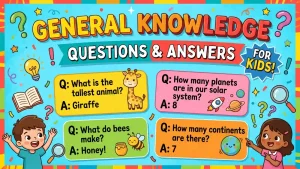
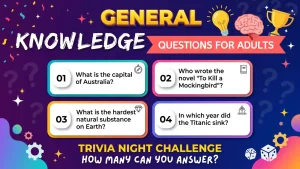
Cool trivia questions are fun questions about surprising facts from science, history, geography, sport and everyday life. Each question has a short, clear answer that you can learn in seconds. This guide explains what cool trivia means, shows examples, and shares 100 questions with answers.
Definition & Meaning of Cool Trivia Questions
Cool trivia questions are interesting questions about facts, events, people, places, and everyday life. They are made to test your knowledge and share surprising information.
The word trivia refers to small facts or pieces of information. These facts may seem simple, but they can be fun, useful, or surprising. The word cool adds the idea that the questions are exciting, unusual, or worth sharing.
For example, you may know that the Earth moves around the Sun. But do you know which planet has the shortest day? Questions like this make you curious and encourage you to learn more.
Examples of Cool Trivia Questions
Here are some examples from different topics.
Science
- What is the chemical symbol for gold?
- Which planet is known as the Red Planet?
- What gas do plants take in during photosynthesis?
Animals
- What is the largest animal on Earth?
- Which bird is famous for copying human speech?
- How many hearts does an octopus have?
Geography
- What is the largest ocean on Earth?
- Which country is home to the Great Pyramid of Giza?
- What is the capital of Japan?
History
- Who was the first person to walk on the Moon?
- Which ancient civilization built the pyramids at Giza?
- Who invented the printing press in Europe?
Movies and Entertainment
- Which superhero is known as the Dark Knight?
- What is the name of Harry Potter’s school?
- Which animated film features the song “Let It Go”?
These questions are fun because they cover many subjects. Some test facts you learned at school. Others ask about movies, hobbies, or things you see every day.
Why Are Cool Trivia Questions Popular?
Cool trivia questions are popular because they make learning feel like a game. You can answer them alone or compete with friends.
They also help you discover new facts. Even when you get an answer wrong, you can learn something useful.
For example:
Friend 1: Which planet is known as the Red Planet?
Friend 2: Is it Venus?
Friend 1: No, it is Mars!
Friend 2: Now I know something new.
This simple exchange shows how trivia can turn an ordinary conversation into a learning moment.
Background & History of Trivia Questions
Trivia has a long history. People have always enjoyed asking questions, sharing facts, and testing what others know. Long before online quizzes existed, families, teachers, and friends used questions to share knowledge.
In ancient times, people learned through stories, debates, riddles, and spoken questions. Teachers asked students questions to check their understanding. Communities also shared interesting facts about nature, history, and daily life.
Over time, question-and-answer games became popular forms of entertainment. Printed books, newspapers, and magazines helped spread quizzes to more people.
The Rise of Modern Trivia
Trivia became especially popular as a social game during the twentieth century. Radio and television quiz shows allowed people to test their knowledge from home.
Board games and pub quiz nights also helped make trivia a group activity. People could answer questions about sports, music, science, history, and popular culture.
The word trivia became strongly linked with general-knowledge games. These games gave people a chance to learn facts while competing with others.
Trivia in the Digital Age
The internet changed how people enjoy trivia. Today, anyone can find thousands of questions online. Websites, mobile apps, and social media platforms make quizzes easy to access.
People now share trivia in many ways:
- Social media: Users post questions and invite others to comment.
- Online games: Players answer questions to earn points.
- Educational websites: Students use quizzes to review lessons.
- Video platforms: Creators share quick quizzes and challenge viewers.
- Messaging apps: Friends send questions to test each other.
For example, someone might post, “Can you name the only mammal capable of true sustained flight?” Followers can guess the answer in the comments.
The answer is a bat.
Today, cool trivia questions are used for both learning and entertainment. They bring people together and make useful facts easier to remember.
Usage of Cool Trivia Questions in Various Contexts
Cool trivia questions can fit into many parts of daily life. You can use them at school, at home, online, or with friends. The best question depends on the people taking part and the setting.
1. Cool Trivia Questions in Casual Conversations
Trivia is a simple way to start a conversation. You can ask a fun question when you want to break the silence or make a meeting with friends more interesting.
Example:
Alex: Do you know which animal has three hearts?
Sam: A whale?
Alex: Not quite. It is an octopus!
Sam: That is a cool fact.
Questions like this can lead to longer talks about animals, science, or nature.
2. Cool Trivia Questions in Text Messages
You can send trivia questions to friends through text messages or messaging apps. Short questions work best because they are easy to read and answer.
Example:
You: Quick quiz! What is the largest planet in our solar system?
Friend: Saturn?
You: It is Jupiter!
You can send one question at a time or create a daily trivia challenge.
3. Cool Trivia Questions on Social Media
Trivia works well on social media because people enjoy sharing opinions and testing their knowledge.
You can post a question, create a poll, or ask followers to comment with their answers.
For example:
Post: Which ocean is the largest on Earth?
A. Atlantic Ocean
B. Indian Ocean
C. Pacific Ocean
D. Arctic Ocean
Answer: C. Pacific Ocean.
Questions with clear answers and interesting facts can encourage people to join the discussion.
4. Cool Trivia Questions in Gaming
Trivia games are popular with people who enjoy challenges. Players answer questions to earn points, unlock levels, or beat their friends.
You can also add trivia rounds to games that are not based on knowledge.
Example:
Player 1: Correct answer gets two points. What is the fastest land animal?
Player 2: The cheetah!
Player 1: Correct. You get two points.
This format makes a game more exciting and gives everyone a chance to take part.
5. Cool Trivia Questions at School and Work
Teachers can use trivia to review lessons and make learning more active. At work, a short quiz can help a team relax during a break or take part in a group activity.
However, the questions should match the audience. Simple science questions may suit a school group, while a work event might use questions about history, films, or general knowledge.
The main goal is to make people curious, involved, and ready to learn.
Common Misconceptions & Clarifications
People sometimes misunderstand what makes a good trivia question. Some think trivia must be difficult, while others believe it only covers random facts. Both ideas are incorrect.
Misconception 1: Trivia Questions Must Be Hard
Trivia questions can be easy, medium, or hard. A simple question can still be fun if it shares an interesting fact.
For example:
- Easy: How many days are in a week?
- Medium: What is the capital of Australia?
- Hard: Which element has the chemical symbol W?
The answers are seven, Canberra, and tungsten.
A good trivia question does not have to be difficult. It only needs to be clear and interesting.
Misconception 2: Trivia Is Only About Random Facts
Trivia can cover almost any subject. It includes science, geography, history, sports, music, art, technology, and more.
You can even make trivia questions about a book, a movie, or a topic you are studying in school.
This makes trivia useful for both fun and education.
Misconception 3: Every Trivia Question Has an Easy Answer
Some questions need careful wording. For example, asking for the “best” movie or the “most beautiful” place does not have one clear answer. These questions depend on personal opinions.
A strong trivia question should have an answer that can be checked.
Instead of asking, “What is the best country to visit?” ask, “Which country is home to the city of Kyoto?”
The second question has a clear answer: Japan.
Misconception 4: Getting an Answer Wrong Means You Know Nothing
Trivia is a learning activity. You do not need to know every answer to enjoy it.
When you miss a question, read the explanation and try to remember the fact. Over time, you may notice that your knowledge grows.
Misconception 5: Trivia Is Only for Children
Trivia is suitable for people of all ages. Children may enjoy questions about animals and cartoons. Adults may prefer history, science, sports, or world facts.
The best questions match the interests and knowledge levels of the people playing.
Can Trivia Questions Be Inappropriate?
Most trivia questions are harmless. However, questions about private lives, sensitive events, or cultural stereotypes can make people uncomfortable.
Choose topics with care, especially in classrooms, workplaces, and public online groups.
Good trivia should challenge people without insulting or embarrassing them.
Similar Terms & Alternatives
Several terms are related to cool trivia questions. Although they are often used in similar ways, each has a slightly different meaning.
1. General Knowledge Questions
General knowledge questions test facts from many subjects. They may cover history, science, geography, current affairs, and culture.
Example: What is the capital of Canada?
Answer: Ottawa.
These questions are useful for school tests, quiz competitions, and everyday learning.
2. Fun Facts
Fun facts are short pieces of information that people find surprising or entertaining. Unlike trivia questions, they do not always require an answer from the reader.
Example: A group of flamingos is sometimes called a flamboyance.
You can share a fun fact before asking a related trivia question.
3. Quiz Questions
Quiz questions are questions used in a test or game. They can cover one subject or many different topics.
Example: Which organ pumps blood around the human body?
Answer: The heart.
Trivia questions are often quiz questions, but not every quiz question is designed mainly for entertainment.
4. Brain Teasers
Brain teasers test reasoning and problem-solving skills. They may use logic, patterns, or wordplay instead of general facts.
Example: What has hands but cannot clap?
Answer: A clock.
This type of question is ideal for people who enjoy solving puzzles.
5. Riddles
Riddles describe something in a clever or indirect way. The player must work out what the description means.
Example: What has a neck but no head?
Answer: A bottle.
Riddles often depend on creative thinking rather than factual knowledge.
6. Knowledge Challenges
A knowledge challenge is an activity that asks people to answer several questions. It may focus on one subject or cover many topics.
For example, a ten-question science challenge could test knowledge of the human body, planets, and natural forces.
Comparison Table
| Term | Main Purpose | Example |
| Trivia questions | Test interesting facts | Which planet is largest? |
| General knowledge questions | Test broad knowledge | What is the capital of Italy? |
| Fun facts | Share surprising information | Octopuses have three hearts. |
| Brain teasers | Test reasoning | What comes next in a number pattern? |
| Riddles | Encourage creative thinking | What has keys but no locks? |
| Quiz questions | Test knowledge in a game or assessment | Which gas do plants absorb? |
Choosing the right term depends on your goal. Use trivia for interesting facts, riddles for wordplay, and brain teasers for problem-solving.
How to Respond to Cool Trivia Questions
When someone asks you a trivia question, you can respond in different ways. Your answer may be serious, funny, curious, or playful. The best response depends on your relationship with the person and the situation.
1. Give a Direct Answer
If you know the answer, keep it simple.
Friend: What is the largest ocean on Earth?
You: The Pacific Ocean.
You can also add a short fact if you want to keep the conversation going.
You: The Pacific Ocean. It covers more area than any other ocean.
2. Make a Funny Guess
If you do not know the answer, you can make a playful guess.
Friend: Which animal has three hearts?
You: I hope it is not my alarm clock. That thing already gives me heart trouble!
Friend: It is an octopus!
Humor can make trivia more enjoyable, as long as it suits the people taking part.
3. Admit You Do Not Know
There is nothing wrong with not knowing an answer.
Friend: What is the capital of New Zealand?
You: I am not sure. Tell me the answer!
Friend: Wellington.
You: Nice! I learned something new today.
This response keeps the game friendly and helps you learn.
4. Ask for a Hint
If the question seems hard, ask for a clue.
Friend: Which planet has the most prominent ring system?
You: Can I get a hint?
Friend: It is a gas giant.
You: Is it Saturn?
Friend: Correct!
Asking for hints can make a quiz more interactive.
5. Challenge the Other Person
After answering, ask a question of your own.
You: The answer is Mars. Now it is my turn. What is the largest mammal on Earth?
Friend: The blue whale!
This creates a friendly back-and-forth game.
6. Respond in a Professional Setting
At work, choose questions that suit the meeting or activity. Give a clear answer and avoid jokes that may distract others.
Colleague: Which planet is closest to the Sun?
You: Mercury.
Colleague: Correct.
For formal quizzes, explain the answer when needed and keep the discussion respectful.
7. When You Do Not Want to Participate
You can politely decline without giving a reason.
Friend: Want to try this trivia challenge?
You: Maybe later. I am busy right now.
You should never feel forced to answer personal questions just because someone presents them as trivia.
Regional or Cultural Differences
Cool trivia questions are enjoyed around the world, but the topics and styles can vary by culture. People often prefer questions about their own country, language, history, sports, food, and traditions.
A question that is easy for one group may be difficult for another. This does not mean one group is more knowledgeable. It may simply mean they have learned different facts.
1. Trivia in the United States
Trivia games in the United States often include questions about popular films, television, music, sports, presidents, and national history.
For example, a quiz might ask which city is home to the Statue of Liberty or which sport uses a home plate.
These topics can be familiar to people who follow American culture.
2. Trivia in the United Kingdom
British trivia often includes questions about royal history, literature, football, television, and famous landmarks.
A question might ask where Stonehenge is located or who wrote Romeo and Juliet.
Such questions can also appeal to people outside the United Kingdom who enjoy British history and culture.
3. Trivia in Pakistan
In Pakistan, popular trivia topics may include national history, geography, cricket, famous leaders, cultural traditions, and world knowledge.
For example:
Question: What is the capital of Pakistan?
Answer: Islamabad.
A cricket quiz might ask about famous players, while a geography quiz could cover rivers, mountains, and neighboring countries.
4. Trivia in India
Indian trivia often includes questions about history, cricket, cinema, literature, geography, and cultural festivals.
A question might ask which city is home to the Taj Mahal or which sport is especially popular across the country.
The best questions depend on the audience and its interests.
5. Language and Translation
Trivia questions can be translated into many languages. However, wordplay and jokes may not work the same way after translation.
For example, a riddle based on two English words with similar sounds may be difficult to translate directly into Urdu, Arabic, Spanish, or another language.
When creating multilingual quizzes, use simple wording and explain any cultural reference that may be unfamiliar.
6. Avoiding Cultural Confusion
Some questions involve customs, beliefs, or traditions that differ across communities. Avoid presenting one culture’s habits as universal facts.
Instead of asking which country’s food is “the best,” ask a clear question about a dish, ingredient, or place.
Good trivia celebrates cultural differences and helps people learn about one another.
Comparison with Similar Terms
Cool trivia questions are closely related to quizzes, riddles, brain teasers, and general knowledge tests. However, each format offers a different experience.
| Feature | Cool Trivia | General Knowledge Quiz | Brain Teaser | Riddle |
| Main focus | Interesting facts | Broad knowledge | Logic and reasoning | Wordplay and clues |
| Answer type | Usually factual | Usually factual | Often logical | Often creative |
| Difficulty | Easy to hard | Easy to hard | Often challenging | Varies |
| Best for | Fun and learning | Testing knowledge | Solving problems | Creative thinking |
| Example | Which planet is largest? | What is the capital of France? | What number comes next in a pattern? | What has one eye but cannot see? |
Cool Trivia vs. General Knowledge Quizzes
Cool trivia often focuses on facts that are unusual, surprising, or fun to share. General knowledge quizzes can be broader and may include standard school or exam topics.
For example, a trivia question might ask how many hearts an octopus has. A general knowledge quiz might ask for the capital of France.
Both can help people learn, but the style may differ.
Cool Trivia vs. Brain Teasers
Trivia usually asks you to remember or understand a fact. Brain teasers ask you to think through a problem.
For example, knowing that Jupiter is the largest planet is a fact. Solving a number pattern requires reasoning.
Cool Trivia vs. Riddles
A trivia question has a factual answer that can usually be checked. A riddle often uses a clever description to make the answer less obvious.
For example:
- Trivia: Which planet is called the Red Planet? Answer: Mars.
- Riddle: What gets wetter as it dries? Answer: A towel.
Which Type Should You Choose?
Choose trivia when you want to share facts or test general knowledge. Use brain teasers when you want a mental challenge, and choose riddles when you want wordplay and humor.
You can also combine all three formats to create a more varied quiz.
Usage in Online Communities & Dating Apps

Online communities use trivia to bring people together. A short question can start a conversation, create friendly competition, or help people discover shared interests.
Trivia is common in gaming groups, social media communities, discussion forums, and educational platforms.
1. Trivia on Social Media
People post trivia questions on platforms such as X, Facebook, Instagram, and other social networks. They may use polls, comments, or short videos to collect answers.
For example:
Post: Quick challenge! Which is the largest planet in our solar system?
Comment 1: Jupiter!
Comment 2: I thought it was Saturn.
Post owner: Jupiter is correct!
This format is easy to understand and encourages participation.
2. Trivia in Gaming Communities
Online gaming groups often use trivia as a break between matches or as part of community events.
Questions may focus on video games, characters, maps, gaming history, or general knowledge.
Player 1: Bonus question! What is the name of Mario’s brother?
Player 2: Luigi!
Player 1: Correct. One point for you!
Keep the questions clear and avoid making new players feel unwelcome if they do not know every answer.
3. Trivia on Dating Apps
Trivia can also help people start conversations on dating apps such as Tinder. A light question gives someone an easy way to reply without needing to think of a long introduction.
For example:
Person A: Important question: If you could visit any planet, which one would you choose?
Person B: Mars. I want to see what it looks like up close. What about you?
Person A: Saturn. Those rings look amazing!
This is more of a fun conversation starter than a strict factual quiz, but it shows how questions can help people connect.
Another example is:
Person A: Quick trivia challenge: What is the largest ocean?
Person B: The Pacific Ocean. Do I win a prize?
Person A: You win the right to ask the next question!
4. Tips for Online Trivia
Follow these tips when sharing trivia online:
- Keep questions short: Make them easy to read on a phone.
- Check the facts: Use reliable sources before posting answers.
- Be friendly: Do not mock people for incorrect guesses.
- Respect privacy: Avoid questions that ask strangers to reveal personal details.
- Match the platform: Use casual questions in gaming groups and more focused questions in educational communities.
Trivia works best when everyone can take part without feeling pressured or embarrassed.
Hidden or Offensive Meanings
The phrase “cool trivia questions” has no common hidden or offensive meaning. It normally refers to fun questions about interesting facts.
The words may still be misunderstood in certain situations, so context matters.
Can Trivia Questions Offend Someone?
The activity itself is usually harmless, but the topic can cause problems.
Questions about race, religion, disability, personal relationships, or painful historical events may be sensitive. A question can also be offensive if it relies on stereotypes or makes fun of a group.
For example, asking people to identify a country’s capital is generally harmless. Asking them to rank cultures as better or worse is not a fair or respectful trivia question.
Can Trivia Be Used to Embarrass Someone?
Yes. A person might ask very difficult questions to make someone look uninformed. This changes the activity from a friendly game into an unpleasant experience.
A good trivia host should explain the rules, accept reasonable answers, and avoid humiliating players.
Does “Cool” Always Mean Good?
In everyday English, cool often means interesting, impressive, or enjoyable. It can also refer to temperature or a calm attitude.
The meaning depends on the sentence.
For example:
- “That is a cool trivia question” means the question is interesting.
- “Keep the drink cool” refers to temperature.
- “Stay cool during the game” means remain calm.
These meanings are not usually confusing when the words appear in a clear context.
How Can You Keep Trivia Respectful?
Use reliable facts, avoid harmful stereotypes, and consider your audience. If a question concerns a sensitive topic, explain why it is being asked and give people the option not to participate.
Trivia should make people curious, not uncomfortable.
Suitability for Professional Communication
Cool trivia questions can be suitable for professional settings when they match the purpose of the activity. They can help teams relax, encourage interaction, and make training sessions more engaging.
However, they may not fit every meeting or business message. Consider the audience, timing, and workplace culture before using them.
1. Trivia During Team-Building Activities
A short quiz can help colleagues get to know one another. Choose neutral topics such as science, geography, books, technology, or popular culture.
For example:
Team leader: Here is our warm-up question. Which planet is known as the Red Planet?
Team member: Mars.
Team leader: Correct. Let’s move to the next question.
This approach is simple and does not require anyone to share private information.
2. Trivia in Training Sessions
Teachers, trainers, and managers can use trivia to review information.
For example, a safety training session might include questions about workplace procedures. In this case, accuracy matters more than entertainment.
Make sure each answer follows approved training materials and current policies.
3. Trivia in Business Presentations
A relevant trivia question can open a presentation and capture attention.
For example:
“Before we begin, can anyone guess how many countries are members of the United Nations?”
If you use a changing statistic, verify the current figure and date before presenting it.
4. Professional Alternatives
In formal settings, you may want to use more specific phrases than “cool trivia questions.”
| Casual Phrase | Professional Alternative |
| Cool trivia questions | General knowledge questions |
| Fun quiz | Interactive knowledge assessment |
| Quick trivia game | Short team quiz |
| Trivia challenge | Knowledge challenge |
| Fun facts quiz | Educational quiz |
5. When Should You Avoid Trivia?
Avoid trivia when it interrupts urgent work, distracts from a serious discussion, or creates pressure for employees to participate.
Do not use questions that reveal personal details or test knowledge unrelated to the activity’s purpose.
The best professional trivia is brief, relevant, inclusive, and accurate.
Frequently Asked Questions
Cool trivia questions are interesting questions about facts, people, places, science, history, entertainment, and other subjects. They test knowledge and help people learn new things.
Yes. They can help children learn facts, build curiosity, and improve recall. Choose age-appropriate questions about animals, space, nature, and school subjects.
Yes. Trivia is a fun party activity. Divide people into teams, ask questions from different topics, and award points for correct answers.
Choose a topic, find a reliable fact, and turn it into a clear question. Check that the answer is correct and make sure the difficulty suits your audience.
You can share them in classrooms, family games, group chats, social media posts, online gaming communities, and team-building activities.
Conclusion
Cool trivia questions are a simple way to make learning fun. They cover many subjects, from science and animals to history, geography, sports, and entertainment. You can use them in conversations, classrooms, family games, online communities, and even professional activities.
The best trivia questions are clear, interesting, and suitable for the people answering them. They do not always need to be hard. Even an easy question can teach you a surprising fact.
You can also use trivia to start conversations, challenge friends, and learn about different cultures. When you get an answer wrong, treat it as a chance to learn rather than a reason to feel bad.
If you want to create your own quiz, start with a topic you enjoy. Choose reliable facts, write simple questions, and check every answer before sharing it.
Whether you play alone or with a group, cool trivia questions can help you explore new ideas and test your knowledge. Ask a question, take a guess, and enjoy learning something new every day.
Keep exploring with more quizzes on this site: trivia today, general knowledge quiz, trivia questions for kids, and family trivia questions.

Thomas Mitchell is a writer at New Learn Knowledge, sharing clear and useful educational content.
He enjoys creating simple guides and informative articles that help readers learn and discover new knowledge.