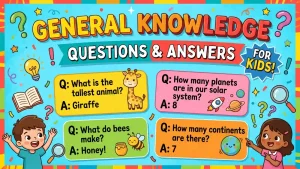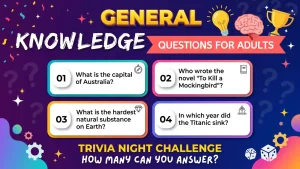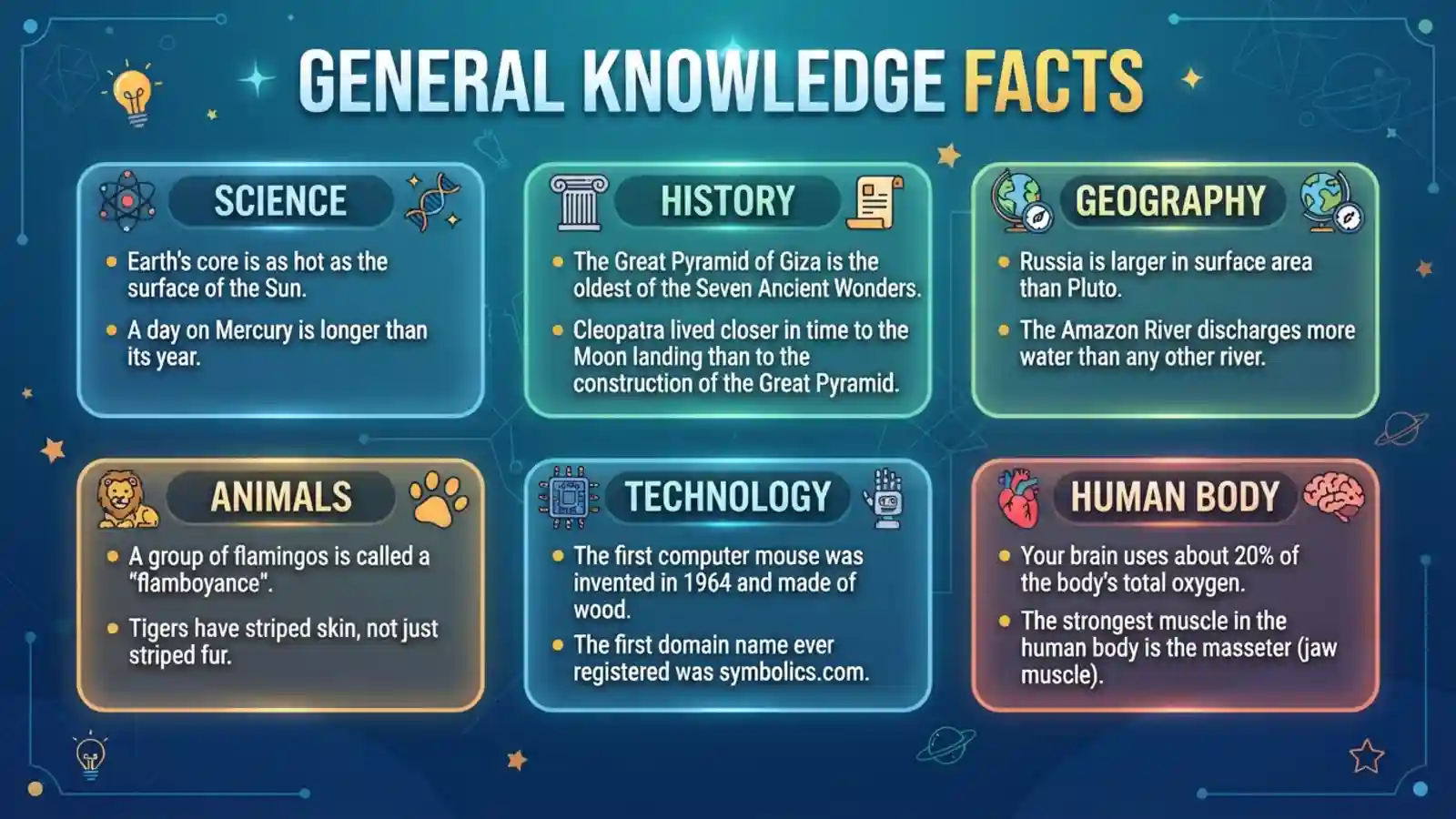
General knowledge facts are true pieces of information about many topics, such as science, history, geography, sports and daily life. They are short, clear and easy to check. This guide gives you facts you should know, with examples you can use in quizzes, exams and talks.
A good general knowledge fact has one clear answer. Water boils at 100 degrees Celsius at sea level. The Pacific is the largest ocean on Earth.
Facts like these help you learn fast. Each one adds a small piece to what you know about the world.
They also help in daily life. You can follow the news, join talks and answer quiz questions with ease.
In this guide you will find facts grouped by topic, with simple notes on each one.
Start with the facts below. Pick a few you did not know and test yourself on them.
Use them in study, quizzes and daily talks. Small facts add up to strong general knowledge.
General knowledge grows one fact at a time. Keep learning, keep asking, keep sharing.
General Knowledge Facts – Quick Answer

General knowledge facts are true pieces of information about many topics. They are not tied to one subject. They cover science, history, geography, sports, art, and world events.
Here are some examples:
- Water boils at 100°C (212°F) at sea level.
- The Pacific is the largest ocean on Earth.
- Mount Everest is the tallest mountain above sea level.
- Canberra is the capital of Australia.
- An adult human has 206 bones.
- Light travels faster than sound.
- An octopus has three hearts.
- The Sun is a star.
Notice how simple they are. Each one is short, clear, and checkable. That is what makes a good general knowledge fact.
The Origin of General Knowledge Facts

Let’s break the phrase into three words.
General comes from the Latin word generalis. It means “of a whole kind.” It is the opposite of “specific.”
Knowledge comes from Old English. It is linked to the old word cnawan, which means “to know.”
Fact comes from the Latin word factum. It means “a thing done.” Over time, it came to mean “a thing that is true.”
“General knowledge” became a well-known school and exam label in British education. It spread across the Commonwealth. Today, “GK” is a common school subject and quiz round in India, Pakistan, Nigeria, and many other countries.
Why do spelling differences exist? The phrase itself has none. But other English words do. The reason goes back to Noah Webster. In 1828, he published an American dictionary. He wanted simpler spelling. So Americans wrote “color” and “center.” The British kept “colour” and “centre,” which came from French. Both spellings stuck.
British English vs American English Spelling
Good news: “general knowledge facts” is spelled the same in both. The real difference is how often people use it, and which words sit beside it.
| Feature | British / Commonwealth | American |
| General knowledge | Very common | Less common |
| Quiz night style | Pub quiz | Trivia night |
| Similar term | GK | Trivia, common knowledge |
| Color | Colour | Color |
| Favorite | Favourite | Favorite |
| Center | Centre | Center |
| Organize | Organise (or Organize) | Organize |
| Traveling | Travelling | Traveling |
| Math | Maths | Math |
Simple rule: American spelling often drops letters. British spelling often keeps them. Pick one style and stay with it.
Which Spelling Should You Use?
Your audience decides.
Writing for the US: Use American spelling. Write “color,” “center,” and “organize.” Use “trivia” as a second keyword. Americans search for it more.
Writing for the UK, India, Pakistan, Australia, or Africa: Use British spelling. Write “colour,” “centre,” and “organise.” Use “general knowledge” and “GK” freely.
Writing for a global crowd: Use “general knowledge facts” as your main phrase. It works everywhere. Keep your spelling the same from start to end. Many global sites choose British spelling. Others choose American. Either is fine if you stay consistent.
Common Mistakes with General Knowledge Facts

| Mistake | Fix |
| “General knowledges” | “Knowledge” has no plural. Write “general knowledge.” |
| “General knowledge are important” | Use “is.” Knowledge is singular. |
| Mixing “colour” and “color” in one text | Choose one style. |
| Using “GK” in a formal essay | Write “general knowledge” in full. |
| Calling opinions “facts” | A fact can be checked. An opinion cannot. |
| Sharing facts without checking | Verify with a trusted source first. |
| Treating it as the same as common knowledge | Common knowledge is what most people already know. General knowledge is broader. It includes things you must learn. |
General Knowledge Facts in Everyday Examples

In an email:
“Hi team, here is a fun general knowledge fact for Friday: an octopus has three hearts.”
In the news:
“The quiz show tests contestants on general knowledge facts, from history to science.”
On social media:
“Today’s general knowledge fact: Canberra, not Sydney, is Australia’s capital. 🌏”
In formal writing:
“Students with strong general knowledge often perform better in interviews and competitive exams.”
In school:
“Our teacher gives us five general knowledge facts every morning.”
Each example is clear and short. Use the same style in your own writing.
General Knowledge Facts – Google Trends & Usage Data

I can’t show live numbers here, so check the latest data yourself at trends.google.com. Here is what such searches usually show:
- Countries: Interest tends to be strong in India, Pakistan, Bangladesh, Nigeria, the Philippines, and the UK. These places treat general knowledge as a school and exam subject.
- The US: People often search for “trivia” or “fun facts” instead.
- Timing: Searches often rise before exam seasons and around big quiz events.
- Context: Students search for exam prep. Adults search for fun facts and quiz help. Parents search for kid-friendly facts.
Tip: Type “general knowledge facts” into Google Trends. Then compare it with “trivia” and “fun facts.” Filter by country. You will see who uses which phrase.
Keyword Variations Side by Side
| Phrase | Meaning | Popular in | Best use |
| General knowledge facts | True facts on many topics | Global | Blogs, study sites |
| General knowledge | Broad knowledge of the world | UK, South Asia, Africa | Exams, schools |
| GK | Short form of general knowledge | India, Pakistan | Informal, school |
| Trivia | Small, fun facts, often for games | US | Quizzes, games |
| Fun facts | Surprising, light facts | Global | Social media |
| Common knowledge | What most people already know | Global | Legal and everyday talk |
| Random facts | Facts with no theme | Global | Casual posts |
Frequently Asked Questions
They are true pieces of information about many topics, such as science, history, geography, and sports.
It is singular. Write “general knowledge is,” not “general knowledge are.”
GK stands for general knowledge. It is a short form used in schools and exams, mostly in South Asia and other Commonwealth countries.
No. “General knowledge facts” is spelled the same. Differences show up in nearby words, like “colour” and “color.”
General knowledge is broad and useful. Trivia is often small, fun, and used in games. The two overlap a lot.
Read a little every day. Follow trusted news. Use quiz apps. Watch documentaries. Learn one new fact each morning and share it.
They show how aware you are of the world. Employers and schools want people who understand more than one subject.
They should be. But facts can change. Populations, records, and leaders change over time. Always check a fresh source.
Conclusion
General knowledge facts are true, simple pieces of information about the world. They cover science, history, geography, sports, art, and more. They help you in school, at work, and in daily talk.
Here are the key points. The phrase “general knowledge facts” is spelled the same in American and British English. The real differences are in usage. People in the UK, India, Pakistan, and many Commonwealth countries say “general knowledge” or “GK” all the time. Americans often say “trivia” or “common knowledge.”
Remember the tips. Keep “knowledge” singular. Do not mix UK and US spellings in one text. Check every fact before you share it. Use “general knowledge facts” when you write for a global crowd.
Most of all, stay curious. Read a little each day. Learn one new fact and share it with a friend. Small steps add up fast. Soon you will win the quiz night, ace the exam, and enjoy every conversation a bit more.
Now pick a fact and go share it.
Continue Reading:
- Interesting General Knowledge: for Curious Minds (for 2026)
- General Knowledge: Questions, Facts, and Answers (for 2026)
- General Knowledge Questions: To Improve Your Skills (for 2026)

Alexander Reed is a writer who shares clear, useful insights on learning, knowledge, and everyday topics.
His work on New Learn Knowledge helps readers discover simple and helpful information.