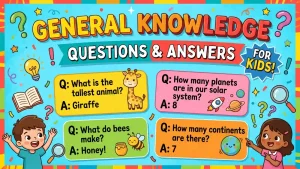
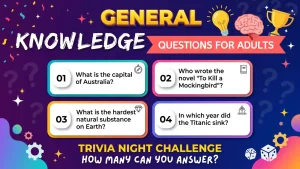
General knowledge means having basic facts about many subjects, such as history, science, geography, sports and culture. It helps you follow conversations, answer quiz questions and learn new topics with ease. This guide gives you clear questions, facts and answers you can use every day.
These subjects can include history, geography, science, sports, culture, technology, famous people, nature, and current events.
General knowledge is useful in daily life. It can help you understand conversations, answer questions, take part in quizzes, and learn about the world around you.
You may use it while talking with friends, reading social media posts, watching the news, playing games, or studying at school.
For example, someone may ask, “What is the capital of France?” Knowing that the answer is Paris is a simple example of general knowledge.
General knowledge is not only about remembering facts. It also helps you understand how different parts of the world work.
It can make learning new topics easier and help you feel more confident when joining a conversation.
What Is General Knowledge?

General knowledge is a broad understanding of facts, ideas, events, and information from many areas of life.
Unlike specialized knowledge, general knowledge does not focus on only one subject. A doctor may have deep medical knowledge, while a historian may know a great deal about the past. General knowledge covers smaller amounts of information across many subjects.
Common areas include:
- History
- Geography
- Science
- Literature
- Art
- Sports
- Technology
- Politics and government
- Nature
- Culture
- Famous people
- World events
For example, knowing that Earth moves around the Sun is general knowledge. Knowing how to perform a complex medical procedure is specialized knowledge.
General knowledge can also be useful in simple conversations.
Friend: “Do you know which planet is known as the Red Planet?”
You: “Yes. It is Mars.”
It can also appear in quizzes and games.
Question: “Which ocean is the largest?”
Answer: “The Pacific Ocean.”
People gain general knowledge in many ways. They may read books, watch educational programs, visit museums, follow reliable news sources, study at school, or simply ask questions.
It is also important to understand that general knowledge changes over time. New inventions, discoveries, events, and research can add new information to what people commonly know.
Background and History of General Knowledge

The idea of learning about many subjects is not new. People have shared knowledge for thousands of years through speech, writing, teaching, and observation.
In ancient societies, knowledge was often passed from one generation to another. People learned about farming, weather, medicine, travel, nature, and local customs. Written records later helped preserve information for future generations.
The development of schools and libraries made learning more accessible. Books allowed people to study subjects beyond their local communities.
Newspapers also played an important role. They gave people information about events, discoveries, government, sports, and other topics.
Later, radio and television made information easier to access. People could learn about distant countries and major world events without traveling.
The internet created another major change. Today, people can search for information within seconds. Online encyclopedias, educational websites, videos, podcasts, and digital libraries have made general knowledge easier to explore.
However, easy access to information also creates a new challenge. Not everything online is correct. People need to check important facts and use trustworthy sources.
General knowledge has therefore changed from information passed mainly through books and teachers to information available through many digital platforms.
General Knowledge in Different Contexts

General knowledge appears in many parts of everyday life.
Daily Conversations
People often use simple facts while talking.
Person 1: “Where did you visit last summer?”
Person 2: “I went to Japan.”
Person 1: “I know Japan is famous for its cherry blossoms.”
A small amount of background knowledge can help keep conversations going.
Social Media
Social media users often share facts about history, science, geography, and culture. Some posts may also include quizzes.
For example:
Post: “Can you name the largest continent?”
Reply: “Asia.”
People should still check surprising claims before accepting or sharing them.
Gaming
Many quiz games use general knowledge questions. Some games test knowledge of countries, famous people, science, sports, movies, or history.
Game: “Which country has the city of Rome as its capital?”
Player: “Italy.”
School and Study
Students use general knowledge across many subjects. Knowing basic facts can also help them understand new lessons.
Professional Settings
General knowledge can help with communication and small talk at work. However, formal decisions should be based on accurate and relevant information rather than casual facts.
Common Misconceptions About General Knowledge

One common misunderstanding is that general knowledge means knowing everything. It does not.
Nobody knows every fact. General knowledge simply means having a reasonable understanding of information from different areas.
Another misconception is that memorizing thousands of facts is the only way to build general knowledge. Memory helps, but understanding is also important.
For example, memorizing the names of planets is useful. Understanding the basic difference between a planet and a star is even more useful.
Some people also believe that general knowledge never changes. In reality, information can change when new research or discoveries become available.
Another issue is misinformation. A fact repeated many times online does not automatically become true.
For example:
Person: “I saw this fact on social media, so it must be correct.”
Reply: “It is better to check the original source first.”
General knowledge should be based on reliable information whenever accuracy matters.
Similar Terms and Alternatives
Several terms are related to general knowledge, but they do not always mean exactly the same thing.
| Term | Meaning |
| General knowledge | Broad information about many subjects |
| Common knowledge | Information widely known by people in a group or society |
| General awareness | Understanding of important events and issues |
| Basic knowledge | Fundamental information about a subject |
| Trivia | Interesting facts, often used in quizzes |
| Specialized knowledge | Deep knowledge of one particular subject |
| World knowledge | Information about countries, people, events, and the wider world |
For example, knowing the capital of Canada is general knowledge. Knowing the detailed rules of Canadian constitutional law is specialized knowledge.
How to Respond to General Knowledge Questions

When someone asks a general knowledge question, your response can depend on the situation.
Casual Response
“I think the answer is Paris.”
This works when you are not completely certain.
Confident Response
“The answer is Paris.”
Use this when you know the fact clearly.
Funny Response
“My brain says Paris. Let’s hope my brain is right!”
This can work with friends.
Professional Response
“According to the information I have, the answer is Paris.”
This sounds more careful and formal.
Privacy-Conscious Response
Sometimes a question may involve personal information rather than general knowledge. You do not have to answer every question.
“I would rather not share that information.”
The key is to match your response to the situation.
Regional and Cultural Differences General Knowledge

General knowledge can vary between countries and cultures.
A fact that is common knowledge in one country may be less familiar somewhere else. Local history, national holidays, famous people, sports, food, and traditions can strongly influence what people know.
For example, people in one country may know many details about their national sports teams, while people in another country may know little about them.
Language also affects access to information. A person may know a fact in their first language but struggle to explain it in another language.
Cultural differences should therefore be considered when discussing general knowledge.
A person who does not know a particular fact is not necessarily uninformed. They may simply have learned different information based on their education, culture, language, or interests.
General Knowledge Compared With Similar Terms

General knowledge and trivia are often confused.
it usually refers to useful or commonly known information across many subjects.
Trivia often refers to interesting, unusual, or entertaining facts.
For example:
General knowledge: “The Earth has one natural satellite, the Moon.”
Trivia: “Some turtles can breathe through specialized tissues while underwater.”
Both can be interesting, but their purpose can differ.
General awareness is another related term. It often focuses on important events and issues that people should understand.
Basic knowledge is usually narrower. It means knowing the fundamental ideas of a specific subject.
General Knowledge in Online Communities and Dating Apps

Online communities often use general knowledge as a way to start conversations.
On social platforms, users may post questions such as:
“What country would you love to visit?”
A person with basic world knowledge can easily join the discussion.
Gaming communities often use trivia and knowledge questions as part of competitions or group activities.
Dating apps can also involve general knowledge in conversation.
For example:
Person A: “Quick question: What is your favorite historical place?”
Person B: “Probably the pyramids in Egypt.”
This can lead to a longer conversation about travel, history, or personal interests.
The important point is that general knowledge should support conversation rather than become a test of intelligence.
If someone does not know an answer, a friendly response can be:
“I don’t know that one. Tell me about it!”
That can turn a question into a learning opportunity.
Hidden or Offensive Meanings of General Knowledge

The phrase general knowledge is normally neutral and has no offensive meaning by itself.
However, tone can change how a statement feels.
For example:
“Everyone knows that. It is general knowledge.”
This may sound dismissive if another person genuinely does not know the information.
A better approach is to explain the fact without making the other person feel embarrassed.
It is also important to separate from stereotypes. A claim about a culture, country, group, or person should not be treated as a fact simply because it is repeated often.
When discussing sensitive topics, reliable sources and respectful language are especially important.
Is General Knowledge Suitable for Professional Communication?

Yes. The phrase general knowledge is suitable for professional and academic communication.
For example:
“The position requires good and strong communication skills.”
However, professional communication may use more specific terms when needed.
Possible alternatives include:
- General awareness
- Broad knowledge
- Foundational knowledge
- Basic understanding
- Broad subject knowledge
- Knowledge of current affairs
The best term depends on the context.
For example, a job advertisement may ask for “general awareness of industry trends” when it wants applicants to understand important developments in a particular field.
Frequently Asked Questions
General knowledge means having basic information about many different subjects, such as history, science, geography, culture, sports, and technology.
It can help people understand conversations, learn new subjects, answer questions, and take part in quizzes and discussions.
No. Trivia usually refers to interesting or unusual facts, while general knowledge covers broader information that may be useful in everyday life.
Read reliable books and articles, follow educational resources, learn about different subjects, watch informative programs, and ask questions when you do not understand something.
Yes. New discoveries, inventions, research, and events can add to or change what people commonly know.
Yes. It can support conversations and broad understanding. However, professional decisions should rely on accurate and relevant information.
No. People have different backgrounds, education, cultures, languages, and interests. Nobody knows every fact.
Conclusion
General knowledge is a broad understanding of information from many areas of life. It can include history, geography, science, culture, technology, sports, and many other subjects.
It is useful in everyday conversations, education, online communities, games, and professional settings. It can also make it easier to understand new topics and communicate with other people.
Building general knowledge does not mean trying to memorize every fact. A better approach is to stay curious, learn from reliable sources, ask questions, and understand the information you find.
Most importantly, knowledge should remain open to new evidence. Facts can change as people discover more about the world.
Whether you are preparing for a quiz, improving your studies, or simply becoming more curious, it can help you understand the world one fact at a time.
Continue Reading:
- Interesting General Knowledge: for Curious Minds (for 2026)
- General Knowledge Information About the World (for 2026)
- Common Knowledge: Simple Facts Everyone Should Know (for 2026)

Alexander Reed is a writer who shares clear, useful insights on learning, knowledge, and everyday topics.
His work on New Learn Knowledge helps readers discover simple and helpful information.