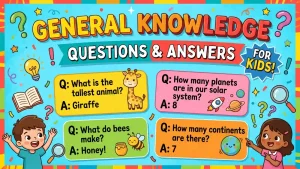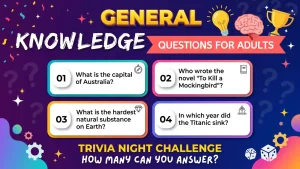
General knowledge information is a set of basic facts about many subjects, such as science, history, geography, culture, sports and daily life. It helps you follow talks, answer quiz questions and learn new topics. This guide explains what it means, where it is used and how to build it.
General knowledge is broad, not deep. You know a little about many topics, not everything about one topic.
For example, knowing that the Earth moves around the Sun is general knowledge. Knowing that water freezes at 0 degrees Celsius is general knowledge too.
These facts are easy to check and easy to share. That is why they appear in quizzes, exams, talks and games.
In this guide you will find a clear meaning, examples, uses and tips for learning.
You can use it in school, work and daily talks. Each fact you learn adds to your view of the world.
Start with the basics below. Pick a topic you like and learn a few facts each day.
Learning general knowledge is not only useful. It is also a fun way to find something new every day.
Definition & Meaning

what does general information mean ?
General knowledge information refers to facts and basic information that people learn about many different subjects. It is not limited to one school subject or professional field.
For example, knowing that Earth moves around the Sun is general knowledge. Knowing that water freezes at 0°C under standard conditions is also basic general knowledge. Knowing the capital city of a country, learning about a famous historical event, or understanding a common scientific fact can also fall into this area.
The main idea is simple: general knowledge covers a wide range of useful information.
It can include:
- History and important events
- Geography and countries
- Science and nature
- Arts and culture
- Sports
- Technology
- Literature
- Famous people
- World records
- Everyday facts
- Basic current affairs
For example, someone might ask:
Friend: “Do you know which planet is known as the Red Planet?”
You: “Yes. It is Mars.”
This is a simple example of general knowledge.
General knowledge is different from expert knowledge. A doctor may have deep knowledge of medicine. An engineer may understand complex systems. A historian may study the past in great detail. General knowledge, however, gives people a broad understanding of many subjects.
It can also help connect different areas of learning. A person who learns about geography may better understand history. Someone who learns basic science may better understand health, technology, or nature.
General knowledge can be learned from books, school lessons, newspapers, documentaries, museums, educational websites, quizzes, and everyday experiences.
Background & History

The idea of learning general knowledge is not new. People have always shared information about their surroundings, communities, history, nature, and culture.
In ancient societies, knowledge was often passed from one generation to another through stories, teaching, observation, and written records. People learned about farming, weather, geography, traditions, rulers, and important events.
As writing became more common, people could record and preserve knowledge. Books, libraries, schools, and universities later helped organize information into different areas of study.
During the growth of newspapers and magazines, people gained easier access to information about events and discoveries. General knowledge became useful not only for education but also for everyday conversations.
The rise of radio and television made information even easier to share. People could learn about distant countries, scientific discoveries, sports, history, and culture without traveling.
The internet has changed general knowledge even more. Today, people can search for information within seconds. Online encyclopedias, educational websites, videos, podcasts, and digital libraries give people access to huge amounts of information.
However, having access to information does not always mean that all information is correct. People still need to check facts and use reliable sources.
Today, general knowledge is commonly used in schools, quizzes, interviews, competitions, games, online learning, and everyday discussions.
Usage in Various Contexts

General knowledge information can be useful in many situations.
In Daily Conversations
People often share simple facts during conversations.
Ali: “Did you know that the Pacific Ocean is the largest ocean?”
Sara: “No, I did not know that. That is interesting.”
The fact adds something useful to the conversation.
In Texting
People may send facts to friends through messaging apps.
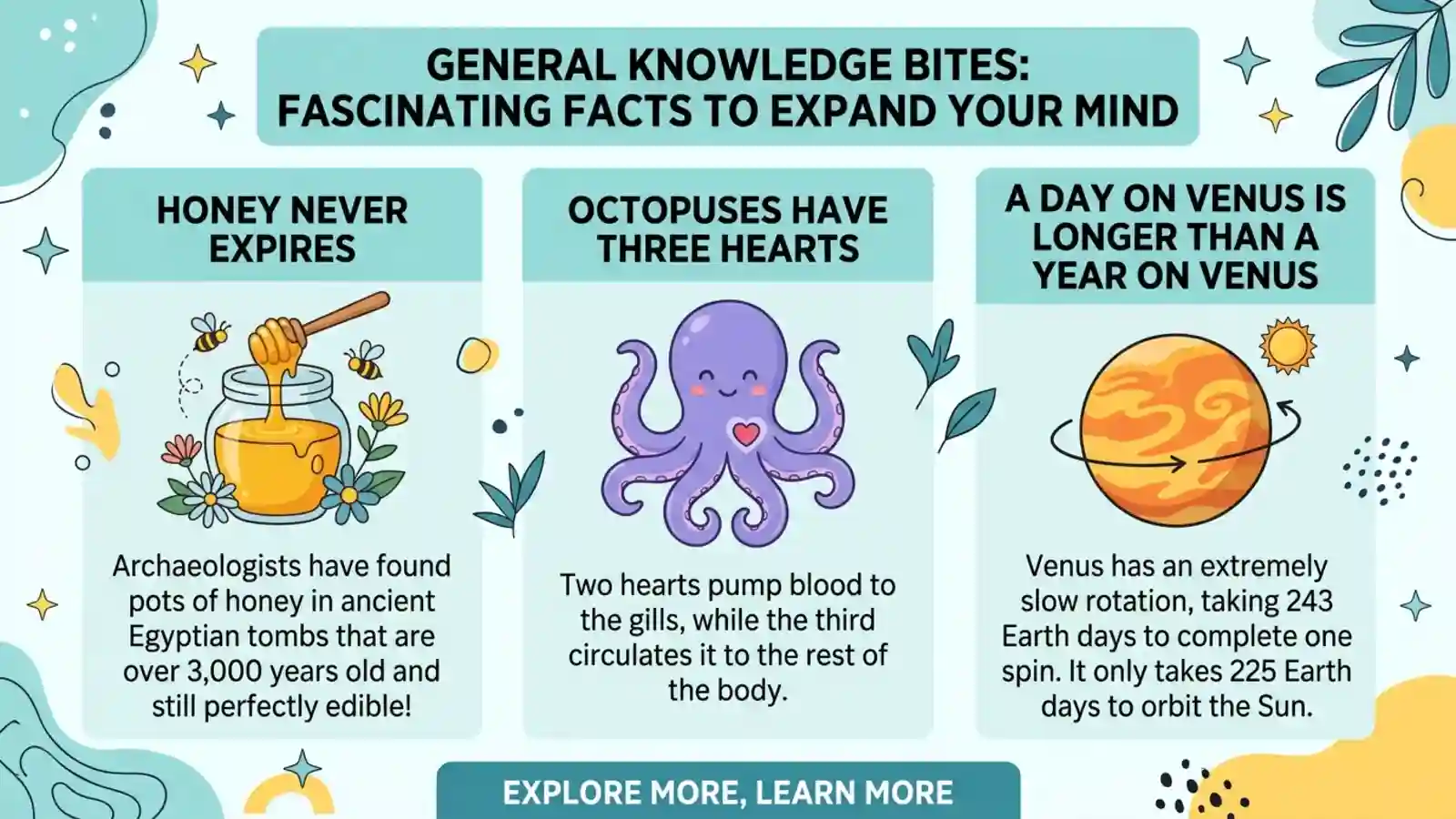
Friend: “I just learned that honey can last for a very long time.”
You: “Really? I need to read about that!”
On Social Media
Educational pages often post short facts, quizzes, and historical information.
For example:
Post: “Can you name the largest planet in our solar system?”
Comment: “Jupiter.”
In Gaming
Many games use history, geography, science, and culture as part of trivia challenges.
Player 1: “What is the capital of Japan?”
Player 2: “Tokyo!”
In Education
Teachers may use general knowledge questions to help students explore different subjects.
Teacher: “Which continent is the Sahara Desert located in?”
Student: “Africa.”
These examples show that general knowledge is useful in both learning and casual communication.
Common Misconceptions & Clarifications

There are several common misunderstandings about general knowledge.
One misconception is that a person with good general knowledge must know everything. This is not true. General knowledge is broad, not unlimited. Nobody can know every fact about every subject.
Another misunderstanding is that memorizing random facts is the same as having strong knowledge. Memorization can help, but understanding information is also important.
For example, remembering that a country is in Europe is useful. Understanding its location, neighboring countries, culture, and history gives a deeper level of knowledge.
Some people also think general knowledge only means history and geography. In reality, it can cover many areas, including science, technology, literature, sports, culture, and everyday life.
Another important point is that information can become outdated. Facts about technology, world records, populations, and current events may change. Reliable and updated sources matter.
It is also important to separate facts from opinions. A fact can often be checked with reliable evidence. An opinion reflects someone’s personal view.
Similar Terms & Alternatives

Several terms are related to general knowledge information.
| Term | Meaning |
| General Knowledge | Broad information about many subjects |
| Common Knowledge | Information widely known by many people |
| Basic Knowledge | Simple information needed to understand a subject |
| World Knowledge | Information about countries, cultures, events, and the world |
| Trivia | Interesting facts, often used in quizzes |
| General Awareness | Understanding of important events and issues |
| Background Knowledge | Information that helps explain a subject |
These terms can overlap, but they are not always identical.
Trivia often focuses on interesting or surprising facts. General knowledge is broader and may include important basic information.
How to Respond to General Knowledge Information

When someone shares general knowledge information, your response can depend on the situation.
Casual Response
“That’s interesting. I didn’t know that.”
This works well with friends and family.
Curious Response
“Really? How did you learn that?”
This keeps the conversation going.
Funny Response
“My brain just received a free update!”
This can work in a relaxed conversation.
Professional Response
“That is useful information. Thank you for sharing it.”
This is suitable when the conversation is more formal.
Privacy-Conscious Response
Sometimes an online conversation may include personal information along with a fact. You do not need to share private details just to continue the discussion.
You can say:
“Interesting fact. I prefer not to share personal information online, though.”
The key is to match your response to the situation.
Regional or Cultural Differences

General knowledge is not exactly the same in every culture.
People in different countries may learn different historical events, famous people, traditions, languages, and cultural facts. A fact that is widely known in one country may be less familiar somewhere else.
For example, students may study different national histories in school. Sports knowledge can also vary by region. Cricket may be very familiar to people in South Asia, while baseball may be more familiar to many people in the United States.
Language also affects how information is shared. Some facts may have different names or spellings in different languages.
This does not mean that one culture has more general knowledge than another. It simply shows that knowledge is influenced by education, culture, language, media, and experience.
Comparison with Similar Terms

| Expression | Main Focus | Example |
| General Knowledge | Broad facts | “Earth is a planet.” |
| Common Knowledge | Widely known facts | “The Sun rises in the east.” |
| Trivia | Interesting facts | “Which animal has the longest neck?” |
| General Awareness | Important information and events | “What is happening in the world?” |
| Basic Knowledge | Essential information | “Plants need light to grow.” |
| Expert Knowledge | Deep subject knowledge | “How does a complex engine work?” |
The best term depends on the context.
If you are talking about a wide range of facts, general knowledge is usually the clearest term.
Usage in Online Communities & Dating Apps

General knowledge can appear in many online communities. Social platforms often have educational pages that share facts, quizzes, puzzles, and questions.
Gaming communities may use trivia questions as part of competitions or challenges.
For example:
Player: “Quick quiz: Which planet is closest to the Sun?”
Other player: “Mercury!”
On social platforms, users may share facts to start discussions.
Dating apps can also include general knowledge indirectly. Someone may mention a favorite history topic, science fact, book, sport, or travel destination in their profile. A conversation may begin with a simple question.
Person A: “What subject could you talk about for hours?”
Person B: “Probably space and astronomy.”
A useful tip is to keep online conversations respectful. Do not use facts to embarrass someone or make them feel less intelligent. The goal of sharing knowledge should be connection and learning, not showing superiority.
Hidden or Offensive Meanings

The phrase “general knowledge information” does not normally have a hidden or offensive meaning. It is a straightforward educational phrase.
However, the way information is presented can affect how people react.
For example, correcting someone in a harsh way may sound rude.
Instead of:
“You are wrong. Everyone knows this.”
A kinder response is:
“I think the information may be a little different. Let’s check the source.”
Tone matters online because written messages do not always show emotion clearly.
It is also important to avoid presenting stereotypes as facts. Information about cultures, countries, religions, communities, or groups should be handled carefully and supported by reliable sources.
Suitability for Professional Communication

General knowledge information is appropriate in professional communication when it is relevant to the topic.
For example, a teacher may discuss general knowledge in an educational email. A journalist may use verified facts in a report. A business professional may use background information during a presentation.
However, professional communication should focus on accurate and relevant information.
Instead of writing:
“I heard this somewhere, so it must be true.”
A professional message could say:
“According to the available information, this fact can be verified through the cited source.”
Useful professional alternatives include:
- General information
- Background information
- Relevant facts
- Basic information
- Verified information
- General awareness
- Supporting information
The most important rule is simple: check important facts before using them in professional or public communication.
FAQs
Conclusion
General knowledge helps people understand the world around them. It covers many subjects, from science and history to culture, sports, geography, and technology.
You do not need to memorize thousands of facts to build strong general knowledge. Start with simple topics and learn a little each day. Ask questions, read reliable sources, and check information before sharing it.
General knowledge can help in school, work, online communities, games, and daily conversations. It can also make learning new subjects easier.
The most important lesson is that knowledge is not only about remembering facts. It is also about understanding information and knowing how to use it. When you stay curious and keep learning, even small facts can help you build a wider view of the world.
Continue Reading:
- Common Knowledge: Simple Facts Everyone Should Know (for 2026)
- Important General Knowledge: Everyone Should Know (for 2026)
- General Knowledge Facts and Answers: You Should Know (for 2026)

Alexander Reed is a writer who shares clear, useful insights on learning, knowledge, and everyday topics.
His work on New Learn Knowledge helps readers discover simple and helpful information.