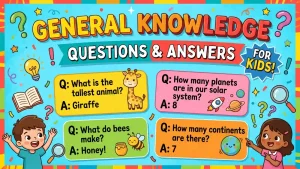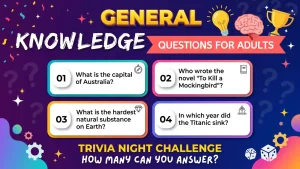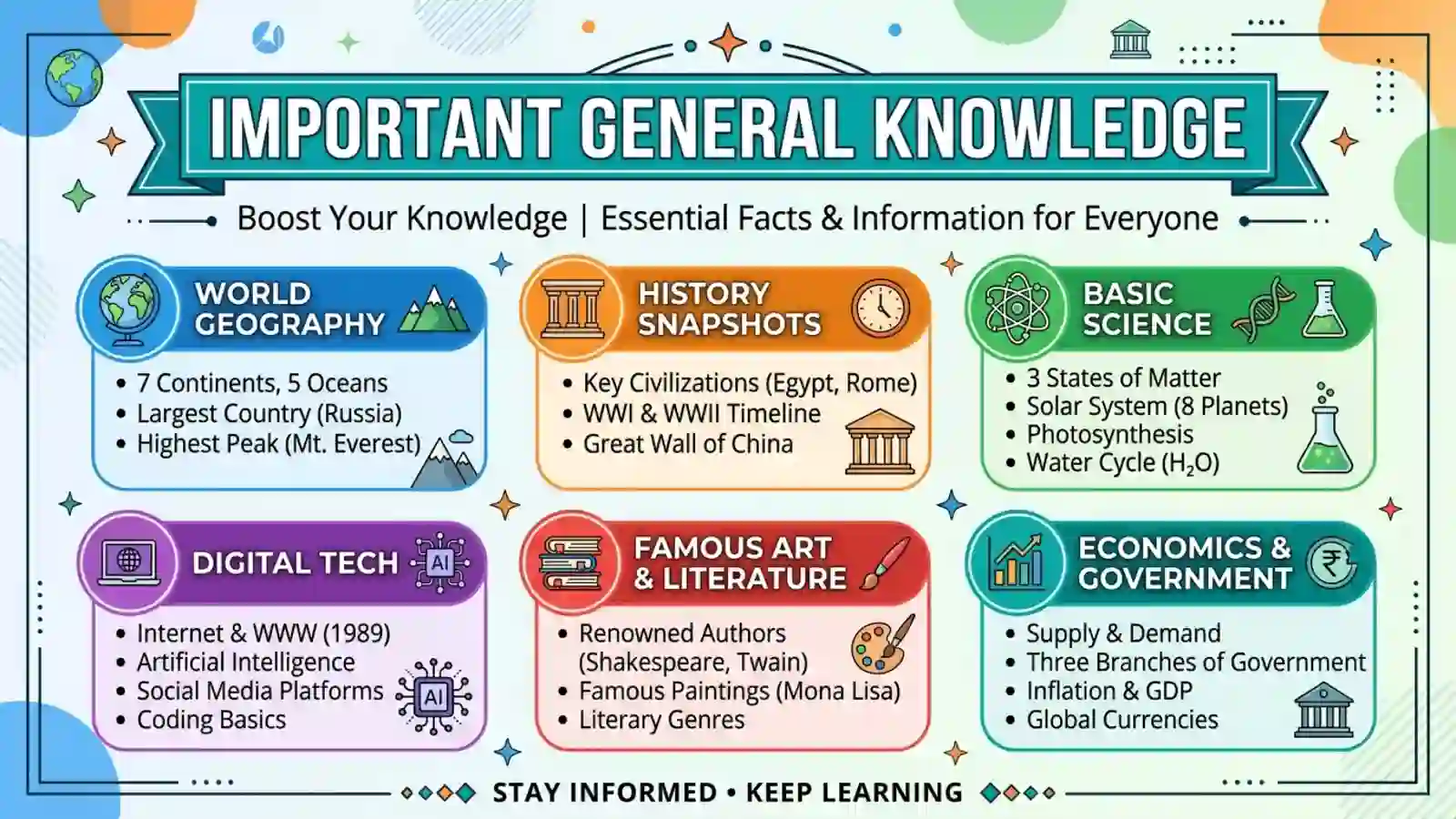
Important general knowledge is a set of basic, useful facts about many subjects, such as history, science, geography, culture, sports, language and everyday life. These facts help you follow talks, answer quiz questions and make sense of the world. This guide gives you the facts that matter most, with clear examples.
Important means useful in daily life, school and work. It does not mean you must know every fact.
Start with facts you meet often. Capitals, oceans, science basics and famous works are good first topics.
Each fact here is short and easy to check. That is what makes it useful for learning and for tests.
General knowledge covers many useful areas. The sections below group facts by topic so you can learn step by step.
It can include history, science, geography, culture, sports, language and everyday facts.
These facts can help us understand conversations and make better sense of the world.
Learning important general knowledge does not have to be hard.
Small facts can make a big difference.
Learning them can build your confidence. You can talk with others, answer questions and understand more each day.
Definition & Meaning: General Knowledge

Important general knowledge refers to basic and useful information that people can learn about many different subjects. It is not limited to one school subject or profession. Instead, it covers a wide range of topics.
For example, Earth is the third planet from the Sun. This is a common fact. Water freezes at 0°C under standard pressure. This is another common fact. General knowledge covers many topics. These include history, countries, languages, inventions, animals, and science.
The word “important” tells us that some facts are more useful than others. People do not need to know every detail about every subject. They can focus on information that helps them understand the world or communicate with others.
Examples of Important General Knowledge
- The capital of Japan is Tokyo.
- The Pacific is the world’s largest ocean.
- The human body has 206 bones in a typical adult skeleton.
- William Shakespeare wrote Romeo and Juliet.
- The Moon orbits Earth.
- Plants use sunlight during photosynthesis.
- The United Nations was founded in 1945.
General knowledge can also include practical information. Understanding basic financial terms, online safety, world geography, health habits, or common technology can be useful in everyday life.
For example:
Person A: “Why should I learn geography?”
Person B: “It helps you understand countries, places, travel, and world events.”
The value of general knowledge comes from its wide use. It gives people a starting point for learning more about a subject.
Try a quick question
Use this short quiz to test what you know. Read the question, pick an answer, then check it below.
Question 1. What is the capital city of Australia?
A. Sydney
B. Canberra
C. Melbourne
D. Brisbane
Answer: B. Canberra.
Canberra is a planned city and the capital of Australia. Sydney is the largest city, but it is not the capital.
Try more questions like this in the sections below.
Each question has one clear answer you can check.
Practise a few questions each day to grow your facts over time.
You can also quiz friends and family with these questions.
A short daily quiz is a simple way to learn and keep facts fresh.
You can practise by topic:
- Science and nature
- History and geography
- Sports and culture
Background & History

General knowledge has existed in some form for thousands of years. Early communities shared information about weather, farming, animals, medicine, travel, and local geography. Much of this knowledge was passed from one generation to another through stories and teaching.
As societies developed, schools and libraries became important places for learning. Books allowed information to be recorded and shared with many people. Encyclopedias later became popular because they collected information from many fields in one place.
The growth of newspapers, radio, and television made general information even easier to access. People could learn about events and discoveries happening far from their homes.
The internet created another major change. Today, people can search for facts within seconds. Websites, online courses, videos, digital libraries, and educational platforms have made learning more accessible.
However, easy access to information also creates a challenge. Not every fact found online is correct. People need to check reliable sources and compare information before accepting a claim as true.
Today, general knowledge is commonly used in:
- Schools and colleges
- Quiz competitions
- Job interviews
- Competitive examinations
- News discussions
- Online learning
- Social media
- Everyday conversations
The main idea has stayed the same: people learn useful information from different areas and use it to understand the world.
Usage in Various Contexts

Important general knowledge appears in many parts of daily life. It can be used in casual conversations, education, social media, gaming, and professional settings.
In Casual Conversations
Which planet is the largest? asked Ali.
Sara: “Yes. Jupiter.”
Simple questions like this can start an interesting conversation.
In Texting
People may send quick questions to friends.
A: “Quick GK question. What is the capital of Australia?”
B: “Canberra!”
Here, GK is often used as a short form of general knowledge.
On Social Media
Social media users often share facts as posts, quizzes, polls, or short videos.
Post: “Can you name the largest ocean?”
Comment: “The Pacific Ocean.”
Such content can make learning more interactive.
In Gaming Communities
Many games include history, geography, science, or culture-based questions.
“What is the fastest land animal?” asks Player 1.
Player 2: “Cheetah!”
General knowledge can therefore become part of entertainment.
In Professional Settings
General knowledge may also help during interviews or group discussions.
“Can you name a major international organization?” asked the interviewer.
Candidate: “The United Nations is one example.”
A broad knowledge base can help people understand topics outside their main field.
Common Misconceptions & Clarifications

A prevalent misconception is that general knowledge equates to being all-knowing.
It does not. General knowledge is broad, but no person can know every fact.
Another common mistake is thinking that every fact online is general knowledge. Always check information to make sure it is accurate.
Some people think general knowledge only covers countries, capitals, and famous people. These are common topics, but general knowledge covers much more.
It can include:
- Science
- History
- Geography
- Literature
- Sports
- Technology
- Culture
- Economics
- Environment
- Current affairs
Another important point is that a fact can become outdated. Information about technology, companies, political offices, records, or scientific discoveries can change.
For example, an old record may no longer be a current record. A country’s political leader may also change after an election.
This is why time and source matter when checking general knowledge.
People should also avoid confusing opinions with facts.
People believe that this is the best country to visit. Indeed, Japan is an East Asian island nation.
The first statement depends on personal preference. The second can be checked as a factual claim.
Similar Terms & Alternatives

Several terms are related to important general knowledge.
| Term | Meaning |
| General Knowledge | Broad information about many subjects |
| GK | Common abbreviation for general knowledge |
| Basic Knowledge | Fundamental information about a subject |
| Common Knowledge | Information widely known by many people |
| Trivia | Interesting facts, often used for entertainment |
| Current Affairs | Recent events and developments |
| General Awareness | Understanding of important issues and information |
Although there may be some overlap, these terms are not usually the same.
Trivia, for example, often focuses on fun or unusual facts. Current affairs mainly focuses on recent events. Basic knowledge may focus on the foundation of one specific subject.
How to Respond to This Term

If someone mentions important general knowledge, your response can depend on the situation.
Casual Response
“Sure! Ask me a question.”
Funny Response
“Go ahead. Let’s check to see if my mind is alert today!
Professional Response
“A wide range of helpful information across various subjects is covered by general knowledge.”
Privacy-Conscious Response
If someone asks for personal information while presenting it as a general knowledge question, you do not need to answer.
“I prefer not to share personal information, but I can discuss the general topic.”
The best response depends on the person, platform, and purpose of the conversation.
Regional or Cultural Differences

General knowledge is shared across many countries, but the topics people consider important can differ by culture and education system.
For example, students in one country may focus more on their national history, while students elsewhere may spend more time learning about different regions of the world.
Language also affects how people describe the concept.
In English, people often say “general knowledge,” “general awareness,” or “GK.” In other languages, different local expressions may be used for the same basic idea.
Regional quizzes may also include local:
- Historical figures
- National holidays
- Geography
- Literature
- Sports
- Cultural traditions
- Political institutions
This does not imply that one type of knowledge is superior to another. It shows that education and culture influence what people learn and discuss.
Comparison with Similar Terms
| Expression | Main Focus | Common Use |
| Important General Knowledge | Useful facts across many areas | Learning and exams |
| General Knowledge | Broad information | Quizzes and education |
| General Awareness | Awareness of important issues | Exams and current topics |
| Current Affairs | Recent events | News and competitive exams |
| Trivia | Interesting facts | Games and entertainment |
| Basic Knowledge | Fundamental information | Beginners and education |
The biggest difference is purpose. Current affairs focus on recent developments, while trivia often focuses on interesting facts.
Usage in Online Communities & Dating Apps

Online communities use general knowledge in many ways. Users may create quizzes, discussion threads, polls, and educational posts.
On platforms such as X (formerly Twitter), users may post short fact-based questions. Gaming communities may use trivia to create competitions or community events.
Dating apps can also include light general knowledge questions as conversation starters.
For example:
Person A: “Random query: Which nation is home to Rome?”
Person B: “Italy. Are you attempting to put me to the test with this?
This type of question can make a conversation more playful.
However, people should avoid turning a simple question into a test of someone’s intelligence. Different people have different educational backgrounds and interests.
A respectful approach is to treat general knowledge questions as conversation starters rather than judgments about a person.
Hidden or Offensive Meanings

The phrase “important general knowledge” does not normally have a hidden offensive meaning. It is a simple phrase that describes helpful information.
However, context can change how a question feels.
For example, repeatedly asking someone very basic questions and making fun of them for not knowing an answer can feel insulting.
Person A: “You don’t know that? Everyone knows it.”
This response can make a normal learning question uncomfortable.
A better approach is:
“No problem. The answer is ____. I learned it recently too.”
Tone matters because the same question can sound friendly, educational, or judgmental depending on how it is asked.
Suitability for Professional Communication

The phrase “important general knowledge” is suitable in many professional and educational contexts. It can appear in articles, presentations, study materials, quizzes, and training resources.
More precise terminology may occasionally be more understandable in professional writing.
Instead of:
“You need important general knowledge.”
You could write:
“A broad understanding of current affairs and basic facts can be useful.”
Or:
“A general understanding of their industry and the larger business environment may be beneficial to employees.”
In professional communication, the best wording depends on the subject. For recent events, use current affairs.
Basic facts fall under foundational knowledge.
Broad awareness is known as general awareness.
FAQs
1. What is important general knowledge?
Important general knowledge is useful information about many subjects, such as science, history, geography, culture, and technology.
2. Is GK the same as general knowledge?
Yes. GK is a common abbreviation for general knowledge.
3. Why is general knowledge important?
It helps people understand conversations, news, education, quizzes, and many everyday topics.
4. What subjects are included in general knowledge?
It can include history, geography, science, sports, literature, technology, culture, and current affairs.
5. How can I increase my general knowledge?
Read reliable books and news sources, use educational resources, take quizzes, and stay curious about different subjects.
6. Is general knowledge useful for exams?
Yes. Many school tests, job exams, entrance tests, and competitive exams include general knowledge or general awareness questions.
7. Does general knowledge change over time?
Some facts remain stable, while information about current events, technology, records, and public figures can change. Always check current information when needed.
Conclusion
Important general knowledge is a broad collection of useful facts and ideas about the world. It covers many subjects, such as science, history, geography, culture, technology, sports, and current affairs.
This knowledge helps people at school, at work, in online discussions, and during quizzes. It also makes everyday conversations easier. Learning new facts can help people understand new topics and ask better questions. Learning general knowledge does not mean memorizing thousands of facts. A better approach is to learn a little every day and understand the information behind the facts.
Most importantly, always check important information against reliable sources, especially when the information may have changed over time.
A curious mind can turn an ordinary question into an opportunity to learn something new.
Continue Reading:
- General Knowledge Facts and Answers: You Should Know (for 2026)
- Daily General Knowledge: Learn Something New Every Day (for 2026)
- General Knowledge for Students: Easy Facts to Know (for 2026)

Alexander Reed is a writer who shares clear, useful insights on learning, knowledge, and everyday topics.
His work on New Learn Knowledge helps readers discover simple and helpful information.