Middle school trivia means quiz questions for students aged about 11 to 14. The questions cover science, history, maths, English, geography and sport. This guide explains what it means, shows examples, and shares questions with answers.
Definition & Meaning of Middle School Trivia
Middle school trivia means a set of fun questions about different subjects for students in middle school. These questions test general knowledge and school skills in an enjoyable way.
Middle school usually includes grades six, seven, and eight in the United States. Students at this level learn many subjects, such as science, math, English, history, and geography. Trivia uses facts from these subjects to create short and interesting questions.
For example:
Question: What is the largest planet in our solar system?
Answer: Jupiter.
Another example is:
Question: How many sides does a hexagon have?
Answer: Six.
These questions are simple to ask, but they can still make students think. Some questions test facts they already know. Others teach them something new.
What Subjects Does Middle School Trivia Cover?
Middle school trivia can include many topics.
- Science: Learn about plants, animals, space, and the human body.
- Math: Solve number problems and answer questions about shapes.
- History: Explore famous people, past events, and ancient cultures.
- Geography: Learn about countries, capitals, rivers, and mountains.
- English: Test grammar, vocabulary, spelling, and literature.
- Sports: Answer questions about teams, players, and games.
- Pop Culture: Explore movies, music, books, and popular characters.
Who Can Play Middle School Trivia?
Middle school students are the main audience, but anyone can enjoy these questions. Parents can play with their children. Teachers can use trivia as a classroom activity. Friends can also compete to see who knows the most facts.
For example:
Alex: “What is the capital of Japan?”
Mia: “Tokyo!”
Alex: “Correct! Now, what is the largest ocean?”
Mia: “The Pacific Ocean!”
This simple game helps students practice what they know while having fun.
In short, middle school trivia combines learning and play. It helps students explore different subjects without making every activity feel like a test.
Background & History of Middle School Trivia
Trivia has been around for a long time. People have always asked questions to share knowledge, test memory, and learn about the world.
Long before modern schools, teachers and scholars used questions to help people remember important facts. Families and friends also shared riddles, puzzles, and questions as a form of entertainment.
As schools developed, quizzes became a common way to check what students had learned. Teachers asked questions about math, history, science, and other subjects. Over time, these questions became part of classroom games and competitions.
How Did Trivia Become Popular?
Trivia became more popular as a form of entertainment through board games, books, radio programs, and television shows.
In the United States, quiz shows became a familiar part of television. People enjoyed answering questions about history, science, sports, and popular culture. Trivia games also became popular at parties and family gatherings.
As schools began using more interactive activities, teachers found ways to turn learning into games. Students could answer questions in teams, earn points, and compete in friendly challenges.
Middle School Trivia in Modern Schools
Today, middle school trivia can be found in classrooms, clubs, school competitions, and online learning activities.
Teachers may use short quizzes to review a lesson before an exam. Students may use trivia cards to study with friends. Some schools also hold quiz competitions that test knowledge across several subjects.
For example:
Teacher: “Which gas do plants take in during photosynthesis?”
Student: “Carbon dioxide!”
Teacher: “Correct. That is an important part of how plants make food.”
The question helps students review science in a fun way.
The Role of Technology
The internet has made trivia easier to access. Students can now find questions on educational websites, quiz apps, and video platforms. Some tools give instant feedback, so players can learn from wrong answers.
Online games may also include timers, points, levels, and leaderboards. These features can make trivia feel more exciting.
However, the main goal has stayed the same: ask questions, test knowledge, and learn something new.
Middle school trivia has changed from simple spoken questions to interactive online games, but it still brings people together through curiosity and friendly competition.
Usage in Various Contexts
Middle school trivia can be used in many settings. It is not limited to a classroom or a school test. Students can enjoy it at home, online, during school events, or while spending time with friends.
1. In the Classroom
Teachers can use trivia to review lessons and help students remember key facts.
Teacher: “What is the process by which water changes into vapor?”
Sam: “Evaporation!”
Teacher: “That is right!”
This type of activity helps students recall facts without taking a formal test.
2. With Friends
Friends can ask each other trivia questions during lunch, on a trip, or at a party.
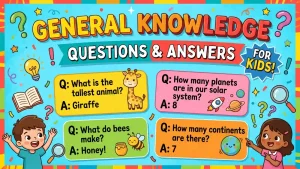
Liam: “Which animal is the tallest in the world?”
Emma: “The giraffe!”
Liam: “Correct! Your turn to ask me one.”
Trivia gives friends a fun way to learn and compete.
3. In Text Messages and Group Chats
Students can share trivia questions through text messages or group chats. They can ask one question at a time and let everyone guess.
Example:
Noah: “Quick trivia! How many continents are there?”
Olivia: “Seven!”
Noah: “You got it!”
Short questions work well in chats because people can answer quickly.
4. On Social Media
Students and teachers may share trivia challenges on social media. A post might show a question and ask followers to choose an answer.
For example:
Post: “Which planet is closest to the Sun? A) Venus, B) Mercury, C) Mars.”
People can comment with their guesses.
Students should follow age rules and school or family guidelines when using social media.
5. In Online Games
Some educational games include trivia rounds. Players answer questions to earn points, unlock levels, or help their teams win.
Player 1: “What is the freezing point of water in Celsius?”
Player 2: “Zero degrees!”
Player 1: “Nice! We got the point.”
These games can make learning feel more like play.
6. At Home
Parents and siblings can use trivia during family game nights. They can choose easy questions for younger players and harder ones for older players.
The best part is that everyone can learn together.
No matter where it is used, middle school trivia offers a simple way to build knowledge, practice memory, and enjoy time with others.
Common Misconceptions & Clarifications
People sometimes misunderstand what middle school trivia means. They may think it is only for students, only about school subjects, or always easy. These ideas are not fully correct.
Misconception 1: Trivia Is Only for School
Trivia often includes school subjects, but it can cover much more.
Questions may focus on sports, animals, movies, music, nature, inventions, or everyday facts.
For example:
Question: Which animal is known for having black and white stripes?
Answer: The zebra.
This question is not tied to one school lesson, but it still helps students learn.
Misconception 2: Trivia Is Always Easy
Some trivia questions are simple, while others need careful thought.
An easy question might ask for the number of days in a week. A harder question might ask students to explain why the seasons change.
The difficulty depends on the topic, the wording, and the knowledge needed to answer.
A good trivia game includes a mix of easy, medium, and hard questions.
Misconception 3: Trivia Is the Same as an Exam
Trivia and exams both use questions, but their main purposes can differ.
An exam often measures learning in a formal setting. Trivia is usually designed for fun, practice, or informal learning.
Teachers may use trivia to review a lesson, but a trivia game does not always count toward a student’s grade.
Misconception 4: You Must Know Every Answer
No one knows everything. Getting an answer wrong is part of learning.
For example:
Mia: “I thought the largest desert was the Sahara.”
Ben: “The Antarctic Desert is actually the largest desert by total area.”
Mia: “I didn’t know that. I learned something new!”
Trivia is more useful when players focus on learning instead of feeling embarrassed about mistakes.
Misconception 5: Trivia Only Tests Memory
Some questions test memory, but others require logic, comparison, or problem-solving.
For example, a question may ask students to find a pattern or work out a math problem. These tasks require more than remembering a fact.
Can Middle School Trivia Be Inappropriate?
Trivia is usually harmless, but the subject and wording matter. Questions that mock people, target a culture, or share private information may make players uncomfortable.
Teachers and parents should choose age-appropriate content.
The main goal is to create a safe and friendly activity where everyone can participate and learn.
Similar Terms & Alternatives
Several terms are related to middle school trivia. They may sound similar, but each can have a slightly different meaning.
1. General Knowledge Questions
These questions cover a wide range of subjects, such as science, geography, history, and everyday facts.
Example:
Question: What is the capital of France?
Answer: Paris.
General knowledge questions are not limited to middle school students. People of different ages can enjoy them.
2. Quiz Questions
Quiz questions are used to test knowledge of a subject or topic. They may appear in classrooms, apps, competitions, or online games.
Example:
Question: What is 8 × 7?
Answer: 56.
A quiz may be formal or informal.
3. Brain Teasers
Brain teasers are questions or puzzles that challenge people to think in creative ways. They may involve logic, patterns, or tricky wording.
Example:
Question: What has hands but cannot clap?
Answer: A clock.
Brain teasers often focus more on reasoning than on facts.
4. Educational Games
Educational games help people learn while playing. They may include trivia, puzzles, spelling activities, or math challenges.
Example: Students answer science questions to earn points in a classroom game.
5. School Quiz Competitions
These competitions allow students to answer questions against other players or teams. They may cover many school subjects.
Example:
Host: “Which planet is famous for its rings?”
Team A: “Saturn!”
Host: “Correct!”
6. Fun Facts
Fun facts are short pieces of interesting information. They do not always require a question or an answer.
For example, an octopus has three hearts.
A trivia question could turn that fact into a challenge: “How many hearts does an octopus have?”
These alternatives can all support learning. The best choice depends on whether you want to test facts, solve puzzles, or explore new ideas.
How to Respond to Middle School Trivia
How you respond to a trivia question depends on the situation. You may want to give a quick answer, make a joke, explain your thinking, or ask for help.
1. Give a Direct Answer
If you know the answer, say it clearly.
Friend: “What is the largest planet in our solar system?”
You: “Jupiter!”
A short answer works well when the question has one clear answer.
2. Make It Funny
You can keep the game light with a friendly joke.
Friend: “What do bees make?”
You: “Honey. They must be very busy workers!”
Keep jokes kind. Avoid making fun of someone who gets an answer wrong.
3. Admit When You Don’t Know
It is fine to say you do not know the answer.
Teacher: “Who wrote Romeo and Juliet?”
You: “I’m not sure. Can you tell me?”
You can also make a guess if the rules allow it.
4. Ask for a Hint
Some trivia games allow hints.
Friend: “Which planet is known as the Red Planet?”
You: “Can I get a hint?”
Friend: “It is named after the Roman god of war.”
You: “Mars!”
Asking for a hint can help you learn without giving up.
5. Explain Your Answer
For questions that need reasoning, explain how you reached your answer.
Teacher: “Why does ice float in water?”
Student: “Ice is less dense than liquid water, so it floats.”
This kind of response shows understanding, not just memory.
6. Respond Politely When Someone Is Wrong
Trivia should be fun for everyone.
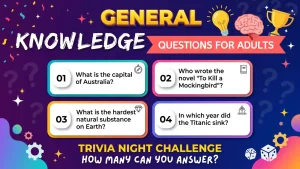
Alex: “I think the capital of Australia is Sydney.”
Jordan: “That is a common guess, but the capital is Canberra.”
A polite correction helps others learn without feeling embarrassed.
7. Use a Professional Response
In a classroom or organized competition, listen carefully and answer in a clear voice.
You might say, “My answer is Canberra,” or “I would like to choose option B.”
Clear answers help the host understand your response.
The most important rule is simple: be respectful, enjoy the challenge, and treat wrong answers as chances to learn.
Regional or Cultural Differences
Middle school trivia is popular in many places, but school systems, languages, and cultural interests differ. These differences can affect the questions people ask and the answers they expect.
Differences in School Grades
In the United States, middle school often covers grades six through eight. Other countries use different names and age groups for similar stages of education.
For example, schools in the United Kingdom often use terms such as Key Stage 3 for students aged around 11 to 14. Other countries may have junior secondary school or lower secondary school.
As a result, a trivia set designed for American middle school students may not match the exact curriculum in another country.
Differences in History and Geography
Some questions focus on facts that students learn in their own country.
A quiz in the United States may ask about American presidents or national holidays. A quiz in Pakistan may include questions about Pakistan’s provinces, national history, or important landmarks.
For example:
Student 1: “What is the capital of Pakistan?”
Student 2: “Islamabad.”
Student 1: “Correct!”
A quiz for students in another country may focus on its own capital city and national history.
Differences in Language
Trivia questions may use words that are familiar in one region but less common in another.
For example, some English-speaking countries use different words for school items, sports, or everyday activities. A question may need extra explanation if players use different terms.
Translating trivia into another language can also change its difficulty. Wordplay and jokes may not work the same way in every language.
Differences in Popular Culture
Movies, sports, music, and television can vary in popularity across regions.
Students who follow cricket may know different sports facts from students who mainly watch baseball. Some students may know more about local books, musicians, or historical figures than international celebrities.
A fair quiz should reflect the knowledge and interests of its players.
How to Make Trivia More Inclusive
To make a trivia game enjoyable for everyone:
- Use a mix of local and international questions.
- Explain unfamiliar words.
- Avoid assuming every student celebrates the same holidays.
- Check facts carefully.
- Choose questions that match the players’ ages and learning levels.
Good trivia helps students explore both their own culture and the wider world.
Comparison with Similar Terms
Middle school trivia is related to quizzes, tests, puzzles, and general knowledge games. However, these activities do not always have the same purpose.
| Activity | Main purpose | Example |
| Middle school trivia | Test and build knowledge in a fun way | What is the largest ocean? |
| General knowledge quiz | Test facts across many topics | What is the capital of Italy? |
| School test | Measure learning or progress | Complete a science test |
| Brain teaser | Challenge logic and creative thinking | What has hands but cannot clap? |
| Flashcards | Help students remember facts | Match a word with its meaning |
| Educational game | Teach or review skills through play | Solve math problems to earn points |
| Quiz competition | Compare scores between players or teams | Answer timed history questions |
| Fun facts | Share interesting information | An octopus has three hearts |
Middle School Trivia vs. General Knowledge Quiz
These two activities often overlap. The main difference is the target audience.
Middle school trivia is usually written for students in middle school. A general knowledge quiz may be designed for children, teenagers, or adults.
Middle School Trivia vs. School Tests
A school test often checks how well students understand a lesson. It may affect their grades.
Trivia is usually more relaxed. It can help students review facts without the pressure of a formal test.
Middle School Trivia vs. Brain Teasers
Trivia often asks for a known fact. Brain teasers usually require a person to think through a puzzle.
For example, “What is the largest planet?” is trivia. “What has a face and two hands but no arms or legs?” is a brain teaser.
Which Activity Should You Choose?
Choose middle school trivia when you want to review different subjects or play a group game. Choose flashcards when you need to memorize terms. Use brain teasers when you want to build logical thinking.
You can also combine these activities to make learning more interesting.
Usage in Online Communities & Dating Apps

Middle school trivia is often shared through educational websites, classroom platforms, video channels, and online gaming communities. It is less common as a main topic on dating apps, which are designed for dating rather than school activities.
Trivia in Online Learning Communities
Students may use online groups to share questions, review lessons, and prepare for school competitions.
For example:
Student A: “Can anyone answer this science question? What force pulls objects toward Earth?”
Student B: “Gravity!”
Student A: “Correct!”
Online study groups can help students learn together, but they should use trusted resources and follow school rules.
Trivia on Social Media
Trivia posts may ask followers to answer a question in the comments. Short multiple-choice questions are common because they are easy to understand and share.
For example:
“Which is the largest continent? A) Africa, B) Asia, C) Europe.”
The answer is Asia.
Students should avoid sharing private information and should follow age requirements for each platform.
Trivia in Gaming Communities
Some online games use quiz rounds to test knowledge. Others allow players to create their own question sets.
Trivia can make group play more educational and help players learn about topics outside the game.
Players should keep the experience friendly and avoid insulting others for incorrect answers.
What About Dating Apps?
Trivia is not a central feature of most dating apps. Adults may use fun questions as conversation starters, but middle school trivia is mainly an educational or recreational activity.
For example, an adult might ask, “What was your favorite school subject?” or “Can you answer this quick geography question?”
These questions can start a conversation, but users should respect personal boundaries and avoid pressure.
For younger students, school-approved learning platforms and supervised group activities are more suitable places to share trivia.
Hidden or Offensive Meanings
The phrase “middle school trivia” has no widely recognized hidden or offensive meaning. It normally refers to questions designed for middle school students.
However, the way people use trivia can affect how others feel.
When Can Trivia Become Unkind?
A trivia game may become unpleasant if players use questions to embarrass others or make fun of their knowledge.
For example:
Student A: “You got that easy question wrong! You must be bad at school.”
This response is unkind and does not help anyone learn.
A better response would be:
Student B: “It’s okay. The answer is Jupiter. Now you know!”
Questions About Sensitive Topics
Some trivia topics need care. Questions about religion, culture, personal experiences, or painful historical events should be worded respectfully.
Avoid questions that treat stereotypes as facts or suggest that one group is better than another.
False Facts and Misleading Questions
Not every trivia question shared online is accurate. Some posts use confusing wording or give incorrect answers to attract attention.
For example, a question may ask for the “largest desert” without explaining whether it means the largest hot desert or the largest desert overall.
The answer can change depending on the definition. Antarctica is the largest desert overall, while the Sahara is the largest hot desert.
This shows why wording matters.
How to Keep Trivia Respectful
- Check answers with reliable sources.
- Avoid insults and personal attacks.
- Explain questions that could have more than one meaning.
- Use age-appropriate subjects.
- Let players ask for clarification.
The goal of trivia is to share knowledge. It should challenge the mind without hurting anyone’s feelings.
Suitability for Professional Communication
The phrase “middle school trivia” is suitable for most professional settings when used in the right context. Teachers, school leaders, tutors, and educational writers may use it to describe classroom activities or learning resources.
However, the phrase is less likely to be useful in formal business discussions unless the topic relates to education, student learning, or team-building activities.
In Schools and Educational Settings
Teachers may use the phrase in lesson plans, emails, worksheets, and school newsletters.
Example:
“We will use middle school trivia to review key science facts before the next lesson.”
This sentence is clear and appropriate.
In Educational Websites
Writers may use the phrase in page titles, headings, and descriptions.
For example:
“Explore middle school trivia questions about science, history, math, and geography.”
This wording tells readers what the content offers.
In General Business Settings
If you are speaking to people who are not familiar with the term, you may need to explain it.
Instead of saying, “We are doing middle school trivia,” you could say, “We are hosting a knowledge quiz for students in grades six through eight.”
This version is more specific.
Professional Alternatives
You can use these alternatives depending on the situation:
- Student knowledge quiz: A clear and general term.
- Educational quiz: Useful for learning activities.
- Classroom review game: Suitable for reviewing lessons.
- General knowledge challenge: Works for a broad range of subjects.
- Academic quiz competition: Best for organized school events.
- Grade-level quiz: Useful when the activity is designed for a specific school level.
Tips for Professional Use
Choose a term that matches your audience. Keep questions clear and factual. If the quiz is part of a formal event, explain the rules and scoring system.
In professional educational communication, middle school trivia is a useful phrase. It describes an activity that can make learning active, social, and enjoyable.
Frequently Asked Questions
Middle school trivia is a collection of questions about subjects such as science, maths, history, geography, sports, and general knowledge. It is usually designed for students in grades six through eight.
Good topics include space, animals, world geography, famous inventors, literature, sports, basic science, and historical events. A mix of subjects keeps the game interesting.
Yes. Trivia can help students review facts, improve recall, and explore new subjects. It works best when players discuss answers and learn from mistakes.
Yes. Teachers can use trivia to review lessons, start a class, encourage teamwork, or prepare students for a test. Questions should match the students’ age and learning level.
Use teams, scoreboards, timed rounds, and different question types. Mix easy questions with harder ones so every player has a chance to take part.
Conclusion
Middle school trivia is a simple and fun way to learn about the world. It includes questions about science, math, history, geography, sports, literature, and many other subjects. Students can enjoy it in classrooms, at home, with friends, or through suitable online learning activities.
Trivia can help improve memory, build confidence, and encourage students to explore new ideas. It also gives classmates and families a chance to learn together. The best games include a mix of easy and challenging questions, clear answers, and friendly competition.
Remember, you do not need to know every answer to enjoy trivia. Each question gives you a chance to practice what you know or discover something new.
The main goal of middle school trivia is to make learning enjoyable. Choose interesting topics, respect other players, and treat mistakes as learning opportunities. Whether you are preparing for a school quiz or planning a game with friends, middle school trivia can turn everyday facts into an exciting challenge.
Keep learning with more quizzes on this site: general knowledge quiz, trivia questions for kids, family trivia questions, and trivia today.

Thomas Mitchell is a writer at New Learn Knowledge, sharing clear and useful educational content.
He enjoys creating simple guides and informative articles that help readers learn and discover new knowledge.